“We’re going to Rachel’s.”
I grabbed his arm.
“No.”
He looked at me.
“Why not?”
“Because I don’t want to scream at her.”
I looked at the photographs.
“I want her to hear the truth.”
So we went.
When Rachel opened the door, she looked terrified.
Her eyes immediately went to the envelope in my hand.
“You got it.”
“Yes.”
She stepped backward.
“Please.”
I held up the photographs.
“Why?”
She started crying.
“I was angry.”
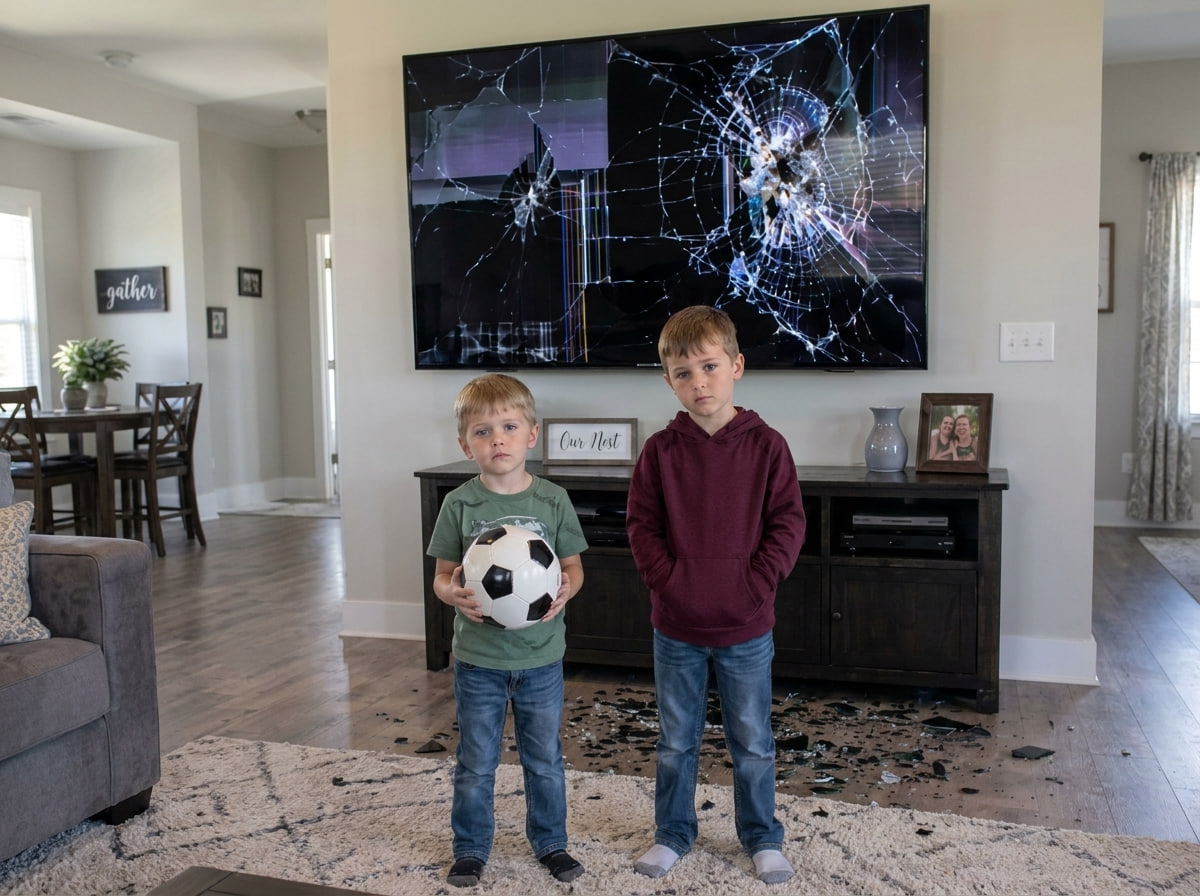
“You destroyed our television.”
“I know.”
“You used your children.”
“I know.”
“You told them they’d get toys for doing it.”
She covered her face.
“I know!”
Her voice broke.
For the first time, I didn’t feel angry.
I felt sad.
Because standing in front of me wasn’t the powerful, rude woman who had spent years criticizing everything I did.
It was someone who had allowed jealousy and resentment to turn her into a person I barely recognized.
“You could have talked to us,” I said.
She shook her head.
“I was embarrassed.”
“Embarrassment doesn’t give you the right to hurt people.”
“I know.”
“And your boys?”
She looked toward the hallway.
“They’re terrified.”
That stopped me.
“What?”
“They’ve been crying all morning.”
She wiped her eyes.
“They thought they’d done something terrible. They didn’t understand why I told them to do it.”
I looked at my husband.
Then I turned back to Rachel.
“Then you owe them an apology too.”
Rachel nodded.
“I know.”
There was a long silence.
Finally, she said,
“I’ll pay for the TV.”
I shook my head.
“Yes, you will.”
She looked surprised.
“But not because I want your money.”
I placed the photographs on the table.
“Because you need to understand that actions have consequences.”
She nodded.
“And you’re going to tell the family the truth.”
Her eyes widened.
“Please don’t make me—”
“I’m not making you do anything.”
I looked directly at her.
“You made the choice when you told your children to break our television.”
She lowered her head.
A week later, Rachel stood in front of the entire family.
She admitted everything.
She admitted that she had planned it.
She admitted that she’d given the boys the soccer ball.
She admitted that she’d told them to hit the television.
And she admitted that she’d promised them toys afterward.
Nobody spoke when she finished.
Her father was furious.
Her mother was crying.
Her own children were sitting beside her, confused and ashamed.
Then something unexpected happened.
Rachel turned to me.
“I’m sorry.”
Not the kind of apology people make because they have been caught.
A real apology.
She told me she’d been jealous.
She told me she’d hated seeing us happy because she felt like her own life was falling apart.
She admitted that she’d spent years putting me down because it made her feel better about herself.
I listened.
And when she finished, I said only one thing.
“I forgive you.”
She looked surprised.
“But that doesn’t mean everything goes back to the way it was.”
She nodded.
And that became the boundary I needed.
Rachel paid for the television.
We replaced it several weeks later.
But something else changed too.
I stopped trying to keep the peace at my own expense.
I stopped laughing at insults.
I stopped pretending hurtful behavior was acceptable just because the person doing it was family.
And Rachel?
She eventually got help for her financial problems and started rebuilding her relationship with her children.
It wasn’t perfect.
It took time.
But at least the truth was finally out.
Months later, we had another family dinner.
This time, Rachel arrived with the boys.
They stood at the entrance holding a small gift.
One of them looked at me nervously.
“We’re sorry about the TV.”
I knelt down and smiled.
“I know.”
The younger one held out the gift.
“We bought this with our own money.”
I opened it.
It was a tiny picture frame.
Inside was a drawing of our living room.
And in the middle was a giant television.
Underneath it, in crooked children’s handwriting, were the words:
“Sorry we broke your TV.”
I laughed through the tears in my eyes.
Then I hugged them.
The television had cost us $2,000.
But what Rachel had broken wasn’t just a television.
She had broken my trust.
And that was something money could never replace.
Still, sometimes people can learn from the damage they cause.
And sometimes the biggest lesson isn’t revenge.
It’s finally deciding that you deserve to be treated with respect.
That night, as everyone sat around the dinner table, I looked across the room at the new television.
Then I looked at my family.
The old TV was gone.
The resentment was slowly fading.
And for the first time in a long time, our home actually felt peaceful.
I realized something I’d wish I’d understood years earlier:
Keeping the peace isn’t the same thing as accepting disrespect.
Sometimes, the most important lesson you can teach someone isn’t how to hurt them back.
It’s how to hold them accountable—and then refuse to let their behavior control your life anymore.