“A document can be altered. A mark someone has carried on their skin for decades is different.”
Then he looked directly at Mom.
“Helen, were you connected to Maplewood House?”
For several seconds, she said nothing. She looked at me with an expression I had never seen before, as though thirty years of avoiding a single conversation had finally reached its end.
“I worked there.”
I stared at her.
“As a nurse.”
“What?”
Tears appeared in her eyes.
“Emma, there’s something I should have told you years ago. I tried many times, but every time I thought I was ready, I became afraid.”
“Afraid of what?”
She took a shaky breath.
“You weren’t born to me.”
For a moment, the sounds of the hospital outside seemed to disappear. I could only stare at the woman I had called Mom for thirty-two years while trying to understand what those words meant.
“What are you saying?”
“I adopted you.”
“From Maplewood?”
“Yes.”
Mom explained that I had been two years old when I arrived there after my biological parents died in a serious car accident. Relatives existed on both sides of my family, but complicated disagreements prevented anyone from immediately taking custody, and weeks eventually became months without anyone coming for me.
At the time, Mom and Dad had spent years unsuccessfully trying to have children. Helen was working as a nurse at Maplewood when she met me, and she said the first interaction between us had changed everything.
“The first time I met you, you grabbed my finger and wouldn’t let go.”
She smiled through her tears.
“That was it for me.”
Eventually, she and Dad adopted me through an independent attorney because Mom already suspected something was wrong at Maplewood. Every legal requirement had been reviewed separately, and despite the corruption surrounding the facility, my adoption itself had been completely legitimate.
Only one question mattered to me then.
“Why didn’t you tell me?”
Mom’s face crumpled. She admitted that they had originally planned to tell me when I was old enough to understand, but every birthday gave her another excuse to wait.
“Were you afraid I would leave?”
“Yes.”
Her voice broke.
“I was terrified that if you knew, you might stop seeing me as your mother. It was selfish. I chose my fear over your right to know your own story, and I am so sorry.”
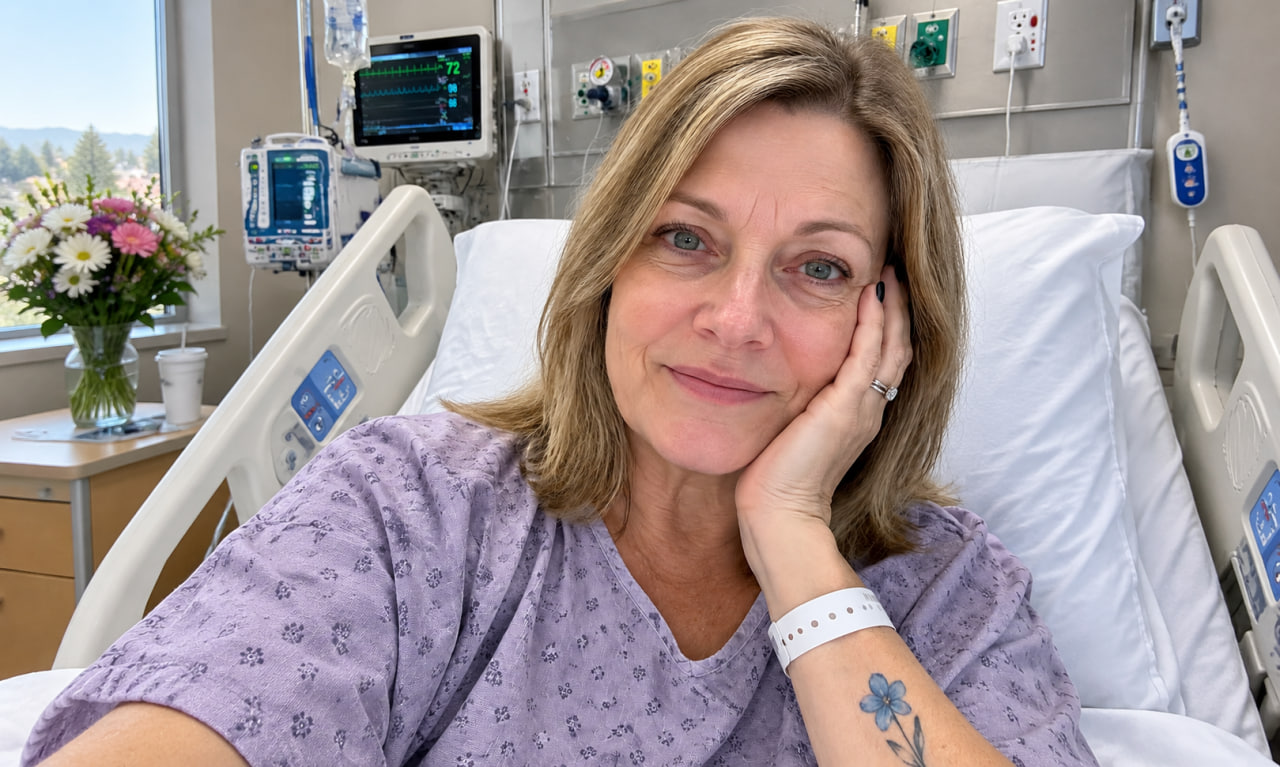
I took the hand with the blue flower and held it tightly.
“Mom, look at me. I’m not going anywhere.”
Thirty-two years of love had not disappeared because of one revelation.
But the blue flower had opened a door neither of us could close again.
Part 3: What My Mother Had Hidden in the Attic
After Mom told me the truth, Dr. Reeves gave us time alone. For nearly twenty minutes, neither of us said much because there was too much to absorb at once: the adoption, Maplewood House, the tattoo, and the fact that my entire life had contained a history I had never known existed.
Eventually, Mom looked at me with swollen eyes and admitted she had rehearsed this conversation for years. She had planned to tell me when I turned ten, then eleven, then twelve, but every birthday gave her another reason to wait because the longer she delayed, the more frightening the truth became.
“That’s how thirty years passes, Emma. One ‘not today’ at a time.”
“I wish you had told me.”
“I know.”
I squeezed her hand and told her the truth as gently as I could.
“I’m shaken, but I’m not angry.”
When Dr. Reeves returned, he brought a woman named Agent Morris, who was part of the reopened investigation into Maplewood House. She explained that dozens of former children had been identified as possibly having altered histories, including changed names, inaccurate birthdays, and missing connections to biological relatives.
Then she looked directly at me.
“I want to make one thing clear immediately. Your adoption was not compromised.”
Some tension I had not realized I was carrying finally left my chest. Agent Morris confirmed that Helen and my father had completed the adoption through proper legal channels, meaning whatever corruption had existed at Maplewood did not affect the validity of our family.
Then she turned toward Mom.
“During your time at Maplewood, did you keep anything? Records? Photographs? Copies of files?”
Mom became very still before answering.
“Yes.”
Agent Morris leaned forward.
“How much?”
Mom looked almost embarrassed.
“Everything I could.”
She explained that while working at Maplewood, she had gradually become suspicious of the way records were handled. Before leaving, she quietly copied children’s files, staff information, photographs, and other documents because something in her told her those records might matter someday.
“Where are they?”
“In my attic.”
Agent Morris stared at her.
“For thirty years?”
Mom nodded.
The investigator’s expression changed instantly. She explained that if those copies were accurate, they could help reconstruct the histories of adults who had spent decades living with incomplete or false information.
“Helen, those files may be exactly what we’ve been searching for.”
Mom did not hesitate.
“Take everything.”
“Everything?”
“Every page. Every photograph. Whatever helps.”
For the first time since the tattoo had been recognized, my mother looked like herself again. She was no longer frightened or ashamed, just focused on what she could do to help.
Then Patricia returned to the room.
“I’m sorry. I didn’t mean to frighten either of you. When I saw the flower, I reacted. I spent time at Maplewood when I was younger, and I’ve thought about those children for decades.”
Mom gave her a tired smile.
“Maybe this needed to happen.”
Patricia nodded, then reached into her pocket and pulled out an old envelope with softened edges and yellowed paper. She handed it to me carefully.
“This came from one of the Maplewood archive boxes investigators recently brought in for review. It was filed under your original name.”
My hands began to tremble.
Written across the front in faded blue ink were the words:
“To be opened by Emma when she’s ready.”
I stared at the envelope while Mom watched me quietly.
“You don’t have to read it now.”
I shook my head.
“No.”
Then I slid my finger beneath the flap.
“If I put it down now, I might become too afraid to pick it up again.”
Part 4: The Letter From My First Mother
Inside the envelope was a single folded page covered in handwriting that looked slightly rushed but remained easy to read. My hands trembled as I unfolded it, aware that I was about to hear the voice of a woman whose name I did not even know.
The letter began simply.
“My dearest Emma,
If you are reading this, then life did not turn out the way I hoped it would.”
I stopped for a moment before forcing myself to continue. She wrote that she had wanted to be the person who told me how deeply I had been loved from the beginning, but if the letter reached me instead of her voice, then she had somehow lost the chance to say those words herself.
“None of what happened was your fault. You were the greatest joy of my life.”
My vision blurred.
She described holding me for the first time and imagining a future in which I was present for every ordinary day. She hoped that if another family eventually raised me, they would love me completely and that I would never mistake being loved by them as proof that she had loved me any less.
“Most of all, I hope you never believed you were unwanted. You were wanted from the very beginning.”
The sentence broke something open inside me.
Then came the part I had not expected. My biological mother did not ask me to choose her memory over the family who had raised me.
“If the people who raised you loved you well, hold onto them. They are your family.”
She wrote that learning where I came from should never diminish the people who had stood beside me while I grew. Maybe, she said, it simply meant I had been fortunate enough to be loved twice.
At the bottom of the page was her name.
“With all the love a mother can give,
Your first mom,
Alicia.”
Alicia.
I whispered the name silently, trying to attach it to the idea of a woman I could not remember. She had died when I was two, yet somewhere before that accident, she had taken the time to leave words behind in case life prevented her from staying.
I read the letter again, then a third time. By then, tears were running down my face.
Helen sat beside me without interrupting. She did not reach for the letter or ask what Alicia had written, giving me space to meet this unknown part of myself on my own terms.
“She sounds like she was a good person.”
“I’m sure she was.”
Then Mom reached for my hand.
“And Emma, loving her doesn’t take anything away from us.”
I started crying harder.
“There’s room for both. There always has been.”
For the first time that day, something inside me settled. Helen had loved me through scraped knees, school plays, heartbreak, birthdays, my father’s death, and every ordinary day in between, while Alicia had loved me fiercely during the first two years of my life.
“I think someday I want to learn more about her.”
“Of course.”
“Not today.”
“Whenever you’re ready.”
“I want to know where I came from.”
Mom nodded without hesitation.
“And I’ll help you.”
I carefully folded Alicia’s letter and placed it back inside the old envelope. For thirty-two years, I had thought family was a single story, but suddenly I understood it could contain blood, choice, memory, loss, and the people who stayed.
I did not have to decide which mother’s love was real.
Both were.
And the tiny blue flower that had hidden one family secret for three decades was now helping me discover a second family I never knew existed.
Part 5: What the Blue Flower Finally Gave Back
In the days that followed, Agent Morris arranged to collect the boxes Helen had kept in her attic for more than thirty years. What my mother had once hidden out of fear now became evidence that could help former Maplewood children recover names, birthdays, photographs, relatives, and pieces of personal history that had been altered or erased.
That transformation affected Mom more deeply than I expected. For years, the blue flower had represented the secret she was afraid would change how I saw her, but now the same symbol connected her to people who might finally receive answers they had spent decades searching for.
Before Agent Morris left the hospital that morning, Mom repeated her offer without hesitation.
“Take everything. Every page, every photograph, whatever helps.”
For the first time since Patricia had noticed the tattoo, Helen looked completely like herself again. She was no longer shrinking from the past; she was using it.
Patricia returned a little later and apologized once more for frightening us. She admitted that seeing the flower had brought back memories of Maplewood and the children she had known there, many of whom she had thought about for years without ever knowing what happened to them.
“Maybe this needed to happen,” Mom said.
I looked at the faded envelope in my hands and silently agreed.
I still had questions about Alicia, my biological relatives, and the life I might have known if the accident had never happened. Those questions mattered, but they no longer felt like threats to the family I already had.
Helen was my mother. Alicia was my first mother. Those truths could exist together.
Then, somewhere in the middle of everything, I remembered why we had come to the hospital in the first place.
“Your surgery is still happening today.”
Mom blinked at me.
“What?”
“Your knee.”
I pointed toward her leg.
“Mom, you are not going to reveal a thirty-year family secret, meet federal investigators, uncover evidence from a closed children’s home, and hand me a letter from my biological mother just to leave this hospital with the same bad knee you walked in with.”
For a second, she simply stared at me.
Then she laughed.
Not the polite laugh she used with strangers, but the short, surprised laugh I had heard throughout my entire childhood. I started laughing too, and within seconds we were both crying and laughing at the same time because the morning had become too enormous to process any other way.
Patricia appeared in the doorway holding the IV supplies.
“She does have a point.”
Then she smiled.
“And I would really like to finish at least one thing I started today.”
Mom wiped her eyes and extended her left arm.
The tiny blue flower faced upward.
For the first time in thirty years, she did not pull her sleeve down to cover it.
“All right. Let’s get this surgery over with before this hospital discovers another family secret.”
Patricia laughed and reached for her wrist.
I looked at the little blue flower differently then. It was no longer just a mysterious tattoo from my mother’s youth, nor was it only a reminder of the secret she had kept from me.
It was evidence of her past. It was the doorway into mine. And somewhere beyond us, it might become the key that helped dozens of other people recover pieces of themselves they had never known were missing.
For thirty years, Mom had believed the truth might tear our family apart.
Instead, the truth made room for more of it.
More history. More love. More people who belonged.
And for the first time, neither of us had anything left to hide.