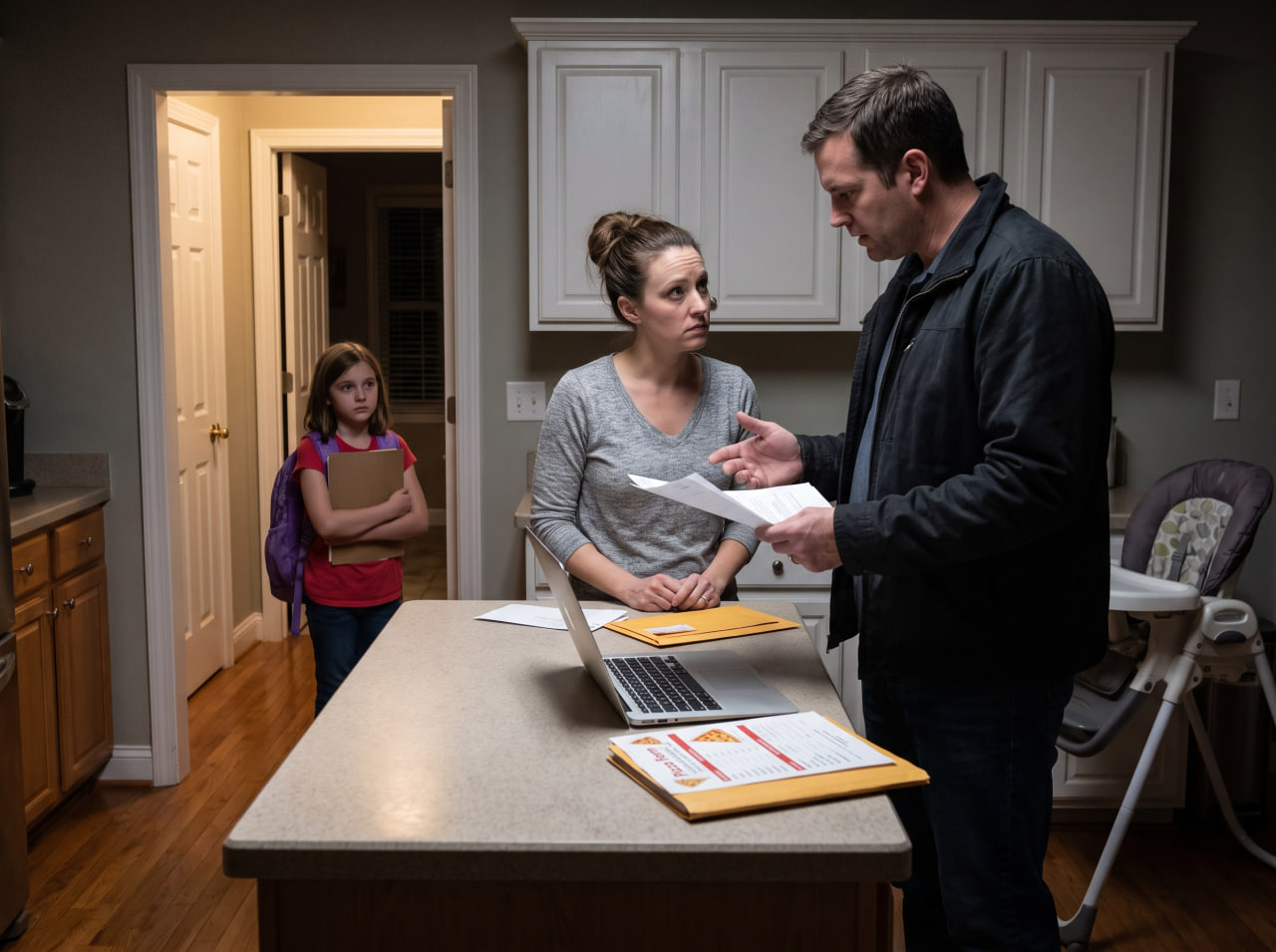
“No.”
“Did anyone else?”
She hesitated.
Then she said:
“My former attorney.”
The detective looked up.
“Name?”
She gave it.
The detective wrote it down.
“Do you still have communication with him?”
“No.”
“Why?”
“Because Daniel hired him.”
I felt my stomach drop.
“Daniel hired your lawyer?”
She nodded.
“Six months ago.”
“Why?”
“To pressure me into giving him custody.”
The detective leaned back.
“And the money?”
My wife looked at me.
“He told me if I didn’t give him $50,000, he’d make sure I lost Lily.”
The detective sighed.
“That sounds like extortion.”
My wife nodded.
“I know that now.”
Three days later, the police arrested Daniel.
They found enough evidence to connect him to the bank transfers.
He had been using stolen information to drain accounts, threaten my wife, and manipulate the custody situation.
But there was another surprise.
The former attorney was involved too.
They had been working together.
They had tried to make my wife look financially irresponsible so Daniel could argue that Lily should live with him.
The $32,000 my wife had secretly moved wasn’t stolen.
She had been protecting it for Lily.
The $12,000 missing from our joint account?
Daniel had taken it.
The debt in my name?
It wasn’t my wife’s doing either.
The lawyer had submitted fraudulent documents using my information.
When I heard that, I finally understood the note.
He cannot know yet.
It hadn’t been written by my wife.
It had been written by the attorney.
They had been trying to keep me unaware until they could finish the scheme.
But there was still one thing I couldn’t stop thinking about.
Lily.
The nine-year-old girl who had stood in my kitchen and asked where her dinner was.
The nine-year-old girl who had apologized for asking.
The nine-year-old girl who believed she was a financial burden.
I went upstairs.
She was sitting on her bed doing homework.
I knocked.
She looked up.
“Can I come in?”
She nodded.
I sat beside her.
For a while, neither of us spoke.
Then I said:
“I’m sorry.”
She looked confused.
“For what?”
“For the burger.”
She smiled a little.
“You don’t have to be.”
“I do.”
“But Mom made eggs.”
“I know.”
She looked at her homework.
“I wasn’t really hungry anyway.”
I knew that wasn’t true.
“I should have bought you dinner.”
She shrugged.
“You don’t have to.”
I looked at her.
“Actually, I do.”
She looked up.
“Why?”
I took a breath.
“Because you’re part of this family.”
Her eyes filled with tears.
I continued.
“I was so focused on proving that I wasn’t responsible for you that I forgot to ask myself whether I wanted to be someone you could rely on.”
She wiped her eyes.
“You don’t have to be my dad.”
“I know.”
She smiled.
“But can I still call you when I need help with math?”
I laughed.
“Only if you promise not to make me do fractions.”
She giggled.
It was the first time I had heard her laugh in days.
Then she asked:
“Are you still going to leave?”
I looked at her.
“No.”
She smiled.
Then she asked the question that hurt the most.
“Does that mean Mom isn’t leaving either?”
I didn’t know.
So I told her the truth.
“Your mom and I have a lot to talk about.”
She nodded.
“Okay.”
Before I left, she called after me.
“Can we have pizza Friday?”
I smiled.
“Absolutely.”
She pointed toward me.
“You’re paying.”
I laughed.
“Yes.”
My wife and I didn’t magically fix everything.
The next few weeks were difficult.
We went to counseling.
We went through every bank statement.
We rebuilt the accounts.
We changed every password.
We met with lawyers.
And we talked about the things we’d both avoided.
She admitted that she had been afraid to depend on me.
I admitted that I had been using money as a boundary because I was afraid of becoming responsible for a child whose father might someday come back and demand something from me.
But I learned something important.
There is a difference between being obligated and choosing to care.
I wasn’t Lily’s biological father.
I never would be.
And I didn’t need to pretend otherwise.
But I had married her mother.
I had helped create a home with them.
And once a child trusts you enough to believe you’re family, you don’t get to measure your love in grocery receipts.
One evening, months later, I came home from work.
My wife was in the kitchen.
The baby was crawling across the floor.
Lily was doing homework at the table.
She looked up.
“Guess what?”
“What?”
“I got an A on my math test.”
I put my bag down.
“Seriously?”
She nodded proudly.
“What did you get?”
“Twenty out of twenty.”
I smiled.
“That’s my girl.”
She immediately corrected me.
“I’m Mom’s girl too.”
I laughed.
“Fine. You’re everyone’s girl.”
My wife looked at me.
There was something in her eyes.
Something peaceful.
After dinner, she asked me to sit outside.
“I owe you an apology.”
“You’ve already apologized.”
“I know.”
She looked down.
“But I need to say it again.”
I waited.
“I almost destroyed our marriage because I was so afraid of losing Lily that I forgot you were scared too.”
I shook my head.
“I wasn’t exactly innocent.”
“You hurt her.”
“I know.”
“And yourself.”
“I know.”
She took my hand.
“Do you regret marrying me?”
I looked through the window.
Lily was laughing with the baby.
“No.”
My wife squeezed my hand.
“Do you regret marrying someone with a child?”
I thought about it.
Then I answered honestly.
“I regret that it took me so long to understand what that meant.”
She smiled through her tears.
“That’s not the same answer.”
“No.”
I looked at her.
“It’s a better one.”
A year later, Friday pizza night became a family tradition.
Every Friday.
No matter how busy we were.
No matter what bills came in.
No matter whether the month had been difficult.
We ordered pizza.
Lily always chose pepperoni.
My wife always wanted vegetables.
I always lost the argument.
And our youngest daughter—who was now running around the living room—usually ended up stealing pieces from everyone’s plate.
One Friday evening, Lily handed me a piece of paper.
It was another school form.
I looked at it.
“What’s this?”
She smiled.
“It’s for Family Day.”
I read the question.
Who will attend with you?
There were several choices.
Mother.
Father.
Guardian.
Other.
Lily had checked Other.
Then beside it, she had written something herself.
My family.
I looked at her.
“You didn’t put my name.”
She shrugged.
“I don’t have to.”
“Why?”
“Because you’re already family.”
I couldn’t speak.
She ran back toward the kitchen.
Then she turned around.
“Oh, and Dad?”
“Yeah?”
“Can you sign the pizza form?”
I laughed.
“Every time.”
She handed me the pen.
And as I signed, I realized how much my life had changed because of one blank piece of paper.
The pizza form I once saw as proof that I wasn’t responsible for another man’s child had become the reminder that family isn’t always created by biology, paperwork, or obligation.
Sometimes it’s created by the small decisions you make every day.
Showing up.
Buying the extra meal.
Signing the school form.
Listening when a child says she’s fine even when she isn’t.
And choosing, again and again, not to walk away.
I still remember that first night.
Two burgers.
One empty place at the table.
A little girl asking a simple question.
“Where’s mine?”
Back then, I thought the answer was:
“Your dad can buy it.”
Now I know the answer should have been:
“I’ll get you one.”
Because the truth was never about the burger.
It was about whether I was willing to become the kind of man who made a nine-year-old child feel safe in her own home.
And eventually, I was.
Not because anyone forced me.
Not because the law required it.
Not because her biological father failed.
But because I finally understood something I should have understood from the beginning:
A child should never have to earn a place at the table.
And neither should the people you call family.
That Friday, Lily took the last slice of pizza.
She looked at me mischievously.
“You’re not going to complain, are you?”
I smiled.
“No.”
She grinned.
“Good.”
Then she took a bite.
And for the first time, there was no empty place at our table.