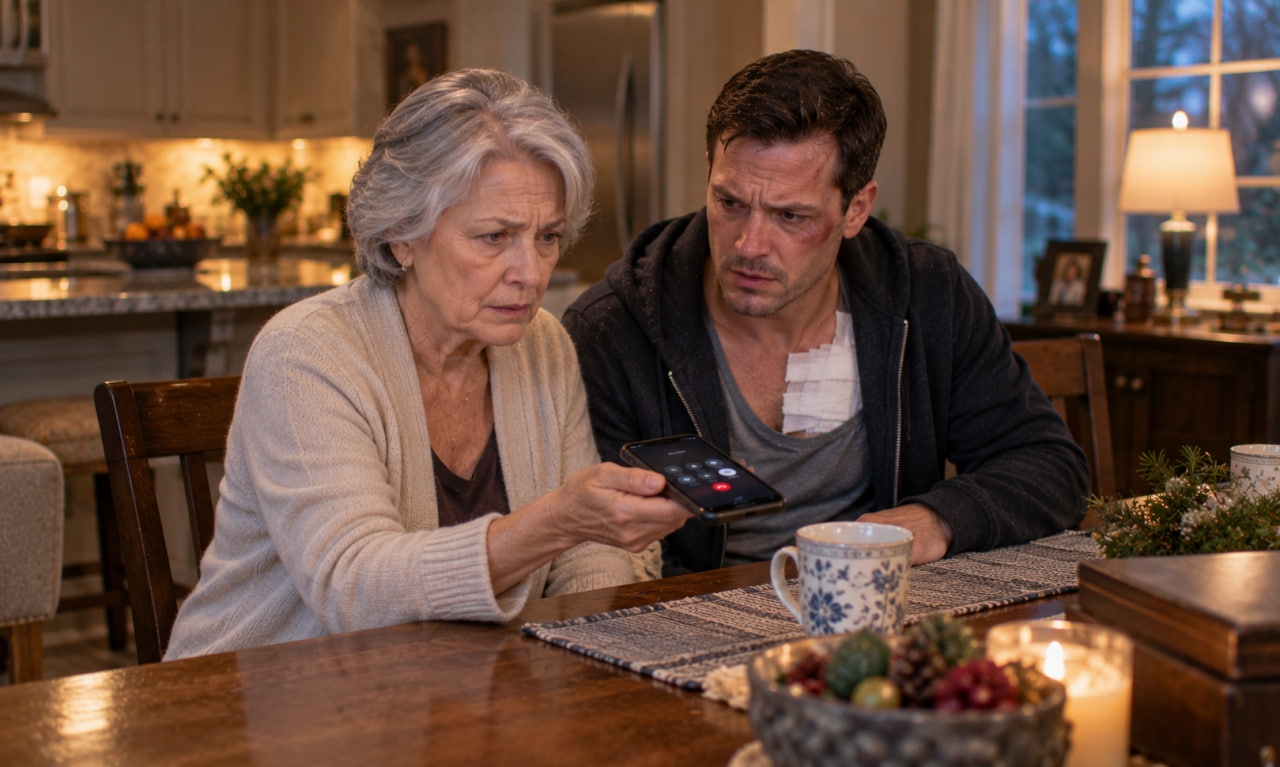
I fell.
I begged for help.
David refused.
He destroyed my phone.
He told me no ambulance was coming.
He told me nobody would believe me.
Then he laughed.
The judge watched the entire recording.
When it ended, she asked:
“Is there anything else?”
My attorney stood.
“Yes.”
He presented the financial records.
Then the emails.
Then the evidence of the attempted property transfer.
Then the documents showing David’s financial misconduct.
By the end of the hearing, David’s attorney looked exhausted.
The judge denied him any claim to the house.
A criminal investigation was opened.
His law license was suspended pending disciplinary proceedings.
Sylvia was charged for the assault.
David faced charges related to financial crimes and obstruction.
But I didn’t feel victorious.
I felt empty.
Because none of that changed what had happened.
None of it erased the fear.
None of it erased the hours I spent wondering if my daughter would survive.
Justice could punish people.
It couldn’t undo pain.
My father seemed to understand that.
That evening, he sat beside me on the porch.
“You okay?”
I looked at the sunset.
“I don’t know.”
He nodded.
“That’s an honest answer.”
I rested one hand on my belly.
“She kicked today.”
My father smiled.
“Strong girl.”
“She always kicks when I’m scared.”
“Maybe she knows when to remind you that you’re not alone.”
I smiled.
“I think so.”
Three months later, my daughter was born.
Her name was Grace.
She arrived six weeks early.
She was tiny.
So tiny that when the nurse placed her against my chest, I was afraid to breathe.
Her fingers wrapped around mine.
I whispered:
“Hi, Grace.”
She opened her eyes.
And somehow, in that moment, every terrible thing that had happened became smaller.
Not gone.
Never gone.
But smaller.
My father stood beside the bed.
He touched her tiny hand.
“She’s beautiful.”
“She is.”
“What will you tell her about her father?”
I looked at him.
“The truth.”
He nodded.
“And what will you tell her about you?”
I smiled.
“That I survived.”
A year later, I stood in my kitchen on Christmas morning.
There was no Sylvia.
No David.
No guests.
No enormous dinner.
No one ordering me around.
Just me.
My daughter.
And my father.
Grace sat in her high chair, wearing a ridiculous red sweater, throwing pieces of toast onto the floor.
I laughed.
My father picked one up.
“She’s wasting food.”
“She gets that from you.”
He raised an eyebrow.
“I’ve never wasted food in my life.”
“You once spent twenty dollars on a sandwich because you forgot you’d already eaten lunch.”
“That was different.”
Grace laughed.
We both looked at her.
For the first time in years, Christmas felt like Christmas.
Not an obligation.
Not a performance.
Home.
After breakfast, my father handed me a small box.
“What is this?”
“Open it.”
Inside was a photograph.
My mother.
She was standing beside a Christmas tree, holding me as a little girl.
On the back, my father had written:
You were never meant to spend your life proving you deserved a seat at the table. You were meant to build your own table.
I cried.
Then I understood something.
The greatest revenge wasn’t David losing his career.
It wasn’t Sylvia facing prison.
It wasn’t taking the house back.
It wasn’t watching their lives collapse.
The greatest revenge was that I no longer needed any of it to feel whole.
I had spent years believing strength meant never needing anyone.
My father taught me otherwise.
Strength meant knowing when to ask for help.
Strength meant walking away.
Strength meant telling the truth even when the truth frightened you.
And strength meant refusing to let someone else’s cruelty decide who you became.
Years later, Grace would ask me why there was no photograph of her father in our living room.
I would tell her the truth.
Not every ugly detail.
Not yet.
I’d tell her that some people make terrible choices.
I’d tell her that being related to someone doesn’t mean you have to become like them.
I’d tell her that love without respect isn’t love.
And I’d tell her something my father had taught me on that Christmas morning:
“You never have to earn your place at a table where you are loved.”
David eventually lost his law license.
The financial investigation uncovered more than anyone expected.
His career ended.
The house remained mine.
Sylvia was convicted for assault and spent years dealing with the consequences of what she had done.
And me?
I never remarried.
Not because I was afraid of love.
Because I learned the difference between being alone and being lonely.
I was never alone again.
My father remained my closest friend until the day he died.
Grace grew up knowing that her grandfather loved her fiercely.
And every Christmas, we kept one tradition.
We cooked together.
Nobody stood in the kitchen alone.
Nobody was forced to serve.
Nobody was made to feel smaller.
We set the table together.
Then we sat down together.
And every year, before we ate, my father would raise his glass.
“To family,” he would say.
And Grace would smile.
I would look around that table.
At the people who loved me.
At the little girl who had survived before she had even taken her first breath.
And sometimes I would remember that terrible Christmas night.
The kitchen.
The broken phone.
The blood.
David’s voice telling me nobody would believe me.
And I would remember what I had said.
Then call my father.
He had laughed because he thought my father’s power was the reason I would win.
But he had misunderstood.
My father didn’t save me because he was the Chief Justice of the Supreme Court.
He saved me because he was my father.
And I didn’t survive because I was the daughter of a powerful man.
I survived because, somewhere beneath all the fear and humiliation, I finally remembered that I was powerful too.
Not because of my name.
Not because of my family.
But because I chose myself.
And that was the one thing David had never expected me to do.
Choose myself.
And once I did, he could never control me again.