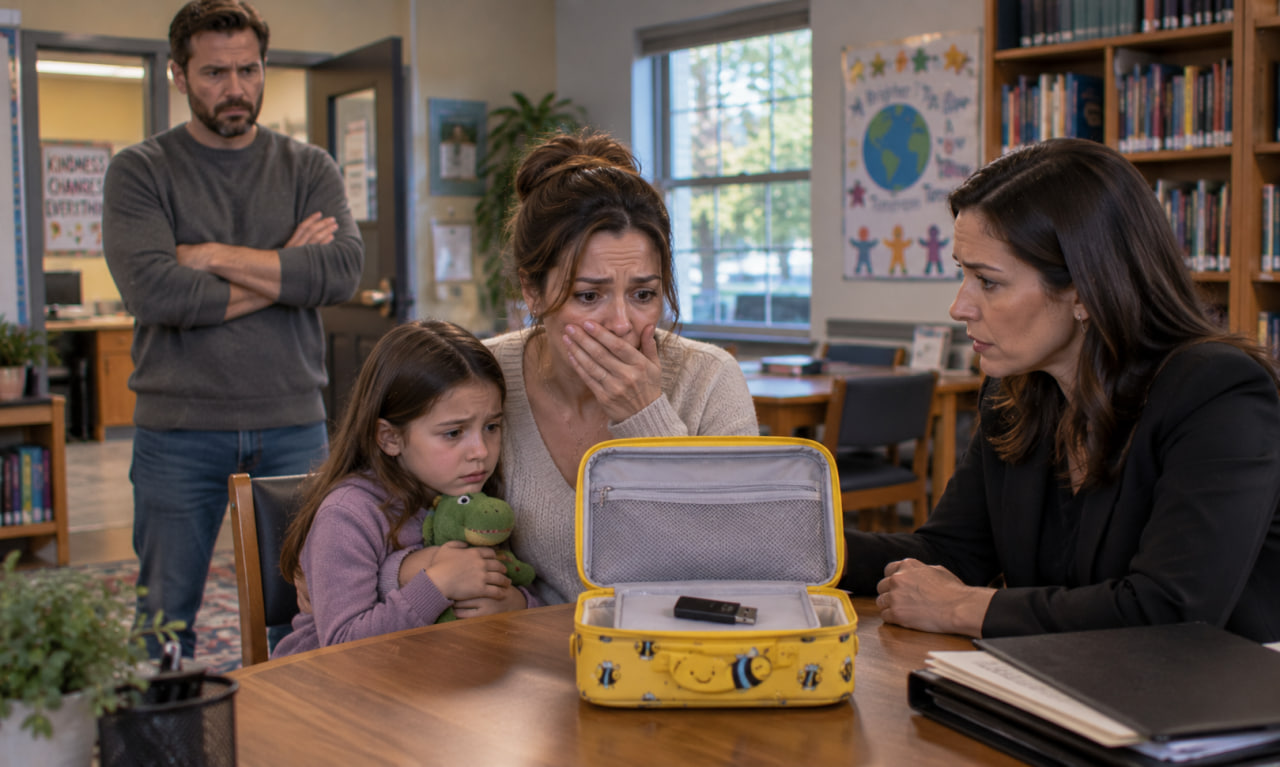
“But thanks to your daughter… we’re finally going to find out.”
Renata reached for my hand.
I squeezed hers tightly.
For the first time since leaving that house, hope didn’t feel impossible.
It felt dangerous.
But real.
PART 4
Detective Moreno did not call the next morning.
Or the morning after that.
Every hour without news became its own kind of torture.
The shelter had rules: breakfast at seven, counseling at ten, lights out by ten. The routines were meant to create safety, but I couldn’t stop checking my phone every few minutes. Every vibration made my heart race.
Renata had started sleeping through the night again.
Not completely.
She still woke whenever she heard keys jangling in the hallway.
One night she whispered into the darkness, “Mom?”
“I’m here.”
“If they put him in jail… will the house still be angry?”
I turned toward her bed.
“The house wasn’t angry, sweetheart.”
She was quiet.
“He made it angry.”
Children have a way of saying in one sentence what adults spend years trying to explain in therapy.
Forty-two flash drives
On the fourth day, Moreno arrived carrying two cardboard evidence boxes.
He looked exhausted.
“We’ve cataloged everything from the safe.”
He opened the first box.
Inside were neatly numbered evidence bags.
“There were forty-two USB drives.”
I stared.
“Forty-two?”
“They weren’t random. Each one belonged to someone.”
He placed a printed spreadsheet in front of me.
Every drive had a label.
Elena.
Brianna.
Carmen.
My name.
Then others I had never heard.
Sofia.
Lydia.
Marissa.
Nicole.
Some had dates spanning nearly sixteen years.
“What are they?” I asked.
Moreno answered carefully.
“David recorded people.”
“Why?”
“Control.”
He explained that the hard drive recovered from the garage contained organized folders filled with secretly recorded conversations, edited audio clips, scanned documents, photographs, and detailed notes about nearly every woman David had dated.
He wasn’t collecting memories.
He was building weapons.
“If someone threatened to leave,” Moreno said, “he already had material prepared to destroy their credibility.”
I felt physically ill.
The recording he forgot
“Forensic analysts found something important,” Moreno continued.
“They recovered deleted files.”
He placed headphones on the table.
“This one wasn’t on Renata’s flash drive.”
I hesitated before pressing play.
Static.
Then David’s voice.
He sounded annoyed.
“I told you to print the guardianship with today’s date.”
A woman’s nervous voice answered.
“I don’t think that’s legal.”
“It isn’t your job to think.”
Papers shuffled.
The woman spoke again.
“The mother’s signature looks copied.”
David laughed.
“That’s because it is.”
My hands began shaking.
The analyst had recovered the exact conversation proving the guardianship document was intentionally forged.
The voice of the other woman belonged to an employee at a small document preparation office in Cicero.
She had already agreed to cooperate.
A familiar face
A week later Detective Moreno asked if I was emotionally prepared to attend a lineup.
“Do I have to?”
“No.”
“But it may help identify someone.”
Inside the observation room, six women stood separately.
I wasn’t identifying David.
I was identifying the employee whose voice appeared on the recording.
Number four.
She looked barely twenty-two.
When detectives questioned her, she broke down within minutes.
She admitted David had paid cash.
He told her the paperwork was needed because his “mentally unstable wife kept kidnapping his daughter.”
She believed him.
She copied my signature from an older insurance document.
She stamped the counterfeit seal he had supplied.
She cried through most of her statement.
“I didn’t know there was a child.”
Her testimony became another piece of the case.
The birthday nobody celebrated
Renata turned nine while we were still living in the shelter.
I apologized all morning.
“No party. No presents.”
She smiled.
“We’re alive.”
I had to step into the bathroom so she wouldn’t see me cry.
The other mothers secretly decorated the dining room with paper butterflies.
Someone baked cupcakes.
Another woman donated a secondhand bicycle painted bright turquoise.
When Renata blew out her candle, every adult made the same silent wish.
Let this child finally be safe.
She didn’t ask for toys.
She asked for a lock.
That afternoon I bought her a tiny diary with a silver key.
She held it like treasure.
The lawyer
Our attorney, Danielle Brooks, specialized in child abuse cases.
She spread folders across her office.
“David has been charged with forgery, coercive control, witness intimidation, child endangerment, and multiple counts related to fraudulent legal documents.”
“Is that enough?”
“It’s a start.”
She slid another document toward me.
“He filed something else.”
I looked down.
A petition claiming I was an unfit mother.
Filed the same morning he appeared at Renata’s school.
“He really thought he’d win.”
Danielle nodded grimly.
“People like David don’t believe they’re lying.”
“They believe they’re entitled.”
She explained that the recordings changed everything.
Without them, the case might have become one adult’s word against another.
Instead, there were hours of audio, forged paperwork, financial records, and now multiple witnesses.
Still, she warned me:
“The hardest part isn’t proving what he did.”
“It’s surviving the courtroom.”
The trial begins
Six months later, we walked into the courthouse.
Reporters waited outside.
Some recognized David immediately.
He looked exactly the same.
Perfect haircut.
Pressed navy suit.
Wedding ring still on his finger.
When he saw Renata, he smiled gently.
She hid behind me.
His attorney argued that the recordings had been manipulated.
That Renata was coached.
That I fabricated allegations because I wanted the house during our divorce.
Then the prosecution played Exhibit 14.
The courtroom filled with Renata’s tiny voice.
“His hand can’t reach me here.”
No one moved.
Jurors stared at the speakers.
Then came David’s reply from another recording.
“Hiding doesn’t change who owns this house.”
His own words became the loudest witness.
My turn
When I took the stand, David never stopped looking at me.
For years that stare had controlled me.
It no longer did.
The prosecutor asked one simple question.
“Mrs. Alvarez, when did you realize your daughter was telling the truth?”
I answered honestly.
“She’d been telling the truth the entire time.”
I was the one who arrived late.
There wasn’t a dry eye in the jury box.
Renata’s courage
We never wanted Renata to testify.
The judge allowed a recorded forensic interview instead.
She sat in a child advocacy room with stuffed animals and colored pencils.
The interviewer asked, “Why did you hide the flash drive in your lunchbox?”
Renata answered after thinking carefully.
“Because nobody checks the lunchbox after lunch.”
The interviewer smiled gently.
“Why did you record him?”
She looked straight into the camera.
“So if my mom forgot again… the computer wouldn’t.”
Even the defense attorney lowered his eyes.
The verdict
The jury deliberated for eleven hours.
It felt longer than the entire marriage.
We stood when they returned.
“Guilty.”
One count.
Then another.
Then another.
By the time the clerk finished reading, David had been convicted on every major charge.
He finally looked at me.
Not with anger.
Not with superiority.
Only disbelief.
As deputies led him away, he said my name once.
“Carmen.”
I didn’t answer.
Neither did Renata.
We simply walked out together.
One year later
We never returned to that house.
The city eventually sold it after the legal proceedings.
I didn’t want the furniture.
I didn’t want the walls.