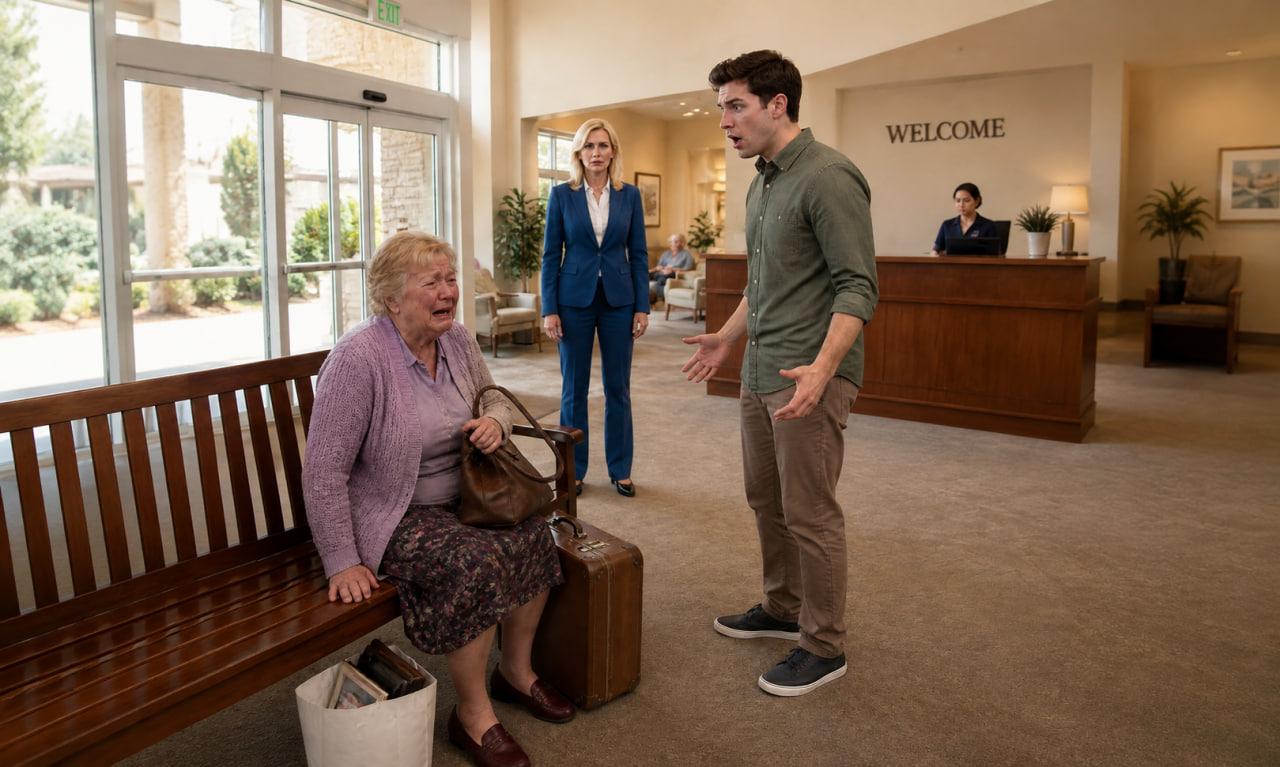
“Can I keep my home?” Grandma asked.
Rebecca didn’t make promises.
“The evidence is strong, but this could still take months.”
Grandma nodded.
“Then we begin.”
Over the following week, investigators interviewed bank employees, nursing-facility staff, Kevin, my parents, and eventually Scott Vance.
Security footage from the nursing facility showed Dad and Mom walking Grandma into the lobby at 12:41 p.m. Dad carried her suitcase while Mom spoke with the receptionist.
Seventeen minutes later, both of them left through a side entrance.
Neither returned.
Even more damaging was a note written by the admissions coordinator. Mom had claimed Grandma suffered from “progressive confusion” and could no longer manage everyday life independently.
There was one problem.
Grandma had passed a cognitive evaluation only two months earlier.
Scott Vance became the next critical piece. At first, he insisted Grandma had personally appeared before him when the deed was notarized.
Investigators then showed him evidence that Grandma had been attending physical therapy across town at that exact time.
His story changed.
Scott admitted Dad had arrived with the document already signed, claiming his mother was recovering from surgery and unable to travel. Scott had notarized it as a personal favor without ever seeing Grandma.
Two weeks later, he surrendered his journal and emails.
One message from Dad stood out.
“She won’t understand the paperwork anyway. Just need this completed by Friday.”
I had spent days wondering whether Dad had simply panicked because his company was collapsing. Maybe desperation had pushed him into one terrible decision after another.
That email destroyed the possibility. He knew exactly what he was doing.
Then Rebecca obtained the financial records from Mercer Renovations, and the eighty-three thousand dollars Dad had taken from Grandma suddenly looked even worse.
It hadn’t all gone toward saving his employees or paying desperate suppliers.
Almost twenty-seven thousand dollars had paid personal credit-card balances. Nine thousand had gone toward Mom’s SUV, while another six thousand covered a vacation deposit my parents later canceled.
Only part of Grandma’s money had actually gone toward business expenses.
Rebecca placed the breakdown in front of her.
Grandma stared at it for nearly a minute before asking one question.
“Did Daniel know?”
“No,” Rebecca said.
Grandma nodded quietly. That question hurt more than the numbers.
She could accept that money had been taken from her. What she could no longer bear was wondering how many people she loved had known about it.
And the investigation still wasn’t finished.
Part 4: The House Was Finally Hers Again
I moved into Grandma’s guest room for the next month. She didn’t need anyone supervising her, despite what my parents had claimed, but unfamiliar cars occasionally slowed outside the house and Dad kept looking for opportunities to speak with her alone.
He came by twice.
Both times, Grandma refused to let him inside.
Mom took a different approach. She sent me long messages accusing me of poisoning Grandma against them and destroying our family over a financial misunderstanding.
I saved every message.
Six weeks after the day my parents abandoned Grandma at the nursing facility, Rebecca called us into her office with news we had barely allowed ourselves to hope for.
The lender was releasing its claim against the house.
Its attorneys had reviewed the questionable deed, the false statements about Grandma’s mental condition, the notary’s admission, and the evidence showing she had never authorized the transaction. Rather than continue defending the mortgage, the lender decided to reverse the deal and pursue Dad and Mercer Renovations directly.
Grandma’s title was restored.
When Rebecca handed her the paperwork, Grandma read every page before looking up.
“So the house is mine?”
“It’s yours.”
Grandma closed her eyes.
For the first time since I had found her sitting beside that brown suitcase, I saw tears roll down her face.
But getting the house back didn’t end the investigation.
Dad faced multiple charges related to unauthorized documents, financial misuse, and the alleged exploitation of an elderly person. Scott Vance faced separate legal proceedings and professional disciplinary action for notarizing a document without Grandma being present.
Mom’s situation was more complicated. Investigators didn’t accuse her of forging Grandma’s signature, but they believed she had participated in placing Grandma in long-term care using inaccurate claims about her mental condition. Her attorney entered negotiations while prosecutors evaluated the evidence.
Then the family began choosing sides.
One aunt called Grandma and reminded her that Richard was still her son.
A cousin argued that putting Dad through criminal proceedings wouldn’t magically return the missing money. Another relative suggested family counseling, as though eighty-three thousand dollars, a disputed deed, and an abandoned suitcase could be resolved by everyone sitting in a circle and discussing their feelings.
Grandma listened patiently.
Then she asked every person the same question.
“If someone outside this family had done this to me, would you still tell me to protect them?”
Nobody gave her a convincing answer.
Dad eventually accepted responsibility for reduced charges rather than taking the case to trial. The outcome included time in custody, supervised release, restitution, and restrictions preventing him from managing Grandma’s finances or contacting her without approval.
Mercer Renovations eventually closed.