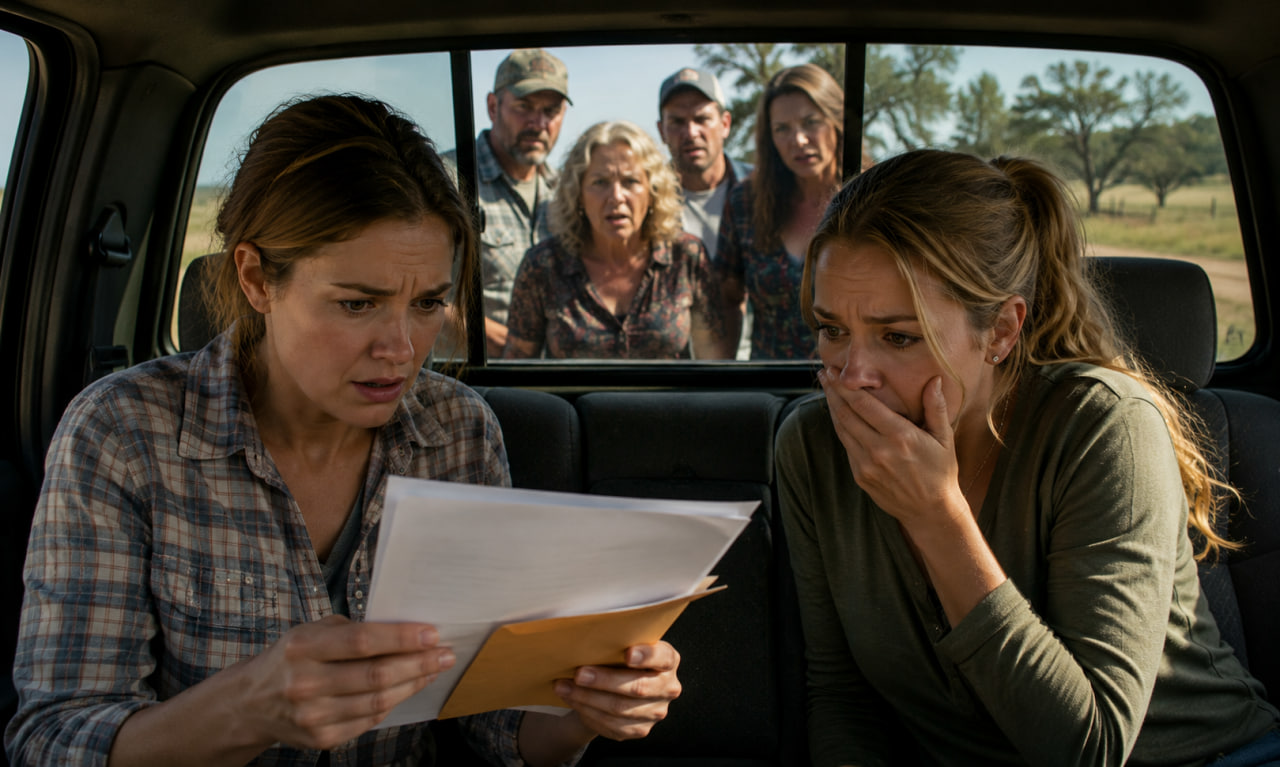
At Grandpa’s will reading, every grandchild received exactly $1—except June, the cousin who had driven 29 miles every Wednesday to shave him, change his sheets, and bring meatloaf in a Cool Whip tub. Aunt Carol actually laughed and said, “That’s all she gets for playing nurse.” Then Grandpa’s lawyer reached into his desk and handed June a thick cream envelope with her full name written in Grandpa’s shaky handwriting. He insisted she open it privately. By 3:45 p.m., six relatives were following her red Tacoma down a dirt road, desperate to know what was inside. June finally stopped at Grandpa’s cattle gate, handed me the envelope, and whispered, “If I open it, they’ll hate me forever.” Then I slid my thumb beneath the flap.
PART 3
I handed it to her.
Her eyes moved across the page.
Then stopped.
“That’s not possible.”
The balance was $418,760.22.
June looked at me.
“Grandpa didn’t have that kind of money.”
“No,” I said.
“He didn’t.”
There was another sheet beneath the bank statement.
I pulled it out.
This one was a photocopy of a deed.
The property description took up half the page.
I recognized the county numbers immediately.
It was Grandpa’s farm.
Or at least part of it.
June stared at the paper.
“What am I looking at?”
“Looks like a deed.”
“To what?”
I pointed.
“Your name.”
Her face went blank.
For several seconds, neither of us moved.
Then the sound of an engine came from behind us.
June folded the papers quickly and shoved them back into the envelope.
“Don’t tell them.”
“I wasn’t planning to.”
“No.”
She looked toward the road.
The Silverado had stopped near the gate.
Mark got out.
Dale climbed from the Jeep.
Aunt Carol was right behind them, still wearing the black dress she’d worn to the funeral.
There was something almost ridiculous about six grown adults standing beside trucks on a dirt road because they couldn’t wait another hour to find out what an old man had left behind.
June locked the envelope inside the glove compartment.
Then she got out.
I followed.
Mark walked toward us.
“What did he leave you?”
June said nothing.
Dale laughed.
“Come on, June. We’re family.”
I almost laughed at that.
Family.
That word had been doing a lot of work for people who hadn’t visited Grandpa in months.
Aunt Carol stepped forward.
“Your grandfather clearly made some kind of mistake.”
June looked at her.
“Mr. Albright read the will.”
“He read what was written.”
“Exactly.”
Carol’s mouth tightened.
“You know what I mean.”
June shook her head.
“No. I don’t.”
Mark came closer.
“Just tell us what’s in the envelope.”
“No.”
One word.
Quiet.
But it landed harder than shouting.
Mark looked genuinely surprised.
Maybe because June had spent two years saying yes.
Yes, I’ll bring groceries.
Yes, I’ll change the sheets.
Yes, I’ll drive him to the doctor.
Yes, I’ll stay another hour.
Yes, I’ll take care of it.
Now she was saying no.
Dale looked at me.
“You know what’s in it.”
I didn’t answer.
“You opened it.”
I said, “It’s June’s.”
Aunt Carol stepped between us.
“Don’t make this ugly.”
I looked at her.
“You followed her down a dirt road.”
Nobody spoke.
Then something happened that none of us expected.
The cattle gate behind us swung open.
Not because anyone touched it.
The wind had caught it.
The metal slammed against the post.
Everyone turned.
And for some reason, June started crying.
Not loudly.
Just two tears.
She wiped them away immediately.
“I need to go inside.”
Grandpa’s house sat another hundred yards down the lane.
Nobody moved.
Then June got back into the Tacoma.
I climbed in beside her.
She started the engine.
Mark shouted after us.
“June!”
She kept driving.
The others followed.
Grandpa’s house looked exactly as it had the day before the funeral.
The porch light was still on.
The newspaper he’d never gotten around to reading sat beside the front door.
His work boots were beneath the chair.
One boot had a dried line of mud across the toe.
June stopped the truck.
She didn’t get out.
“I can’t.”
I looked at her.
“What?”
“I can’t walk in there.”
“You don’t have to.”
She stared through the windshield.
“I was here every Wednesday.”
“I know.”
“And every Wednesday I thought there would be another Wednesday.”
Her voice broke.
“I didn’t know the last one was the last one.”
I didn’t say anything.
Because there was nothing to say.
After a minute, she opened the door.
We walked inside.
The others stayed outside for a moment.
Then Mark and Dale came in too.
Aunt Carol followed.
Nobody asked permission.
The living room still smelled like Grandpa.
Old Spice.
Menthol.
Coffee.
Something faintly medicinal.
June stood in the middle of the room.
Then she looked toward his chair.
His favorite chair.
The brown recliner.
She had spent hundreds of hours beside it.
The blanket she’d washed every week was folded over the arm.
June walked over and touched it.
“That’s where he slept after his surgery.”
Nobody spoke.
She looked at the kitchen.
“That’s where I burned the meatloaf.”
Dale smiled faintly.
“You burned meatloaf?”
June laughed through her tears.
“Once.”
“You said you couldn’t cook.”
“I can cook.”
“You made terrible meatloaf.”
“It was one time.”
For a brief second, we were children again.
Then June’s smile disappeared.
She looked toward the envelope.
“I need to know what he was trying to tell me.”
We went into the kitchen.
June placed the envelope on the table.
She opened it again.
There were more documents beneath the bank statement.
A letter.
Two photographs.
A key.
And a small handwritten note.
June picked up the note first.
It said:
June—
If you are reading this, I am gone.
I know you will be tempted to give everything away because that is what you have always done.
Don’t.
June’s hands began shaking.
She continued.
This is not payment for taking care of me.
You never worked for me.
You loved me.
She stopped.
I saw her swallow.
Then she read the next line.
There is a difference.
Nobody spoke.
Even Carol was silent.
June continued.
The money in the Salina account came from the land.
Not the house.
Not the farm equipment.
The land.
She looked at me.
“What land?”
I pointed to the deed.
“The farm.”
She kept reading.
Twenty-seven years ago, I sold mineral rights on part of the property.
Mark immediately stepped forward.
“Mineral rights?”
Grandpa’s voice seemed to echo through the room.
June kept reading.
I never told the family because I knew what would happen.
Dale frowned.
“What would happen?”
June looked at him.
“Apparently exactly this.”
She returned to the letter.
The first payments were small. Then the company discovered something deeper.
She stopped.
Her eyes widened.
“What?”
I took the letter from her.
The next paragraph was difficult to understand.
But one phrase was very clear.
Natural gas reserve.
Mark swore under his breath.
Dale grabbed the deed.
“Let me see that.”
June pulled it away.
“No.”
Dale stared at her.
“June, this could be worth millions.”
“I know.”
“No, you don’t.”
He laughed nervously.
“Do you understand what you’re holding?”
June looked at him.
“Yes.”
She folded the letter.
“Something Grandpa wanted me to have.”
Mark stepped closer.
“Why would he leave it to you?”
June’s eyes hardened.
“I don’t know.”
Aunt Carol finally spoke.
“He was old. He wasn’t thinking clearly.”
June turned.
“He wrote this before he went into hospice.”
Carol didn’t answer.
June pulled out the bank card Mr. Albright had given her.
On the back was a handwritten phone number.
And below it:
Ask for Helen Ward.
There was another line.
She knows everything.
Nobody slept that night.
At least not me.
June called the number at 8:12 the next morning.
A woman answered.
“Salina National.”
June hesitated.
“My name is June Parker.”
Silence.
Then the woman said:
“Mr. Parker’s granddaughter?”
June’s eyes met mine.
“Yes.”
The woman took a breath.
“I’ve been expecting your call.”
June sat straighter.
“How long?”
“Since your grandfather died.”
“Who are you?”
“My name is Helen Ward. I was his private banking officer.”
June looked at the papers spread across the table.
“How much money did he have?”
Helen paused.
“Which account?”
June stared at me.
“Which account?”
Helen answered carefully.
“The one your grandfather left instructions for you to access.”
June’s voice became quieter.
“How many accounts are there?”
Another pause.
“Three.”
Mark, who had apparently arrived without anyone inviting him, froze in the doorway.
June saw him.
She turned away.
“How much?”
Helen said a number.
June’s face went pale.
She put the phone on speaker.
Helen repeated it.
“$1.8 million.”
Nobody breathed.
Dale whispered, “What?”
June asked, “Is that all?”
Helen replied:
“No.”
June’s hand tightened around the phone.
“What do you mean, no?”
“The money in those accounts is separate from the trust.”
“What trust?”
Helen was silent.
Then she said:
“Mr. Parker established a family trust twenty-one years ago.”
Mark stepped into the kitchen.
“For whom?”
Helen answered.
“That depends on which document you read.”
June’s heart was pounding so loudly I could hear it.
“Who is the beneficiary?”
Helen said:
“You.”
Mark slammed his palm on the counter.
“That’s impossible!”
Helen heard him.
“Mr. Parker specifically instructed us not to discuss the trust with anyone except June Marie Parker.”
Mark grabbed the phone.
“Listen—”
June took it from him.
“Don’t.”
Mark stared at her.
For the first time, he looked afraid.
Not angry.
Afraid.
June said into the phone:
“Helen, what exactly did my grandfather put into the trust?”
Helen answered:
“Land.”
June closed her eyes.
“How much?”
“All of it.”
The next morning, Mr. Albright came to the house.
He looked older than he had at the reading.
He carried a leather briefcase.
When he saw Mark, Dale, Carol, and the others in the living room, he stopped.
“I asked June to meet me privately.”
Carol stood.
“We’re family.”
Mr. Albright sighed.
“Mrs. Wilson, I have explained this already.”
Carol’s cheeks reddened.
He turned to June.
“Your grandfather anticipated this.”
June almost smiled.
“He did?”
“Yes.”
Mr. Albright opened his briefcase.
“He knew there would be questions.”
He pulled out a folder.
“He also knew some of those questions would not be asked politely.”
Nobody moved.
Mr. Albright placed the folder on the table.
“Your grandfather left very specific instructions.”
June opened it.
The first page was a legal document.
The second was a list.
Names.
Amounts.
Property.
Dates.
Then she saw something that made her stop.
Her own name wasn’t alone.
Beside it was another name.
Eleanor Parker.
June whispered:
“Who is Eleanor?”
Mr. Albright looked at her.
“Your grandmother.”
June frowned.
“My grandmother died before I was born.”
“Yes.”
He turned another page.
“This is where your grandfather’s secret becomes complicated.”
June looked at him.
“How?”
Mr. Albright sat down.
“Your grandmother did not die broke, June.”
The room became silent.
“She left your grandfather a substantial inheritance.”
June stared.
“Then why did we grow up thinking they had nothing?”
“Because your grandfather gave almost all of it away.”
“To charity?”
Mr. Albright shook his head.
“To someone.”
“Who?”
He looked toward Mark.
Then Dale.
Then Carol.
Finally, June.
“Your grandfather spent twenty years trying to protect someone.”