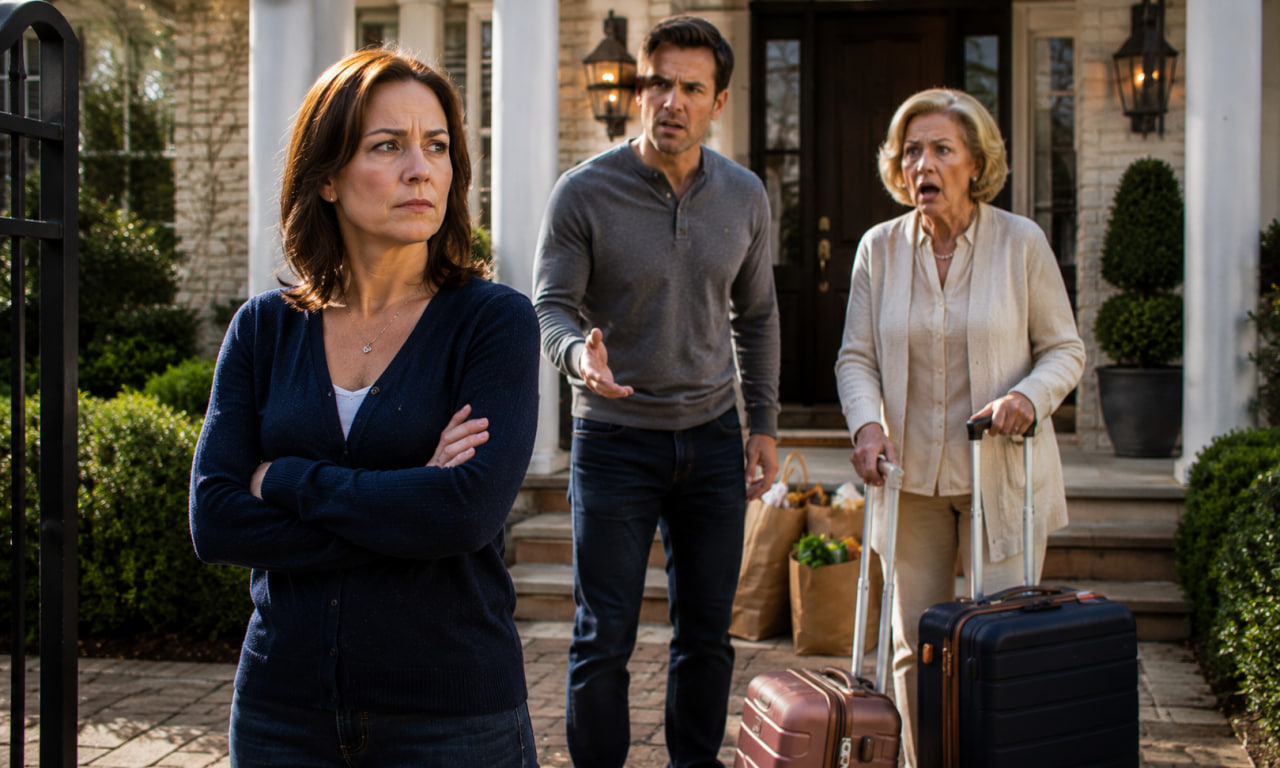
Then he noticed the black makeup bag sitting on the porch railing.
“Where did you get that?”
“You put it beside my coffee.”
“That isn’t the bag Mom gave me.”
Eleanor looked toward it.
Her hand moved instinctively toward one of her suitcases in the car. She unzipped an outer pocket and pulled out another black cosmetic case.
The two bags were nearly identical.
David had taken the wrong one from the Marriott.
Eleanor’s face lost all color.
“Give it back,” she said.
“Why?”
“There are personal things inside.”
“My passport is not your personal property.”
David closed his eyes.
Eleanor stared at him in panic.
“You said she had agreed.”
“I said I could persuade her.”
“You said the application was complete!”
“Stop talking.”
The officer made sure his body camera was recording and reminded both of them that they had the right to remain silent.
Eleanor had already begun exposing the scheme.
“What application?” I asked.
She pressed her lips together.
Rachel held up a copy of the loan documents.
“This application.”
Eleanor pointed a trembling finger at David.
“This was his idea.”
David turned on her.
“You begged me to save your company!”
“You said the house was practically yours!”
“I said Sarah might eventually add me to the deed.”
“You said she owed you!”
The driveway became dead silent.
David finally realized how much they had just confessed.
He looked at me pleadingly.
“Sarah, I can explain.”
“Can you explain my forged signature?”
“You agreed to help us.”
“I had never heard of Vance Elite Events until this morning.”
“We were going to tell you.”
“When?”
“At lunch.”
“There was never going to be a lunch.”
“You would have signed if you understood the severity of the situation.”
“You submitted financial documents in my name before even asking me.”
“The preliminary application wasn’t legally binding.”
“You forged my signature.”
“It was only to show the bank you were interested.”
“I wasn’t interested.”
“You would have been once you understood how much my mother stood to lose.”
“She had already lost her condo.”
Eleanor looked at the ground.
David’s silence confirmed it.
“You both lied to me.”
“We were trying to protect the family,” he said.
“No. You were trying to make me responsible for massive debts you concealed from me.”
“We could have repaid the loan.”
“With what?”
“Mom’s business would bounce back.”
“The business has been bleeding money for two years.”
His expression shifted to shock.
He had not expected me to know the details.
Eleanor lifted her chin defensively.
“You have more than enough. Arthur left you everything.”
“My father’s money has nothing to do with your bankruptcy.”
“He never liked David.”
“My father died before I met David.”
Eleanor faltered.
David looked at her sharply.
She had slipped up again.
“How do you know what my father left me?” I asked.
She did not answer.
I looked at David.
“What did you tell her?”
“Nothing she didn’t already know.”
“How would she know anything?”
David rubbed both hands over his face, looking exhausted.
“She saw some of your financial statements.”
“When?”
“During one of her visits.”
I remembered finding my office door open after Eleanor stayed with us over Thanksgiving. She claimed she had been searching for an iPad charger.
“You let her search my office.”
“I didn’t let her.”
“But you didn’t stop her.”
“She wanted to know whether the house had any second mortgages attached to it.”
“Why?”
“Because her company was already drowning.”
The plan had begun much earlier than I ever suspected.
The constant pressure to add David to the deed.
The casual questions about joint checking accounts.
Eleanor asking what the Evanston property would fetch if I put it on the market.
David encouraging me to keep my tax returns in the unlocked downstairs study because it was “more convenient.”
My missing passport.
They had spent months gathering my information while I naively believed we were arguing about symbolic trust in a marriage.
There was nothing symbolic about it.
They wanted the equity in the house.
Eleanor stepped toward the porch.
“My son gave you six years of his prime. He deserves something.”
“He received six years of mine.”
“You never even gave him a family.”
There it was.
The exact same insult she had used for years.
For most of our marriage, Eleanor blamed me because we didn’t have kids. I endured painful appointments, fertility treatments, and her snide remarks while David pretended the medical issue belonged solely to me.
Then, eight months ago, our specialist recommended testing both of us.
David never showed up for his appointment.
He allowed his mother to berate me rather than face the medical possibility that he might be the reason.
This time, Eleanor’s venom did not break me.
It clarified everything.
“You’re right about one thing,” I said, looking down at her. “I’m not giving your son anything else.”
She lunged forward and grabbed my forearm.
The police officer immediately stepped between us.
“Ma’am, let go and step back right now.”
Eleanor released me and began screaming that I was a selfish, vindictive, cold-hearted woman.
The officer warned her that she would be arrested for battery if she couldn’t control herself.
David looked at the fading red mark near my mouth.
For the very first time, genuine shame crossed his face.
“I’m sorry about last night.”
“This morning, you handed me makeup and told me to cover it up.”
“I was angry.”
“You were honest.”
“What does that mean?”
“You cared more about what your mother might see than the fact that you had physically hurt me.”
He looked toward the brick facade of the house.
“Sarah, we can fix this.”
“No.”
“I’ll call and cancel the loan.”
“The lender already froze it.”
His eyes widened in panic.
“You contacted them?”
“My attorney did.”
Eleanor covered her mouth with trembling hands.
David stared at Rachel.
“This was a private family financial matter.”
“Using forged documents to obtain a commercial loan against another person’s property is federal wire fraud, not a family matter,” Rachel said flatly.
“The application was never completed.”
“That will be for the state’s attorney to decide.”
David turned back to me, desperate.
“You’re going to send my mother to prison over some paperwork?”
“No. The two of you made your criminal choices long before I knew that paperwork existed.”
The movers began loading his designated boxes into a rented box truck. The officer handed David a clipboard with the inventory sheet and explained that any remaining property disputes would be handled exclusively through their lawyers.
David barely glanced at it.
He stood on the driveway as his expensive suits disappeared into the truck, one rolling rack at a time.
He had once confidently told me that a man’s possessions proved how far he had come in the world.
Now, surrounded by everything he legally owned being boxed up, he looked smaller and more pathetic than I had ever seen him.
Eleanor’s suitcases remained untouched in the back of his SUV.
She had arrived in Evanston expecting to take over my guest room indefinitely.
Instead, she had absolutely nowhere to go.
I didn’t take pleasure in that.
But I also didn’t offer to rescue her.
The police did not put David or Eleanor in handcuffs that afternoon. They collected copies of the forged documents, took our statements, and referred the suspected bank fraud to the detective division.
What followed was slower than a dramatic TV arrest, but far more devastating for them.
Over the next four months, detectives subpoenaed emails, bank records, and corporate financial statements.