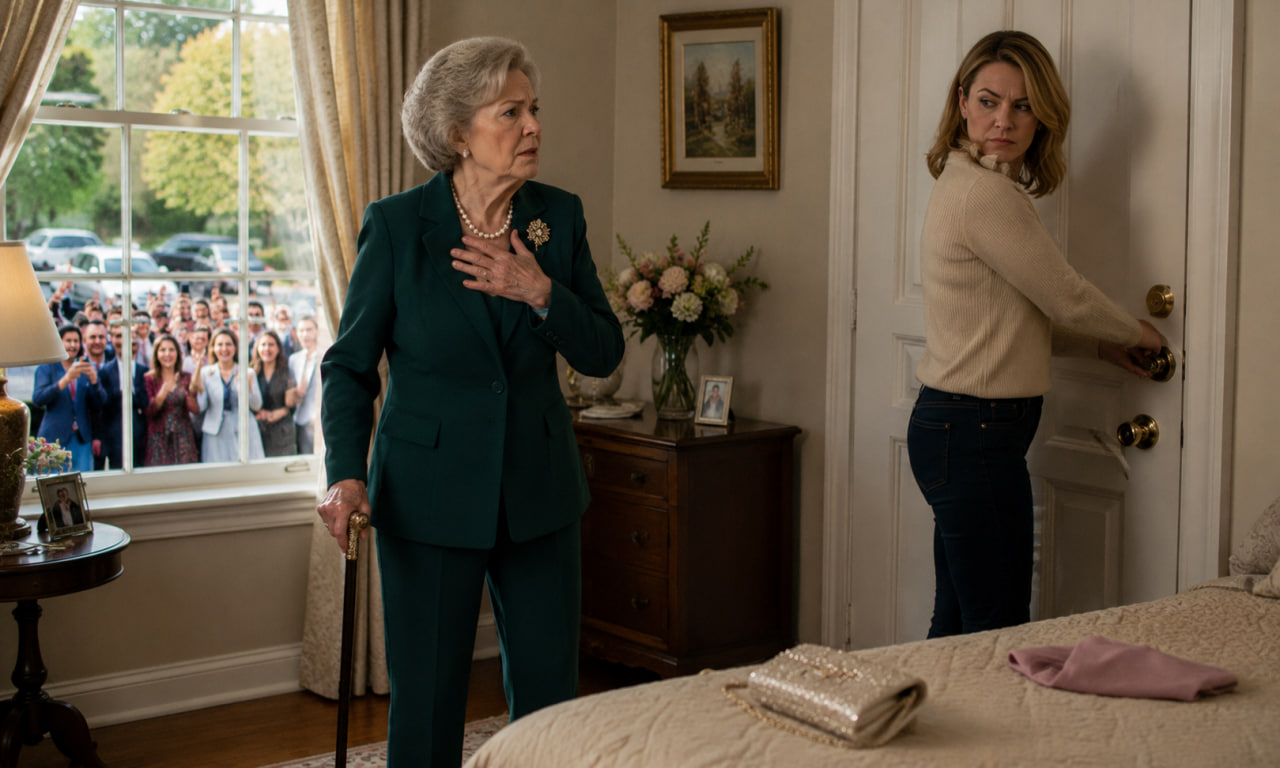
He glanced toward Lauren.
Then back at me.
“You told me never to release it unless you were convinced someone was trying to take control of your affairs.”
My heart stopped.
I looked at the envelope.
My name was written across it.
In my handwriting.
ADELAIDE — OPEN ONLY IF NECESSARY.
I stared at it.
Then at Walter.
“What’s inside?”
“You’ll know when you read it.”
I looked toward Lauren.
She was watching us.
Her face had lost all color.
I understood immediately.
She knew.
Maybe not everything.
But enough.
I opened the envelope.
Inside was a letter.
I unfolded it.
And the first line made my hands tremble.
If you are reading this, Adelaide, it means someone has begun making decisions for you that you did not authorize.
I stopped breathing.
I read the next line.
Do not confront them emotionally. Do not threaten them. Do not warn them. Let them believe they have control. Then open the blue folder in the old office.
I looked up.
The old office.
The room Lauren had never entered.
The room behind the black key.
My fingers closed around it.
I looked at Walter.
“Did you know?”
He nodded.
“You asked me to prepare everything.”
“When?”
“Three years ago.”
Three years.
That was when Lauren had first started controlling my finances.
When she began saying I was forgetful.
When she convinced me to add her name to certain accounts.
When she began telling people I couldn’t manage the business anymore.
I looked toward the house.
Then back at Walter.
“What is in the blue folder?”
He lowered his voice.
“Proof.”
“Proof of what?”
“That your daughter has been lying to you.”
My stomach tightened.
“About what?”
Walter looked around.
“Not here.”
“Then where?”
He pointed toward the house.
“The office.”
I looked at Lauren.
She was already walking toward us.
“Mom.”
Her voice was different now.
Not angry.
Not sweet.
Scared.
“What are you talking about?”
I folded the letter.
“Nothing.”
“Who is Walter?”
“My accountant.”
“I know who he is.”
“Then why did you ask?”
She stared at me.
I smiled.
“Enjoy the party.”
Then I walked away.
Behind me, I heard her whisper:
“Mom, wait.”
I didn’t.
For the first time in years, I didn’t.
The old office was at the far end of the house.
It had been closed for nearly a decade.
Dust covered the shelves.
Old invoices were stacked in boxes.
There were framed photographs of my first employees.
A calendar from 1998 still hung on the wall.
Lauren had never understood why I kept the room.
She once called it a museum.
But when I inserted the black key into the lock, I remembered exactly why.
This room wasn’t a museum.
It was my memory.
My history.
My evidence.
The door opened with a long creak.
Walter followed me.
Thomas stayed outside.
I walked to the desk.
Behind a row of old recipe books was a small safe.
I entered the combination.
The lock clicked.
Inside was a blue folder.
Exactly as Walter had said.
My hands shook as I picked it up.
The first document was a bank statement.
Then another.
Then another.
I flipped through them.
Transfers.
Withdrawals.
Payments.
Large amounts.
Very large amounts.
All from accounts Lauren had been managing.
My eyes narrowed.
“Walter…”
“I know.”
“How much?”
He hesitated.
“Almost $180,000.”
I sat down.
For several seconds, I couldn’t speak.
One hundred eighty thousand dollars.
Money I had saved for retirement.
Money I had planned to leave to my grandchildren.
Money Lauren had told me was being used for household expenses.
I turned another page.
There were credit card statements.
Luxury purchases.
Hotel charges.
Jewelry.
A new vehicle.
Private club memberships.
None of them were mine.
My hands began to tremble.
Then I found something worse.
A document with my signature.
I stared at it.
“I never signed this.”
Walter nodded.
“I know.”
“What is it?”
“A power of attorney.”
I looked at him.
“That’s impossible.”
“You signed something three years ago.”
“I signed a limited authorization for medical emergencies.”
“This is not limited.”
I looked at the document again.
It gave Lauren broad control over my financial affairs.
My property.
My accounts.
My investments.
And nearly everything I owned.
I felt sick.
“Why didn’t you tell me?”
“Because you told me not to interfere unless necessary.”
I looked at him.
“And now?”
“Now it is necessary.”
I turned the page.
Another document.
Then another.
And finally—
A purchase agreement.
For my house.
I stared at it.
“What’s this?”
Walter’s expression hardened.
“Your daughter has been preparing to sell the property.”
I couldn’t breathe.
“To whom?”
He pointed to the bottom of the page.
There was a company name.
I knew it.
Everyone in the city knew it.
A real-estate development company.
They had been buying historic properties for years.
My house sat on a large piece of land.
The developers had wanted it for years.
I had always refused.
But now I saw the proposed sale price.
My heart sank.
Lauren had planned to sell my home.
The home where I raised her.
The home where her father died.
The home where my children took their first steps.
The home where I had built my business from nothing.
And she had planned to do it while I was still living inside it.
I whispered:
“When?”
Walter looked at me.
“Monday.”
I looked at the calendar.
Saturday.
Two days.
Then I heard footsteps outside the office.
Slow.
Careful.
Lauren.
I closed the folder.
But she spoke before she entered.
“Mom…”
I looked at the door.
Her voice trembled.
“You need to give me the keys.”
I stood.
“Which keys?”
“All of them.”
I stared at her.
She swallowed.
“The house is no longer safe for you.”
I almost laughed.
“No, Lauren.”
I held up the blue folder.
“The house is no longer safe for you.”
Her face went completely white.
And for the first time since she had locked me in my bedroom that morning…
My daughter looked afraid of me.
Not because I was powerful.
Not because I was wealthy.
But because she had finally realized something she should have understood years ago:
She had mistaken my silence for weakness.
And now my silence was over.
PART 4
Lauren didn’t move.
Neither did I.
For several seconds, the only sound in the old office was the ticking of the wall clock.
Tick.
Tick.
Tick.
It was the same clock that had hung there for nearly thirty years.
I used to hear it while balancing invoices at two in the morning, when my children were asleep upstairs and I was trying to figure out how to pay the next supplier.
Back then, every tick had meant another problem to solve.
Today, it sounded like a countdown.
Lauren stared at the blue folder in my hands.
“Mom,” she whispered.
I said nothing.
She took one step toward me.
“You don’t understand what you’re looking at.”
“I understand enough.”
“No. You don’t.”
“I understand that you took money from my accounts.”
Her lips parted.
“I understand that you used my signature.”
“I didn’t steal anything.”
“You transferred nearly one hundred eighty thousand dollars.”
“It was for expenses.”
“Luxury hotels?”
She froze.
“Jewelry?”
Silence.
“A new car?”
She looked away.
“Private memberships?”
“You weren’t using the money.”
I stared at her.
“That doesn’t make it yours.”
She suddenly became angry.
“You know what, Mom? Someone had to do something!”
Her voice echoed through the office.
“Someone had to manage everything because you wouldn’t!”
“I managed my business for forty years.”
“That was before!”
“Before what?”
“Before you got old!”
The words hung between us.
I felt them more deeply than any insult she had thrown at me that morning.
Not because I hadn’t heard the word before.
But because this time there was no disguise around it.
No “for your safety.”
No “because I worry about you.”
Just the truth.
She thought my age had erased my right to decide.
I slowly closed the folder.
“Leave.”
She blinked.
“What?”
“Leave my office.”
“Mom—”
“You heard me.”
“This is my house too.”
“No.”
Her face hardened.
“You can’t just say that.”
“I can.”
“I’ve lived here for twelve years.”
“You were allowed to live here.”
“I took care of you!”
I looked directly into her eyes.
“Did you?”
That stopped her.
I continued.
“You controlled my accounts.”
She said nothing.
“You controlled my phone.”
Nothing.
“You decided which friends I could see.”
Her eyes filled with anger.
“You locked me in my room on my birthday.”
“Because you were going to embarrass yourself!”
“No.”
I shook my head.
“You were afraid I would speak.”
She stared at me.
I stepped closer.
“You weren’t afraid I would embarrass myself, Lauren.”
I lowered my voice.
“You were afraid someone would hear me.”
Her face changed.
And I knew I was right.
Outside, the birthday party continued.
Music drifted through the open windows.
Children laughed.
Someone shouted that the cake was ready.
I could smell roasted chicken and fresh bread.
My food.
My kitchen.
My people.
My life.
And for the first time in years, I felt as though the house belonged to me again.
Lauren left the office without another word.
But she didn’t leave the house.
She went upstairs.
I knew why.
She was making a call.
Probably to the developer.
Probably to a lawyer.
Probably to anyone who could help her keep control.
I didn’t chase her.
I didn’t need to.
The blue folder had changed everything.
But I wasn’t interested in revenge.
I wanted the truth.
And truth requires patience.
I spent the rest of the afternoon talking to people I hadn’t seen in years.
Some had traveled for hours.
One former employee had driven six hours with his wife.
Another woman brought me a photograph of her wedding from 1994.
“You catered this,” she said.
I laughed.
“I remember the cake.”
“You remember the cake?”
“You complained that the roses were too sweet.”
She laughed through tears.
“I was twenty-three.”
“You were impossible.”
“So were you.”
We hugged.
Another guest approached me.
A young man in his thirties.
I didn’t recognize him.
“Mrs. Adelaide?”
“Yes?”
“My mother asked me to give you this.”
He handed me a small envelope.
“Who is your mother?”
“Maria Santos.”
My heart stopped.
Maria.
One of my first kitchen workers.
She had died eight years earlier.
I opened the envelope.
Inside was a photograph.
Maria was standing beside me in my first kitchen.
On the back, in her handwriting, were the words:
“For the woman who gave me my first chance.”
I pressed the photograph against my chest.
I suddenly realized something.
I had spent so much time believing I was losing everything.
But maybe I had been measuring wealth incorrectly.
I thought wealth was money.
Property.
Accounts.
Business ownership.
But standing there surrounded by people whose lives had crossed mine, I understood.
The richest thing I had ever built wasn’t the company.