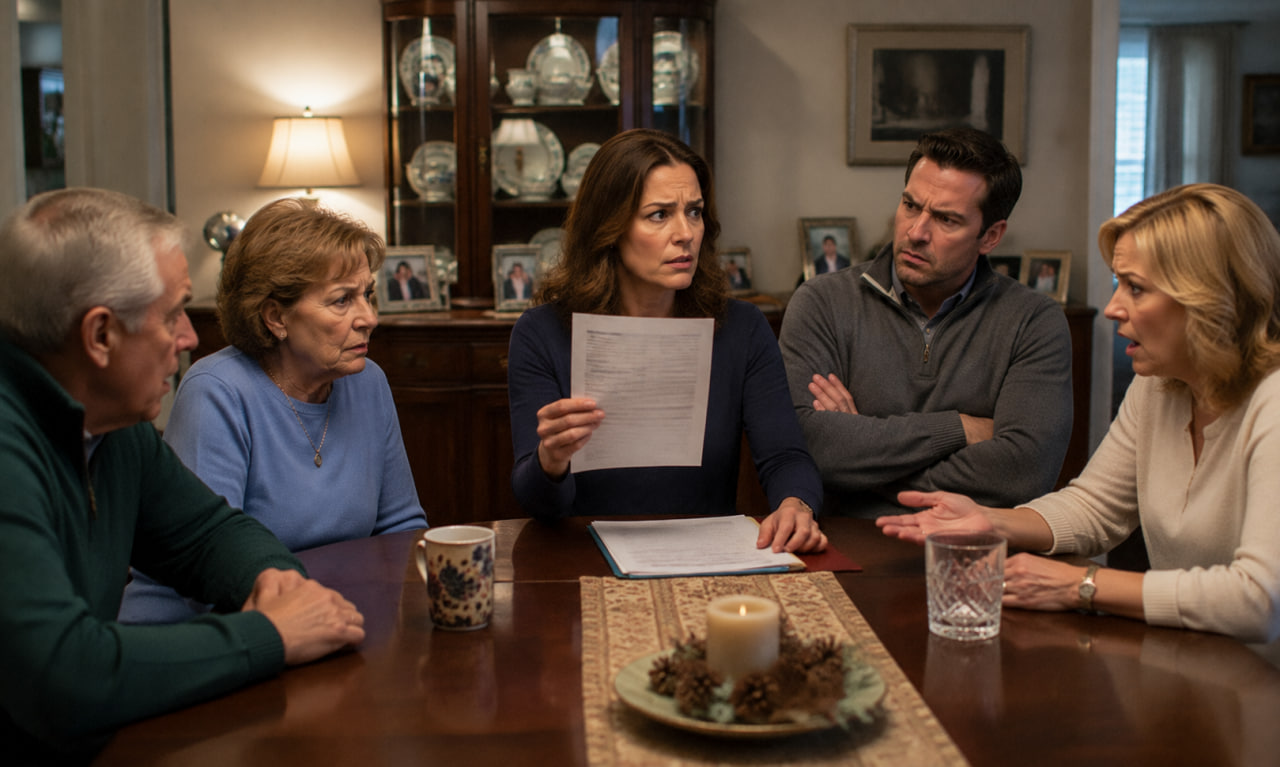
Daniel stood.
“What is this?”
The woman looked at him.
“Mr. Ellis, we received a request to review several transactions.”
His face drained.
Mama looked at me.
I had not called the sheriff.
I had not called the bank.
At least, not that day.
Then I remembered something.
The day before, I had emailed Mama’s attorney.
Apparently, he had already started looking.
The bank employee continued.
“There are concerns about unauthorized transfers.”
Daniel’s eyes went to me.
“You did this.”
I shook my head.
“No.”
I looked at Mama.
“She did.”
Mama frowned.
“What?”
I pointed toward the phone on the table.
“Remember yesterday when I asked you to call Mr. Peterson?”
Mama’s eyes widened.
“You told me to ask him what power of attorney means.”
“Yes.”
“Why?”
“Because you deserved to know.”
She nodded slowly.
The sheriff stepped inside.
“We don’t need to do anything tonight unless necessary. The bank has frozen additional transfers pending review.”
Daniel sat down.
Karen began crying.
But Mama remained standing.
She looked around the dining room.
The same dining room where she had raised us.
The same table where Daddy used to carve the Thanksgiving turkey.
The same walls where Daniel’s childhood photographs hung.
Then she looked at the house papers.
“No.”
Daniel looked up.
“What?”
She pushed the folder away.
“I’m not selling my house.”
He stared at her.
“Mama—”
“No.”
Her voice was quiet.
But firm.
“I’m not moving because you need money.”
He looked broken.
“I was trying to help.”
“You were trying to help yourself.”
He lowered his head.
Mama sat down.
“Tomorrow my daughter is taking me to the doctor.”
I nodded.
“And after that, we are going to see the lawyer.”
Daniel looked up.
“Mama, please.”
She took a breath.
“And I am changing my power of attorney.”
His eyes filled again.
She continued.
“Not because I hate you.”
He looked at her.
“But because loving you has made me ignore too much.”
No one spoke.
The sheriff eventually left.
The bank employee left with him.
Karen followed Daniel into the hallway.
My aunt Helen hugged Mama.
One by one, everyone went home.
I stayed.
I helped Mama clean the table.
Neither of us talked about Daniel.
Not yet.
At eleven-thirty, she finally said:
“Do you think I’m dying?”
I stopped wiping the counter.
I turned around.
“I don’t know.”
She nodded.
“That’s the honest answer.”
“Yes.”
She sat at the kitchen table.
“Thank you.”
“For what?”
“For not telling me everything was fine.”
I sat beside her.
“I was scared.”
“So was I.”
She took my hand.
“I’ve been scared since March.”
“I know.”
“No.”
She looked at me.
“I don’t think you do.”
She stared toward the window.
“Your father died in this house.”
“I know.”
“And after he died, Daniel started handling everything.”
She paused.
“He said I couldn’t manage it.”
I frowned.
“He told me I was too emotional.”
My stomach tightened.
“He said he would protect me.”
Mama gave a sad smile.
“And I let him.”
She looked down at her hands.
“I thought a mother was supposed to trust her son.”
“A mother can trust her son and still ask questions.”
She smiled faintly.
“You sound like your father.”
I laughed softly.
“That’s probably the nicest thing you’ve ever said to me.”
She squeezed my hand.
Then her expression became serious.
“If something happens to me…”
“Mama.”
“Listen.”
I did.
“Don’t let Daniel lose everything because of me.”
I stared at her.
“What do you mean?”
“If he owes money, help him find a way to work through it. But don’t give him the house.”
“I won’t.”
“And don’t let him tell you that taking care of him means sacrificing yourself.”
I nodded.
She looked toward the hallway.
“He needs consequences.”
I realized then that my mother wasn’t asking me to punish my brother.
She was asking me not to rescue him.
There was a difference.
The next morning, we drove sixty miles to Cedar Falls.
The doctor was waiting.
He reviewed the new scans.
Then he sat across from us.
He took off his glasses.
“Martha, I need you to hear me carefully.”
Mama nodded.
“The mass is concerning.”
My heart stopped.
“We need the biopsy.”
“When?” I asked.
“As soon as possible.”
Mama asked the question neither of us wanted to ask.
“Is it cancer?”
The doctor looked at her.
“I don’t know yet.”
Mama closed her eyes.
He continued.
“But whatever this is, I’m glad you came.”
I looked down.
The doctor placed his pen on the desk.
“If you had waited another six months, we’d be having a very different conversation.”
Mama reached for my hand.
This time, neither of us apologized.
The biopsy was scheduled for Friday.
The days that followed were strange.
Daniel stopped calling.
Then he started calling constantly.
He apologized.
He asked to see Mama.
She agreed, but only with me present.
He came on Thursday afternoon.
He looked exhausted.
He had lost weight.
His confidence was gone.
He sat across from Mama.
“I don’t expect you to forgive me.”
Mama nodded.
“Good.”
He swallowed.
“I’ll repay everything.”
“How?”
“I’m selling the lake property.”
Mama looked at him.
“Do it because you should, not because you want me to forgive you.”
He nodded.
“And the house?”
“I’m not touching it.”
“Good.”
He looked at me.
“I’m sorry.”
I believed him.
But I still didn’t trust him.
That took time.
The biopsy came back six days later.
The doctor called us into his office.
He smiled.
And for the first time in months, I saw hope before I heard the words.
“It’s not cancer.”
Mama burst into tears.
I covered my face.
The doctor explained the condition and the treatment.
It was serious.
It required surgery and months of recovery.
But it was treatable.
We cried anyway.
Outside the hospital, Mama hugged me so tightly I could barely breathe.
“I get more time,” she whispered.
“Yes.”
“Then I’m going to use it.”
And she did.
She moved forward with treatment.
She changed her power of attorney.
She hired an independent financial advisor.
She put the house into a protected estate plan.
She opened her own bank account.
And she made Daniel sign a repayment agreement.
Not because she wanted revenge.
Because she wanted boundaries.
Daniel sold the lake property.
He downsized his business.
He paid back what he could.
And for the first time in his life, he learned what it meant to live without his mother’s money cushioning every mistake.
It was hard.
But he survived.
Months later, Mama stood on the porch one Sunday morning wearing the red lipstick she had worn the day we first drove to Cedar Falls.
She looked healthier.
Stronger.
Older, perhaps.
But happier.
Daniel arrived carrying groceries.
He stood at the bottom of the porch steps.
“Can I come in?”
Mama smiled.
“You don’t need permission to come into your childhood home.”
He nodded.
“But I do need permission to make decisions for you.”
She smiled.
“Now you’re learning.”
He hugged her.
I watched from the doorway.
For years, I had thought keeping a family together meant keeping secrets.
It didn’t.
Sometimes love meant telling the truth.
Sometimes love meant saying no.
Sometimes love meant letting someone face the consequences of their choices.
And sometimes love meant taking your mother’s hand and driving sixty miles to a doctor when everyone else told her she was imagining the pain.
A year later, Mama was sitting at the same dining table.
There was sausage on her plate.
Daniel looked at it.
Then he looked at Mama.
“Do you want me to take that away?”
Mama laughed.
“No.”
She took a bite.
“I’m seventy-seven.”
Daniel smiled.
“And?”
She pointed her fork at him.
“And I can eat what I want.”
Everyone laughed.
I looked around that table.
The same walls.
The same chairs.
But everything felt different.
Mama no longer apologized for needing help.
Daniel no longer assumed helping meant controlling.
And I no longer confused keeping peace with keeping quiet.
Later that evening, Mama and I stood on the porch alone.
She looked at the sunset.
“You know what I learned?”
“What?”
“Your body whispers before it screams.”
I nodded.
“And families can do the same.”
She looked at me.
“When people keep saying something is nothing, you should still listen.”
I smiled.
“Especially when it’s your mother.”
She leaned her head against my shoulder.
“I’m glad you listened.”
I kissed the top of her head.
“I’m glad you let me.”
She smiled.
Inside, Daniel was washing dishes.
Nobody had asked him to.
He was just doing it.
And somehow, that small thing felt like a beginning.
Not the old family.
Not the perfect family.
A better one.
One built on truth instead of guilt.
Boundaries instead of fear.
And love that no longer required anyone to disappear inside it.
Mama looked at me one last time.
“Put the kettle on.”
“For tea?”
“For tea.”
I laughed.
“You just ate sausage.”
She grinned.
“Then don’t tell your brother.”
And for the first time in a very long time, our laughter filled the house.
Not because nothing was wrong.
But because we had finally learned that love could survive the truth.
And sometimes, telling the truth was the thing that saved it.
PART 4
The following spring, Mama’s house smelled like cinnamon, coffee, and fresh paint.
It was strange how ordinary everything looked.
That was the thing nobody tells you about surviving a crisis.
The world doesn’t change its shape afterward.
The sun still comes up.
The mail still arrives.
The neighbor still complains about the trash cans.
People still argue about whose turn it is to bring dessert.
But inside you, something has moved permanently.
For Mama, it was the knowledge that she was allowed to speak.
For Daniel, it was the knowledge that love did not mean entitlement.
For me, it was the understanding that sometimes the person who keeps the peace is actually the person keeping everyone else from facing the truth.
Mama was sitting at the kitchen table with her reading glasses low on her nose, sorting photographs.
She had decided that morning that the house needed “less clutter.”
That was Mama’s new favorite phrase.
Less clutter.
Less guilt.
Less pretending.
Less explaining.
She had become surprisingly ruthless about all four.
“This one goes.”
She held up a photograph of Daniel at sixteen.
He was wearing a baseball uniform and making an awful face.
I laughed.
“No.”
“Why not?”
“Because that’s your son.”
“He looks ridiculous.”
“He was sixteen.”
“Exactly.”
She put it in the keep pile.
Then she found another photograph.
This one was of me.
I was eight years old, standing beside Daddy in the garden.
Mama stared at it for a long time.
“You always liked being outside with him.”
“I did.”
“He said you asked too many questions.”
I smiled.
“I did.”
Mama smiled.
“That’s why you saved me.”
I stopped.
She didn’t say it dramatically.
She simply returned to sorting the photographs.
But I knew what she meant.
I sat across from her.
“You saved yourself too.”
She looked at me.
“Maybe.”
Then the doorbell rang.
Daniel walked in carrying a cardboard box.
“I brought the last of the paperwork.”
Mama groaned.
“More paperwork?”
“Last box.”
“Good.”
Daniel put it on the table.
He had changed over the previous year.
Not completely.
People don’t become different human beings overnight.
But he had become quieter.
More careful.
He no longer assumed his opinion was the final one.