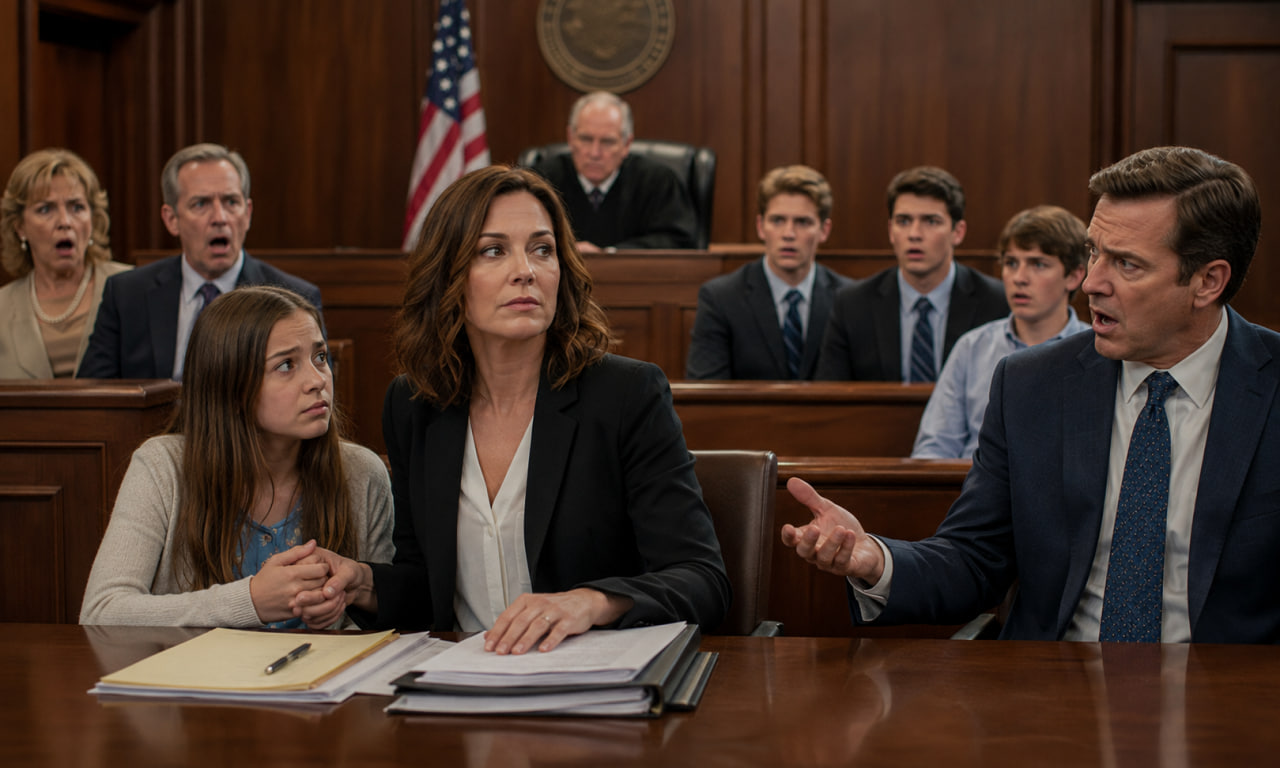
“But you suspect Richard.”
“Yes.”
I stood.
“Then why wasn’t he arrested?”
“Because suspicion isn’t evidence.”
“What about the documents?”
“They proved financial crimes.”
“Not murder.”
Samuel shook his head.
“We needed the final piece.”
I looked at the USB drive.
“This?”
“Yes.”
I handed it to him.
He plugged it into an old laptop.
The screen lit up.
There was one folder.
Password protected.
Samuel typed something.
Nothing happened.
He tried another.
Still nothing.
I frowned.
“What password?”
“Your father never told me.”
“Then how do we open it?”
Samuel looked at me.
“He told me one thing.”
“What?”
“If Claire ever finds the drive, she’ll know.”
I stared at the screen.
Then I remembered.
My father used to call me by a nickname.
A nickname nobody else knew.
I typed it.
The folder opened.
Samuel exhaled.
Inside were twelve files.
The first was a video.
I clicked it.
My father’s face appeared.
Older.
Tired.
Sitting at his desk.
My heart broke.
“Claire,” he said.
I covered my mouth.
His voice.
After eleven years.
It was really him.
“If you’re watching this, I’m gone.”
Lily began crying.
I pulled her against me.
My father’s voice continued.
“I don’t know what Richard will tell you.”
He paused.
“But I need you to understand something.”
“I never hated him.”
“I was afraid of him.”
The video continued.
“He has been stealing from Harlan Industrial through his father’s network. I discovered it. I confronted him.”
My father looked down.
Then back into the camera.
“Richard threatened me.”
My breath stopped.
“He told me that if I went to the police, Claire would suffer.”
The video ended.
I stared at the blank screen.
Samuel whispered:
“There’s more.”
The next file contained audio.
Richard’s voice.
I recognized it instantly.
Even though the recording was eleven years old.
“You should let this go.”
My father’s voice answered.
“No.”
“You don’t understand.”
“I understand perfectly.”
“You’re going to destroy your daughter’s life.”
“I won’t let you destroy hers.”
There was silence.
Then Richard spoke.
“If you make me choose between the money and Claire…”
He stopped.
My father asked:
“What?”
Richard answered:
“I’ll choose the money.”
The recording ended.
I felt sick.
For twenty-two years, I had slept beside a man who had once said those words.
A man my father had feared.
A man who had now transferred millions into our children’s names.
The pieces came together.
The money.
The companies.
The threats.
The divorce.
It wasn’t about losing control of the marriage.
Richard was trying to protect himself.
I turned toward Samuel.
“What do we do now?”
He looked at me.
“We take everything to the authorities.”
Three days later, federal investigators entered Hale Construction.
Richard was in his office when they arrived.
His attorney tried to stop them.
He couldn’t.
The search lasted nine hours.
Computers were seized.
Documents were removed.
Bank records were subpoenaed.
And then investigators found something neither Richard nor I expected.
A second set of books.
Hidden behind a false wall.
They showed that the $1.8 million was only a fraction of what Richard had moved.
The total exceeded $6 million.
Six million dollars.
Money that had disappeared over the course of twelve years.
And beside several transactions was one recurring name.
Victor Hale.
Richard’s father.
But Victor had been dead for seven years.
Which meant Richard had continued the operation after his father’s death.
The investigators also found payments to a former employee who had worked for my father eleven years earlier.
That employee eventually confessed.
He had helped Richard obtain access to my father’s financial records.
And on the night before my father’s death, Richard had visited him.
Richard denied it.
But security footage from a neighboring property showed his car.
The case changed overnight.
It was no longer simply divorce.
It became a criminal investigation.
Richard was arrested two weeks later.
Not for murder.
Not yet.
For fraud, money laundering, falsifying business records, and illegal transfers.
The arrest made the local news.
Our family became a headline.
But I stopped caring what people thought.
For twenty-two years, I had protected Richard’s reputation.
Now I was protecting my children.
The hardest part wasn’t the court.
It was my sons.
Ethan came to see me first.
He sat across from me at the kitchen table.
“I hate what I did.”
I didn’t answer.
He looked at his hands.
“Dad told me you were trying to destroy him.”
“I know.”
“I believed him.”
“I know.”
“I signed papers.”
“Yes.”
“I helped him.”
I nodded.
Then he began to cry.
“I don’t deserve you to forgive me.”
I reached across the table.
“You’re right.”
He looked surprised.
I continued.
“But that doesn’t mean I stopped loving you.”
His face collapsed.
He stood and hugged me.
For the first time in months, I hugged my son back.
Caleb came next.
He brought the handwritten list he’d given me.
“I want to cooperate with the investigators.”
I looked at him.
“Are you sure?”
He nodded.
“Dad needs to face what he did.”
“And you?”
“I need to face what I did too.”
Noah was the hardest.
He was only seventeen.
He had believed his father completely.
He had defended him fiercely.
One evening, he came to my house.
He stood outside the door for almost a minute before knocking.
I opened it.
He looked terrified.
“Mom?”
“Yes?”
“Can I come in?”
I stepped aside.
He walked into the living room.
Lily ran toward him.
They hugged.
Noah cried into her shoulder.
“I was so stupid.”
Lily whispered:
“You didn’t know.”
“I should have.”
She shook her head.
“We all believed Dad.”
I watched them.
My children.
Still my children.
Broken.
But together.
Months passed.
The investigation continued.
Richard’s attorneys fought every accusation.
They tried to claim the companies were legitimate.
They tried to blame his father.
They tried to blame me.
But the records told the truth.
Eventually, Richard accepted a plea agreement.
He admitted to financial crimes.
He admitted to hiding marital assets.
He admitted to using the names of our sons.
But he never admitted to involvement in my father’s death.
The murder investigation remained open.
Then, one morning, Samuel called.
“We found something.”
I met him at the courthouse.
He handed me a photograph.
It showed a pharmacy receipt from eleven years earlier.
The medication listed was a prescription drug that my father had never been prescribed.
The receipt had been purchased by a man using Richard’s driver’s license number.
Richard had claimed his license was stolen that week.
But investigators found another document.
A hotel registration.
Same date.
Same license number.
Same handwriting.
Richard had been there.
The evidence wasn’t enough for an immediate murder charge.
But it was enough to reopen the case formally.
And for the first time, I believed the truth might actually come out.
A year after the divorce began, I returned to the same courtroom.
This time, Richard was sitting behind the defense table.
No expensive suit.
No confident smile.
No country-club arrogance.
Just a tired man in a gray prison uniform.
Judge Morrison looked older.
So did I.
The judge reviewed the final financial settlement.
The house was sold.
The company was divided.
The hidden assets were recovered where possible.
My sons’ accounts were dissolved under court supervision.
The money wasn’t mine simply because Richard had stolen it from our marriage.
A large portion went toward creditors and legal obligations.
The remainder was divided according to the court’s orders.
But I didn’t care about the money anymore.
When Judge Morrison asked whether I had anything to say, I stood.
I looked at Richard.
“I spent twenty-two years believing marriage meant protecting each other.”
Richard looked down.
“I thought loyalty meant staying quiet.”
I took a breath.
“I was wrong.”
I looked toward my children.
“Loyalty doesn’t mean protecting someone from the consequences of their choices.”
Then I looked back at Richard.
“It means protecting the people they hurt.”
Richard finally raised his eyes.
For a moment, I saw regret.
Real regret.
But it came too late.
Judge Morrison finalized the divorce.
Just like that, twenty-two years ended with a signature.
Three months later, something unexpected happened.
Ethan called me.
“Mom?”
“Yes?”
“Can you come over?”
“Why?”
“I want to show you something.”
I drove to his apartment.
He handed me an envelope.
“What is this?”
“Open it.”
Inside was a photograph.
All four children.
Ethan.
Caleb.
Noah.
Lily.
They were sitting around our old dining table.
Smiling.
I stared at the picture.
“When did you take this?”
“Last weekend.”
“Why?”
Ethan smiled.
“Because we’re trying to be a family again.”
I started crying.
Lily walked into the room.
She hugged me from behind.
“We’re having Christmas at your house.”
I laughed through my tears.
“You already decided?”
“Yes.”
Caleb shouted from the kitchen:
“And I’m cooking.”
Noah called back:
“That’s why we’re ordering pizza.”
Everyone laughed.
For the first time in years, the sound didn’t hurt.
It healed something.
One year after Richard’s arrest, my father’s murder case was finally closed.
Investigators could not prove beyond a reasonable doubt that Richard had directly caused the death.
But they established that he had threatened my father, had obtained the medication used in the poisoning, and had been present shortly before my father’s death.
The case remained officially unresolved.
Richard never confessed.
But I didn’t need a confession to understand what my father had tried to tell me.
He had known.
He had tried to protect me.
And I had spent eleven years wishing I could go back and listen.
I couldn’t.
But I could listen now.
I could protect my children.
And I could make sure they never confused wealth with love again.
Two years after the divorce hearing, I stood in my kitchen making coffee.
Lily walked in wearing her graduation gown.
She was eighteen now.
I looked at her and almost didn’t recognize the little girl who had once held my hand in that courtroom.
“You look beautiful.”
She smiled.
“Mom.”
“What?”
“You’re crying.”
“I’m allowed.”
She laughed.
Then she hugged me.
“Grandpa would be proud.”
I closed my eyes.
“I think so.”
She pulled away.
“Are you happy?”
I looked around the kitchen.
There was no marble countertop.
No country-club view.
No expensive furniture.
Just a small house filled with photographs.
My children.
My grandchildren-to-be.
My life.
“Yes,” I said.
“I am.”
Lily smiled.
Then she handed me a small envelope.
“What’s this?”
“A letter.”
“From who?”
She shrugged.
“Read it.”
I opened it.
The handwriting was familiar.
My father’s.
It was another letter investigators had found in an old safe.
There were only three sentences.
Claire,
If you’re reading this, then you finally know the truth.
Don’t spend the rest of your life trying to punish the people who hurt you. Build a life so full of love that they become part of a past you no longer need to carry.
I pressed the letter against my chest.
Lily wrapped her arms around me.
And I finally understood something.
Richard thought he had won that day in court because he believed family could be divided like property.
He thought he could make me choose one child.
He thought money could buy loyalty.
He thought fear could control everyone forever.
He was wrong.
I didn’t choose between my sons.
I chose all my children.
I chose the truth.
And, finally, I chose myself.
Years later, people would still ask me what happened in that courtroom.
They would remember the moment my husband told me to pick one of our three sons.
They would remember how everyone laughed when I said, “None.”
But they wouldn’t know what I learned afterward.
Sometimes the most powerful answer isn’t choosing one side.
Sometimes it’s refusing to let someone turn the people you love against each other.
And sometimes, when someone believes they have taken everything from you, the greatest revenge isn’t destroying them.
It’s rebuilding your life without them.
My father couldn’t come back.
Twenty-two years of marriage couldn’t be restored.
My children’s childhood couldn’t be rewritten.
But the future was still mine.
And for the first time in a very long time…
I wasn’t afraid of it.
I was ready for it.