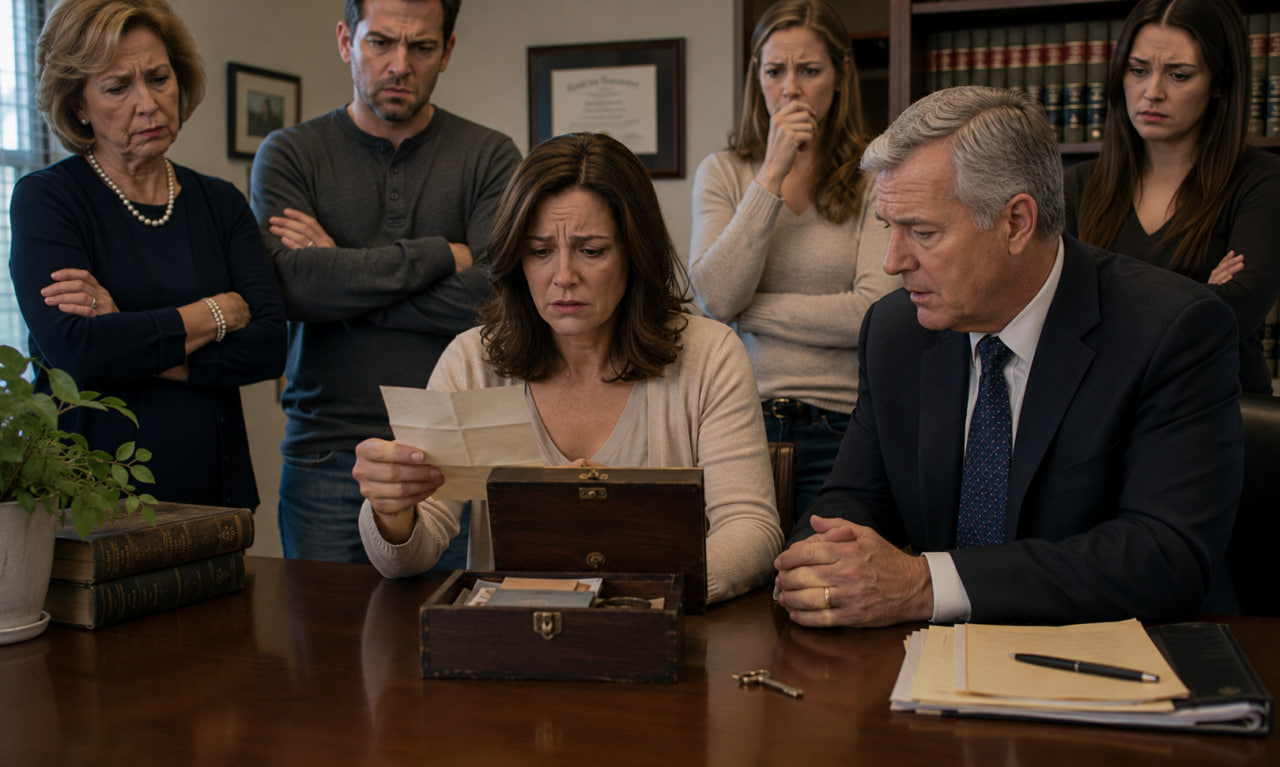
Vanessa entered two minutes later.
At 9:07, Vanessa left.
At 9:11, Derek left.
At 9:15, a nurse entered.
At 9:18, another doctor rushed into the room.
At 9:32, Margaret’s heart stopped.
I felt dizzy.
“They were there.”
Harrison nodded.
“But that’s not enough.”
“No.”
“We need proof of intent.”
We had the photograph.
The video.
The financial records.
The threatening messages.
But we still needed the medication.
Harrison made one call.
Then another.
By evening, a detective was sitting across from us.
Detective Samuel Reed was a quiet man with gray hair and tired eyes.
He listened to everything.
When we finished, he looked at me.
“Mrs. Dawson, I need to ask you something difficult.”
“Ask.”
“Did Margaret ever tell you she was afraid of her son?”
I thought about it.
“Yes.”
“When?”
“About six months ago.”
“What did she say?”
“She said, ‘If anything happens to me, don’t trust Derek.’”
Reed wrote something down.
“Why didn’t you report that?”
“Because I thought she was afraid because she was sick.”
He nodded.
“Many people would.”
Then he looked at the photograph.
“Where did this come from?”
“My phone.”
“Who sent it?”
“An unknown number.”
“Can you forward it to me?”
“Yes.”
He studied the image.
“We’ll investigate.”
I reached into my purse.
“I have something else.”
I handed him Margaret’s letter.
He read it carefully.
Then he looked up.
“Where is Derek now?”
“I don’t know.”
Reed’s phone rang.
He answered.
His expression changed.
“Where?”
He listened.
“Don’t let him leave.”
He hung up.
“Mr. Dawson is at the airport.”
“Derek?”
“He’s trying to leave the country.”
I didn’t know what I expected to feel when I saw him again.
Anger.
Fear.
Hatred.
Instead, I felt nothing.
Derek was standing near the international departure gates when police approached him.
He saw me behind them.
His face changed.
“Elena?”
I said nothing.
“What are you doing here?”
Detective Reed stepped forward.
“Mr. Dawson, we’d like to ask you some questions.”
“I don’t have time.”
“You do now.”
Derek looked at me.
“You called the police?”
I shook my head.
“No.”
“Then who did?”
I didn’t answer.
He stepped closer.
“You don’t understand what you’re doing.”
“I understand more than I did yesterday.”
His eyes narrowed.
“What did my mother tell you?”
“Everything.”
His face went pale.
For the first time in twenty years, I saw genuine fear in my husband’s eyes.
Then he whispered:
“She was sick.”
“She was.”
“She was dying.”
“She was.”
“I didn’t kill her.”
I looked at him.
“I didn’t accuse you.”
He stopped speaking.
Detective Reed watched him carefully.
“You just did.”
Derek’s mouth opened.
Nothing came out.
Then his phone rang.
Vanessa.
The name appeared on his screen.
Detective Reed saw it.
“Answer it.”
Derek didn’t move.
“Answer it.”
He did.
“Hello?”
Vanessa’s voice was loud enough for us to hear.
“Derek, they know.”
His face drained of color.
“Who?”
“The police.”
A pause.
“Where are you?”
“At the airport.”
“Don’t tell them about the money.”
Derek looked at me.
Vanessa continued.
“Especially don’t tell them about the second account.”
The call ended.
Detective Reed took the phone.
Derek didn’t resist.
The second account became the key.
It contained nearly $800,000.
Money transferred from Derek’s business account over eighteen months.
Some went to Vanessa.
Some went to offshore accounts.
Some went toward gambling debts.
And a significant amount had been transferred three days before Margaret’s death.
The transfer description read:
FINAL PAYMENT
The recipient was a private company owned by Vanessa’s brother.
Reed obtained the records.
Then came the final piece.
The hospital pharmacy discovered that a bottle of medication had been removed from the hospital supply room under Derek’s visitor authorization.
The bottle number matched the medication in the photograph.
Derek had taken it.
He had brought it to Margaret.
But Margaret had secretly switched the bottle.
The medication he intended to give her had never entered her bloodstream.
That fact saved the case.
The doctors reopened the death investigation.
Toxicology was performed on the remaining medication.
It contained a dangerous concentration of a drug Margaret had not been prescribed.
Derek had planned to make her heart failure worse.
But Margaret had been one step ahead.
She had survived the attempt long enough to expose him.
And when she knew her time was ending naturally, she made sure I would have the evidence.
Derek was arrested.
Vanessa was arrested two days later.
The charges were complicated.
Financial fraud.
Embezzlement.
Attempted murder.
Conspiracy.
And several other offenses connected to the company.
For months, the legal battle consumed my life.
But I didn’t attend every hearing.
I didn’t need to.
Harrison handled the trust.
The company survived.
The employees kept their jobs.
And Margaret’s money was protected.
But there was one thing I still had to do.
I went back to our house.
My house.
The same house Derek had told me wasn’t really mine.
The same fireplace where Margaret’s white urn had sat.
I placed her ashes in a small garden beneath an old flowering tree.
I sat beside her.
“I wish you had told me sooner,” I whispered.
The wind moved through the branches.
“I would have helped you.”
I paused.
“Actually…”
I smiled through my tears.
“You know I would have.”
A few weeks later, the divorce became final.
Derek sent me one letter.
Only one.
He wrote that he was sorry.
He wrote that he had been angry.
He wrote that he had made mistakes.
He wrote that he still loved me.
I read the letter once.
Then I placed it in a drawer.
I didn’t forgive him.
Not yet.
Maybe not ever.
But I no longer hated him either.
Because hatred was another way of allowing him to occupy space in my life.
I had spent twenty years being his wife.
I wasn’t going to spend another twenty years being his victim.
Six months after Margaret’s death, I received an envelope.
Inside was a photograph.
It was an old picture of Margaret and me.
We were standing in the kitchen.
I was laughing.
She was pretending to look annoyed.
On the back, she had written:
My daughter.
I cried for a long time.
Then I did something I hadn’t done in years.
I laughed.
I opened the windows.
I made coffee.
I played music.
And I started living.
The house felt different.
Not because Derek was gone.
Because I finally understood that it had never truly been his house.
It had been the place where Margaret had raised her son.
The place where I had cared for her.
The place where she had quietly protected me.
And now it was the place where I could begin again.
A year later, I turned one of the rooms into a small office.
Harrison helped me establish a foundation using part of Margaret’s estate.
We called it the Margaret Whitmore Foundation.
Its purpose was simple:
Help caregivers who had spent years taking care of family members without financial support.
The first scholarship went to a woman named Patricia.
She had cared for her disabled husband for sixteen years.
She had never been paid.
She had never complained.
When I handed her the check, she started crying.
“I don’t know how to thank you.”
I smiled.
“You don’t have to.”
And for a moment, I understood exactly why Margaret had done what she did.
Money hadn’t been the gift.
The gift was being seen.
Being believed.
Being told that your sacrifices mattered.
Two years after Margaret’s death, I visited the cemetery.
Her grave was covered with flowers.
I placed a small silver key on the stone.
The same key she had pressed into my palm on her final night.
I sat there for a while.
Then I whispered:
“You saved me.”
The wind moved softly through the trees.
I smiled.
“No.”
I corrected myself.
“You taught me how to save myself.”
I stood and wiped my eyes.
Before leaving, I looked back at her name.
Margaret Elaine Whitmore.
Mother.
Daughter.
Friend.
Protector.
I thought about that first night.
The thirty phone calls.
The ocean waves behind Derek’s voice.
The woman’s laughter.
The white urn.
The divorce papers.
The tiny silver key.
At the time, I thought my life was falling apart.
I didn’t understand that it was finally coming back together.
I had believed Margaret’s death was the end of my family.
Instead, it became the beginning of the life she had spent years trying to give me.
A life without fear.
A life without excuses.
A life where I didn’t have to make myself smaller to keep someone else comfortable.
As I walked toward my car, my phone rang.
It was Patricia.
She had received her first paycheck from the job she got after finishing her training.
“I just wanted to tell you,” she said, crying, “I finally bought something for myself.”
“What did you buy?”
“A new pair of shoes.”
I laughed.
“Why shoes?”
“Because for twenty years, I kept buying things for everyone else.”
I smiled.
“Then wear them proudly.”
“I will.”
We said goodbye.
I sat in my car for a moment.
Then I looked at the passenger seat.
For a second, I imagined Margaret sitting there.
Smiling.
Telling me to stop overthinking everything.
I laughed softly.
“I’m okay now.”
And somehow, saying those words made them true.
I started the engine.
The silver key was no longer a mystery.
It had opened the lockbox.
The lockbox had opened the truth.
And the truth had opened the door to my new life.
I drove home as the sun began to set.
For the first time in twenty years, I wasn’t driving back to a husband.
I wasn’t driving back to a marriage.
I wasn’t driving back to a life I had been afraid to leave.
I was driving home.
To myself.
And that was the final gift Margaret had left me.