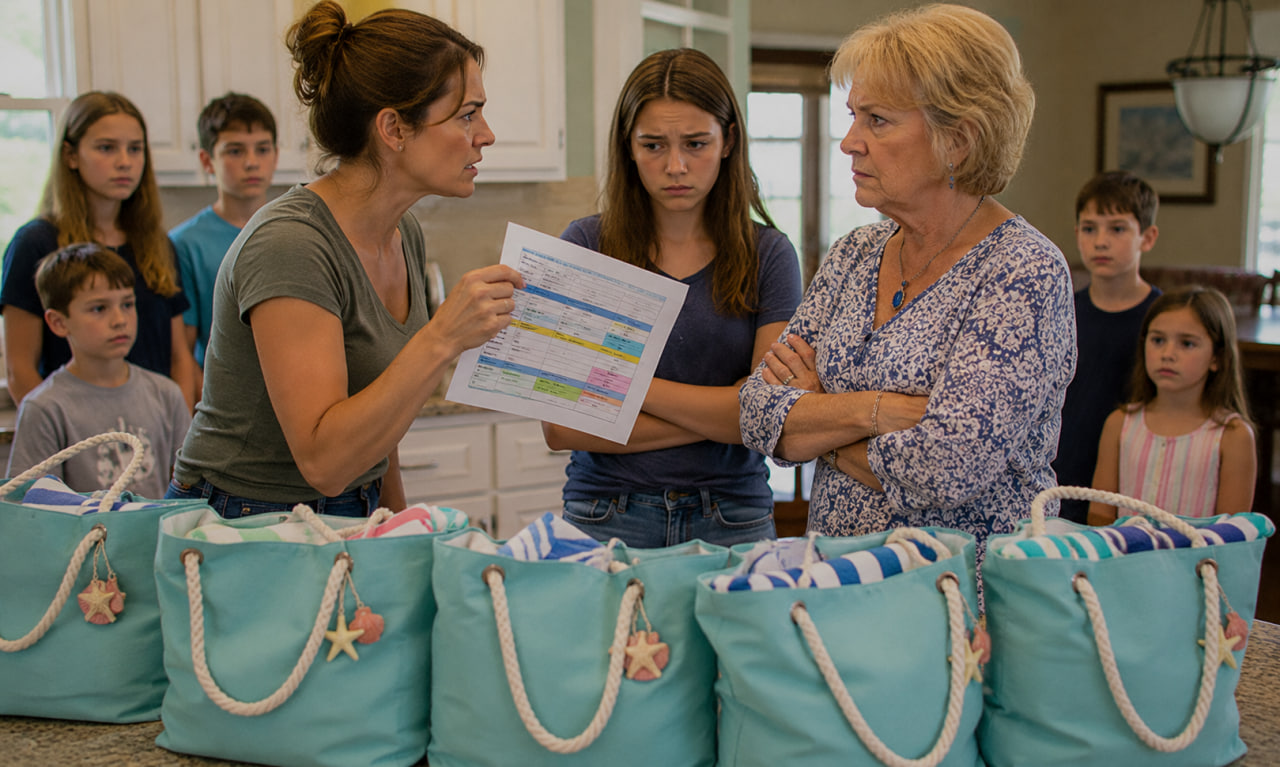
Mom looked down.
“And somehow I confused protecting you with making you responsible.”
I felt my chest tighten.
Mom continued.
“I told myself you were mature.”
She laughed bitterly.
“I told myself you were old enough to understand.”
Her voice broke.
“And every time you quietly accepted something the other children didn’t have, I told myself it was because you were strong.”
Emma whispered, “I wasn’t strong.”
Mom nodded.
“I know.”
“I was scared Grandma didn’t want me.”
Mom covered her mouth.
“I know.”
“And I kept trying to be good.”
“I know.”
Emma finally began crying.
Mom cried too.
“I am so sorry.”
Emma stood still.
Then she said something that made every adult in the room silent.
“I don’t need a bag.”
Mom looked at her.
“I don’t need the same things the little kids get.”
She wiped her face.
“I just wanted to know I mattered.”
Mom closed her eyes.
That was the moment she broke.
She walked forward slowly.
Emma didn’t move.
Mom opened her arms.
Emma hesitated.
Then stepped into them.
They held each other.
I turned away.
Not because I didn’t want to see.
Because sometimes people need privacy even in the middle of a family crisis.
That night, nobody went to the boat dinner.
The adults stayed at the beach house.
The children ate pizza on the porch.
The ocean was loud.
The wind pushed sand across the deck.
For the first time since we arrived, there was no schedule.
No assigned responsibilities.
No list.
Just family.
After dinner, Mom asked me to sit with her.
She brought the letter.
“I need to tell you the rest.”
I nodded.
She explained that Rebecca had eventually agreed to meet my father once.
It happened two years before he died.
The meeting lasted forty-three minutes.
Rebecca told him she didn’t hate him anymore.
But she didn’t want him in her life.
He accepted that.
He never told me because he was afraid I would feel betrayed.
He also never told Mom that he had written to Rebecca again.
Mom found out only after his death.
And then came the part that shocked me.
“Rebecca has a daughter,” Mom said.
I stared at her.
“What?”
Mom nodded.
“Her name is Claire.”
“Does Claire know about us?”
“I don’t know.”
“Does Rebecca know about me?”
“Yes.”
My heart began pounding.
“How?”
“Your father sent her photographs.”
I thought about all the family photographs.
Emma as a baby.
Emma at five.
Emma at ten.
Emma on her first day of middle school.
All the photos Dad had loved.
He had apparently sent copies to a daughter I had never known existed.
I looked at the ocean.
“So she knows who I am.”
Mom nodded.
“And she knows Emma.”
That night, after everyone went to bed, I sat on the porch alone.
Emma came outside.
She wrapped herself in a blanket.
“Can’t sleep?”
“No.”
She sat beside me.
For a while, we listened to the waves.
Then she asked:
“Do you think Aunt Rebecca hates us?”
“I don’t know.”
“Do you hate her?”
“No.”
“Are you angry at Grandpa?”
I thought about it.
“Yes.”
“Me too.”
I smiled slightly.
“That’s okay.”
Emma leaned against my shoulder.
Then she said:
“I think Grandpa wanted me to have the bag.”
I looked at her.
“Why?”
“Because he knew Grandma would forget.”
I laughed softly.
“That sounds like something he’d do.”
Emma smiled.
Then she asked:
“Can I still have one?”
I looked toward the six aqua bags.
“Absolutely.”
She laughed.
“But not because Grandma gives you one.”
“No?”
“No.”
I stood.
“We’re buying you the biggest, ugliest beach bag in North Carolina tomorrow.”
Emma laughed so hard she nearly dropped the blanket.
The next morning, Mom knocked on Emma’s door.
She was holding something.
Not an aqua bag.
A photograph.
She handed it to Emma.
It was a picture of my father holding Emma when she was a baby.
On the back was writing.
My favorite girl.
Emma stared at it.
Then she hugged the photograph against her chest.
Mom whispered:
“He loved you very much.”
Emma nodded.
“I know.”
Mom hesitated.
“Can I ask you something?”
Emma looked up.
“Sure.”
“Would you like to go to the beach with me?”
Emma smiled.
“Okay.”
“Just you and me.”
Emma nodded.
Mom’s eyes filled again.
“No babysitting.”
Emma laughed.
“No babysitting.”
“No chores.”
“Okay.”
“No being the responsible one.”
Emma smiled.
“Deal.”
Mom looked at me.
I nodded.
Something had changed.
Not everything.
But enough.
Three weeks after the trip, Mom found Rebecca.
She didn’t call her.
She wrote a letter.
A real letter.
She explained everything.
She apologized.
She didn’t ask for forgiveness.
She simply told Rebecca that she finally understood what her absence had done to the family.
Two months later, a letter arrived.
From Rebecca.
She wasn’t ready to meet.
But she had written back.
She said she had heard about Emma.
She said she had heard about the beach trip.
And then she wrote one sentence that Mom read to me over the phone.
Maybe the little girl doesn’t have to carry the mistakes of the people who came before her.
Mom cried when she read it.
So did I.
A year later, Rebecca agreed to meet.
Not at Mom’s house.
Not at mine.
At a quiet coffee shop halfway between our cities.
I arrived first.
Mom sat beside me.
Emma sat across from us, nervous.
Then the door opened.
A woman walked in.
She looked like Dad.
Not exactly.
But enough.
Same eyes.
Same crooked smile.
Same habit of pushing her hair behind her ear when she was nervous.
She stopped when she saw us.
Nobody moved.
Then Emma stood.
“Hi.”
Rebecca looked at her.
Her eyes immediately filled with tears.
“Hi.”
Emma smiled.
“I’m Emma.”
Rebecca laughed softly through her tears.
“I know.”
They hugged.
Mom began crying.
I did too.
Rebecca looked at me.
For a moment, neither of us knew what to say.
Then she smiled.
“You look like him.”
“So do you.”
We laughed.
And just like that, thirty-four years of silence became a conversation.
Not an easy one.
Not a perfect one.
But a beginning.
The following summer, we returned to the Outer Banks.
Mom rented the same house.
But this time, she made one change.
She brought seven beach bags.
Not six.
Seven.
They were all different.
One was pink.
One was yellow.
One was green.
One was blue.
One had flamingos.
One had sharks.
And Emma’s was enormous and bright orange.
She laughed when she saw it.
“Grandma, this is hideous.”
Mom smiled.
“I know.”
“Why did you buy this?”
“Because you said you wanted the biggest one.”
Emma looked at me.
I shrugged.
Mom cleared her throat.
“And because I wanted you to know I counted you.”
Emma’s smile faded slightly.
Then she walked over and hugged her.
Mom held her tightly.
“I love you,” Mom whispered.
“I love you too.”
This time, there was no hesitation.
No pretending.
No hidden condition.
Just love.
That evening, all seven grandchildren ran toward the ocean.
Seven bags sat in a row on the sand.
Seven children.
Seven towels.
Seven pairs of sunglasses.
Seven sets of footprints leading toward the water.
I stood beside Mom.
She looked at the bags.
Then at the children.
“Seven,” she whispered.
I smiled.
“Seven.”
She nodded.
“Never six again.”
I squeezed her hand.
“Never six again.”
Behind us, Emma turned around.
“Mom!”
“What?”
She held up the orange bag.
“Come on!”
I laughed.
“Coming.”
And I ran toward the ocean.
Because sometimes families don’t break because someone leaves.
Sometimes they break because someone stays silent.
And sometimes, if you’re lucky, someone finally asks the question everyone has been avoiding.
Why is there only room for six?
That question changed our family.
It brought a hidden sister home.
It gave my mother the courage to admit she had been wrong.
It taught Emma that being older didn’t mean being less deserving.
And it taught me something I should have known all along:
A child should never have to become useful to earn a place at the table.
The seven bags remained on the beach long after the children ran into the waves.
Seven bright little reminders that nobody in our family would ever again be counted as an afterthought.