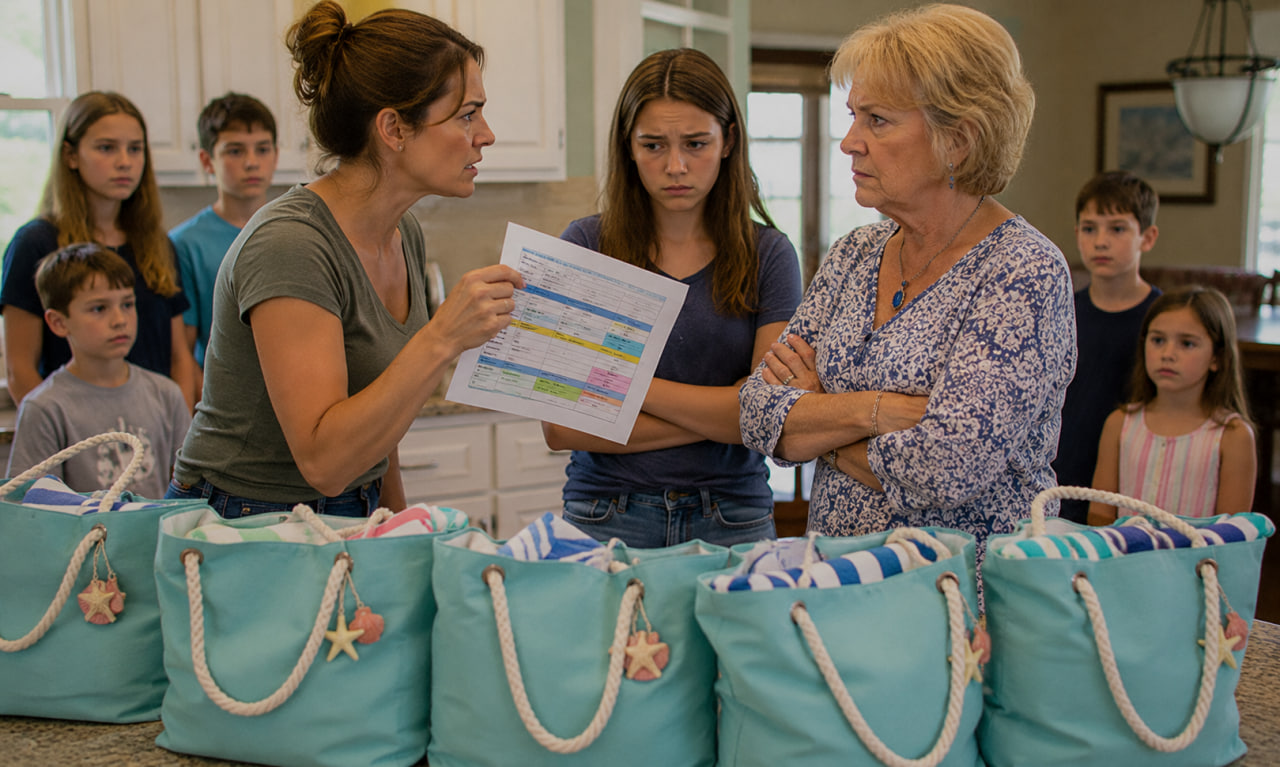
I called Mom.
“Where’s Emma sleeping?”
She appeared behind me.
“Down here.”
“No.”
“Rachel—”
“She is not sleeping in a hallway.”
“She likes staying up late.”
“She also likes having walls.”
Mom sighed.
“There isn’t another bed.”
I looked upstairs.
“There are six beds for six children.”
“Yes.”
“And seven grandchildren.”
Mom said nothing.
I walked into the bunk room.
There were three bunk beds.
Six mattresses.
One empty corner.
I stared at the space.
Then I looked at the room chart.
I understood.
This wasn’t accidental.
Someone had decided Emma didn’t need a place.
She could use the pullout.
She could help with the children.
She could sleep nearby.
She could sit out.
She could be the responsible one.
She could be the almost-adult.
Except nobody had asked her if she wanted to be.
I went downstairs.
Emma was standing near the window.
“Mom?”
“Pack your things.”
She looked confused.
“Where are we going?”
“To a hotel.”
Her eyes widened.
“What?”
“I’m not letting you sleep in a hallway.”
Mom came running.
“You’re leaving?”
“Yes.”
“Rachel, this is ridiculous.”
“No.”
I looked around the house.
“You rented this place for seven grandchildren, but somehow forgot to make room for one.”
Mom’s face changed.
For the first time, I saw something other than irritation.
I saw fear.
Not fear of losing the vacation.
Something else.
Before I could ask what it was, the front door opened.
Dad’s old friend, Mr. Harris, stepped onto the porch.
He was nearly seventy and had driven down separately.
He looked at Mom.
Then at me.
Then at Emma.
His eyes stopped on the six aqua bags.
He frowned.
“Diane.”
Mom stiffened.
“What?”
“Where’s the seventh?”
Nobody answered.
Mr. Harris looked at Emma.
Then back at Mom.
He shook his head slowly.
“You’re still doing this?”
My mother’s face went completely pale.
I looked at him.
“What does that mean?”
He seemed to realize he had said too much.
“Nothing.”
“No.”
I stepped closer.
“What does that mean?”
Mom whispered, “Harris, please.”
He looked at Emma.
Then at me.
Finally, he said something that changed everything.
“Your mother promised your father she would never let Emma feel what he felt.”
I stared at him.
“My father?”
Mr. Harris nodded.
“Before he died.”
Emma came closer.
“Mom?”
I looked at Mom.
“What is he talking about?”
Mom’s eyes filled with tears.
But she still didn’t answer.
Mr. Harris did.
“Your father had another child.”
The room went silent.
Emma stopped breathing for a second.
I felt the floor shift beneath me.
“What?”
Mom whispered, “Harris.”
But he continued.
“Your father had a daughter before you were born.”
I looked at my mother.
“No.”
She closed her eyes.
I shook my head.
“No. Dad had no other children.”
Mom opened her eyes.
“He did.”
“Where is she?”
Mom looked toward the ocean.
And then she said the name I had never heard before.
“Rebecca.”
Emma whispered, “Who is Rebecca?”
Mom looked at her.
And for the first time that day, she didn’t call her honey.
She didn’t tell her she was old enough to understand.
She simply cried.
“Your aunt.”
My daughter looked at me.
I couldn’t speak.
Then Mr. Harris added quietly:
“And that’s why your mother has spent fourteen years treating Emma differently.”
I looked at Mom.
“Why?”
She wiped her face.
“Because your father left Rebecca behind.”
I felt anger rise in my chest.
“That has nothing to do with Emma.”
Mom shook her head.
“You don’t understand.”
“Then explain it.”
She looked at Emma.
Then at me.
And finally said:
“I was afraid your father would do the same thing to her.”
I stared at her.
“What are you talking about?”
Mom’s voice broke.
“Because Emma isn’t the only child in this family who was left behind.”
She walked to the kitchen counter.
She opened a drawer.
From underneath a stack of napkins, she pulled out a small envelope.
There was a name written across it.
Rebecca Cole.
And beneath it, in my father’s handwriting:
For the day Rachel finally asks why.
PART 4
For several seconds, I could only stare at the envelope.
My father’s handwriting was unmistakable.
I had seen it on birthday cards, grocery lists, Christmas tags, and the ridiculous notes he used to leave on the refrigerator when I was a child.
The same slanted letters.
The same heavy pressure on the pen.
But I had never seen that name.
Rebecca.
My half-sister.
My father’s daughter.
A person who had apparently existed before me and somehow remained a secret for thirty-four years.
I looked at Mom.
“Why didn’t Dad ever tell me?”
She lowered herself into one of the dining chairs.
“Because he was ashamed.”
“Of what?”
She looked down at her hands.
“Of leaving her.”
Mr. Harris quietly closed the front door behind him.
The children were still outside.
For the moment, we were alone.
I picked up the envelope.
“Can I open this?”
Mom nodded.
I carefully tore it open.
Inside was a single folded letter.
The paper was old.
Yellow around the edges.
My hands trembled as I unfolded it.
The first line nearly stopped my heart.
Rachel,
If you’re reading this, your mother finally decided you were old enough to know the truth.
I looked at Mom.
She looked away.
I continued.
Before you were born, I had a daughter named Rebecca.
I loved her.
That’s the first thing I need you to understand.
My throat tightened.
I also failed her.
I kept reading.
My father explained that Rebecca had been born when he was twenty-two.
Her mother, Claire, was eighteen.
They were young.
They weren’t married.
And when Claire became pregnant, my father panicked.
His parents pressured him to leave.
He did.
Claire raised Rebecca alone.
Years later, my father married my mother.
Then I was born.
He tried to find Rebecca.
But by then, Claire had moved.
Letters were returned.
Phone numbers changed.
Eventually, my father found an address.
He wrote.
Rebecca never answered.
He tried again.
Nothing.
Then, years later, he finally discovered that Rebecca had been living only two states away.
By then, she was an adult.
She had her own family.
She had no desire to meet him.
The letter continued.
I don’t blame her.
She had every right to hate me.
I swallowed hard.
Then I reached the line that changed everything.
But there is something I have never told your mother.
I am afraid I have repeated the same mistake without realizing it.
I looked at Mom.
She covered her mouth.
I kept reading.
Rachel is the child I stayed for.
Rebecca was the child I left.
And because of that, I have spent my entire life being terrified that someone will someday make Rachel feel like Rebecca felt.
My eyes filled.
Then:
If I am gone when you read this, please make sure Emma never becomes the “responsible one” simply because she is older.
I stopped.
Emma.
My daughter.
My father had written her name.
Before he died.
I read the next paragraph.
She is going to be fourteen soon. She will probably act like she doesn’t need anyone. She will say she’s fine. She will help with the younger children. She will tell you she doesn’t care when someone forgets her.
Don’t believe her.
A tear fell onto the paper.
I couldn’t see the next line clearly.
I wiped my eyes.
Don’t make my granddaughter earn belonging by being useful.
I failed Rebecca once. I don’t want our family to fail another girl.
The letter ended with:
Love, Dad.
I folded it.
For a moment, nobody spoke.
Then Emma asked quietly:
“Grandpa knew?”
Mom nodded.
“He knew.”
“Did he know Grandma treated me differently?”
Mom began crying.
“He did.”
Emma looked confused.
“Why?”
Mom stood.
She walked toward my daughter.
Emma instinctively stepped back.
Mom stopped.
She didn’t reach for her.
She simply stood there.
“I was afraid,” Mom said.
“Of me?”
“No.”
“Then what?”
Mom wiped her eyes.
“Of becoming your grandfather.”
Emma looked at her.
Mom continued.
“Your grandfather spent his whole life regretting that he abandoned Rebecca. After he found her again, she wanted nothing to do with him. He carried that guilt until the day he died.”
She took a breath.
“When you were born, I promised myself I would protect you from ever feeling unwanted.”
Emma’s face softened.
“But then you grew up.”