Then she raised her hand.
Took the oath.
And told the truth.
The whole truth.
She described Dad asking why he was there.
She described him confusing the paperwork with other matters.
She described him repeatedly mentioning the grandchildren.
Then came the question.
The one everyone had been waiting for.
“Did your father read the beneficiary change document before signing it?”
My sister swallowed.
“No.”
The courtroom went silent.
The advisor’s attorney stood immediately.
But the damage was already done.
Then the judge asked a question himself.
“Did your father appear confused?”
My sister looked toward Debra.
Then back at the judge.
“Yes.”
The answer hung in the air.
The financial advisor shifted in his seat.
For the first time all morning, he looked nervous.
Then my attorney introduced the advisor’s own meeting notes.
The notes he never expected anyone else to read.
The judge adjusted his glasses.
Read a line.
Then read it again.
Out loud.
“Client confused but cooperative.”
The room froze.
Even the advisor looked stunned hearing the words spoken aloud.
My attorney walked to the witness stand.
“Did you write that?”
The advisor nodded.
“Yes.”
“At the time of the beneficiary change?”
“Yes.”
“And despite documenting confusion, you still approved the transaction?”
No answer.
The judge wasn’t pleased.
Neither was the courtroom.
Then things got worse.
Much worse.
Medical records were introduced showing Dad’s Alzheimer’s diagnosis months before the meeting.
Neurologist reports.
Memory assessments.
Treatment notes.
All showing significant cognitive decline.
By the end of the day, the picture was clear.
Dad wasn’t managing complex financial decisions.
He was struggling to remember the decade.
The judge recessed until the following week.
Those seven days felt like seven years.
Finally, decision day arrived.
The judge spoke for nearly twenty minutes.
Then came the ruling.
The beneficiary change was invalid.
The court found substantial evidence that Dad lacked the capacity to understand the transaction.
The annuity would revert to the prior beneficiary designation.
I closed my eyes.
Not because of the money.
Because Dad’s wishes mattered.
They had finally been heard.
Then the judge said something unexpected.
He ordered copies of the case file forwarded to state regulators for review of the advisor’s conduct.
The advisor’s face turned white.
My stepmother started crying.
And for the first time since Dad died, I felt something other than anger.
Relief.
Outside the courthouse, my sister approached me.
Slowly.
Carefully.
“I should have stopped it,” she said.
I nodded.
“Yes.”
Tears filled her eyes.
“I was afraid.”
“I know.”
For a long moment, neither of us spoke.
Then she whispered,
“I’m sorry.”
This time, I believed her.
The money eventually went where Dad always intended.
Into trusts for the grandchildren.
College funds.
Future opportunities.
A legacy.
Just like he’d talked about every Christmas.
And whenever I think about the case, I don’t remember the lawyers.
Or the judge.
Or the courtroom.
I remember Dad sitting in his recliner, smiling at the kids, saying the same words he’d repeated for years:
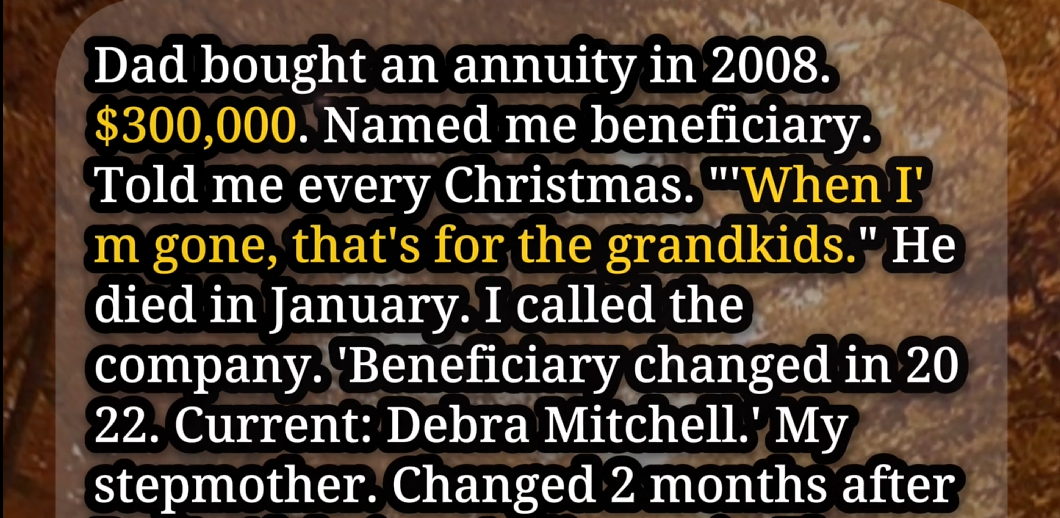
“When I’m gone, that’s for the grandkids.”
In the end, it was.
The End