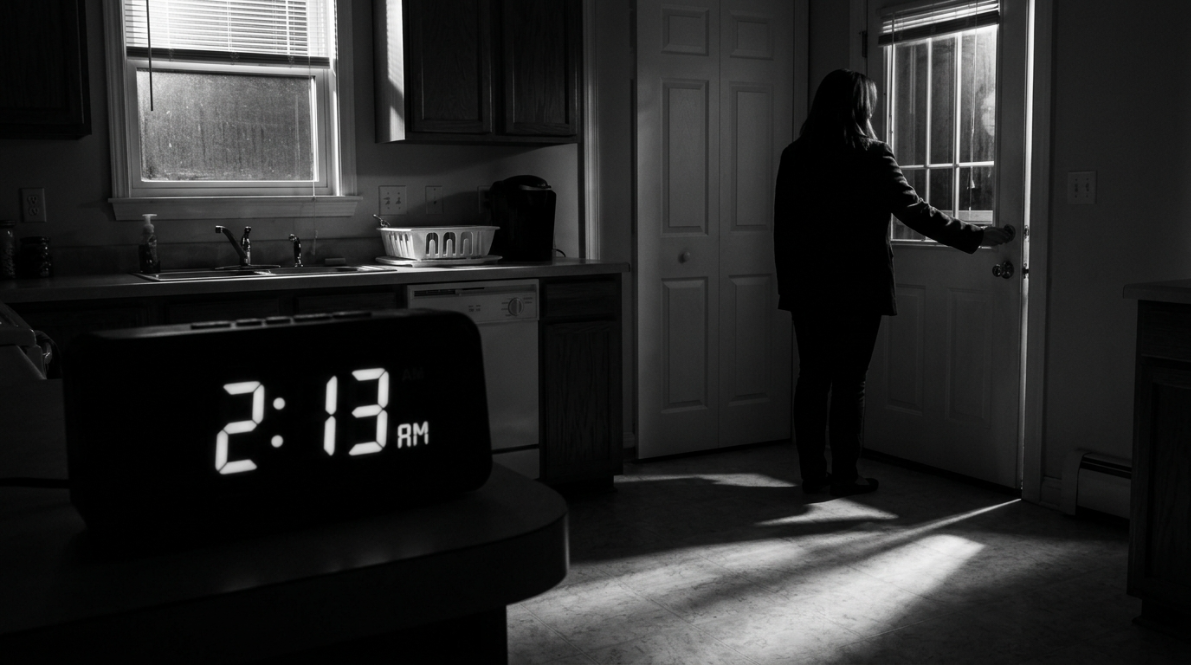
Every night at 2:13 a.m., while Leonard slept in his recliner, I practiced escaping the same 11.6-mile route to a women’s shelter and returned before his alarm. I never even went inside—I was only teaching myself how to leave after thirty-eight years of learning to move quietly around my own husband. Then I made one mistake: I forgot a $12.17 gas receipt in my coat. Leonard placed it beside my coffee the next morning, smiled, and said, “Try it and see.” That night, I buried my keys inside a bag of flour and waited for him to fall asleep. At 2:09, the hallway floor creaked. Four minutes later, three hard, measured knocks landed on the back door.
PART 3
I watched the narrow strip of light beneath the pantry door and saw his shadow stop.
“Gloria?”
His voice was different.
Not angry.
Worse.
Careful.
I looked down at my hands. White flour covered my fingers. My keys were hidden somewhere beneath twenty pounds of flour, and the emergency bag I’d packed was under the bed.
I had made a plan for leaving.
I had planned the road.
The gas.
The shelter.
The parking spaces.
I had even practiced opening the Buick door without making the latch click.
But I had never planned for someone to knock on the back door at 2:13 in the morning.
Leonard’s shadow moved away.
Then I heard him unlock the back door.
My stomach dropped.
The door opened.
Cold air entered the house.
“Who is it?”
No answer.
Leonard stepped outside.
I moved to the little pantry window and looked through the slats of the blinds.
At first, I saw nobody.
The backyard was black except for the weak yellow light above the door.
Then something moved near the fence.
A person.
A woman’s voice whispered, “Gloria?”
I knew that voice.
I nearly collapsed.
“Mrs. Alvarez?”
Leonard heard it.
“Who?”
The woman stepped into the light.
Mrs. Alvarez.
She was wearing a long gray cardigan over her nightgown, house slippers on her feet, and she was holding something in one hand.
She looked directly at Leonard.
“Sorry,” she said. “I thought I left my watering can over here.”
At two-thirteen in the morning.
A watering can.
Even Leonard seemed to understand how ridiculous it sounded.
His voice became suspicious.
“Your watering can?”
She smiled.
“At my age, I forget things.”
Leonard stared at her for a long moment.
Then he laughed.
It was that laugh he used when he wanted another person to know he was smarter than they were.
“You ought to get some sleep, Alma.”
“My name’s Elena.”
He knew her name.
He had known her name for twenty years.
I knew exactly why he called her Alma.
It was another little humiliation. One of the countless ones that accumulated over thirty-eight years until they became a wall.
Mrs. Alvarez didn’t correct him.
Instead, she looked over Leonard’s shoulder.
For half a second, her eyes met mine through the pantry window.
She had come for me.
I knew it immediately.
Leonard closed the door.
“Go back to bed, Gloria.”
I heard his footsteps retreat.
I stayed where I was.
One minute.
Two.
Three.
The television volume went up.
Then my phone buzzed.
I nearly screamed.
I pulled it from the pocket of my robe and stared at the screen.
There was one message.
No name.
Just a number.
THE ROAD ISN’T SAFE TONIGHT. DON’T GO TO THE SHELTER. COME TO MY HOUSE.
I stared at it until the words blurred.
Then another message arrived.
HE KNOWS ABOUT THE SHELTER.
My knees weakened.
I had never given the shelter number to anyone.
Not Mrs. Alvarez.
Not a friend.
Not a doctor.
No one.
I slowly slid down the pantry wall until I was sitting on the floor.
The house felt suddenly too small.
Every room seemed to have ears.
Every wall seemed to be listening.
I thought about the gas receipt.
“Try it and see.”
Maybe Leonard hadn’t been guessing.
Maybe he’d known for weeks.
Maybe my practice runs were exactly what he’d expected me to do.
And maybe the three knocks had nothing to do with Mrs. Alvarez.
Maybe she had only been trying to warn me.
I waited until nearly 2:40.
Leonard finally went to bed.
I heard the bedroom door close.
Then the lock.
He didn’t usually lock the bedroom door.
My fingers went cold.
I crawled to the pantry opening and listened.
Nothing.
I moved through the kitchen and took the flour bag from the shelf.
My keys were still there.
I pulled them out.
Then I stopped.
There was something wrapped around them.
A tiny piece of blue thread.
I hadn’t put it there.
I stared at it.
Then I remembered Mrs. Alvarez’s cardigan.
Gray.
With blue stitching around the cuffs.
She had touched my keys.
She had been in my kitchen.
Somehow.
At some point.
I carried the keys upstairs.
Our bedroom door was closed.
I stood outside it and listened.
Leonard was snoring.
I quietly opened the bathroom window and found the emergency bag where I’d hidden it behind the old towels.
My hands shook as I pulled out my birth certificate.
Then the photograph of Celia.
Then the envelope of money.
Four hundred and eighty dollars.
Thirty-eight years of marriage had taught me how to stretch every dollar.
But it had also taught me something else.
How little a person needed when they had finally decided they wanted to live.
I put on jeans.
A sweater.
My coat.
I took the shoes from the laundry room.
Then I opened the back door.
The cold Missouri air hit my face.
I stepped onto the porch.
And saw the tires.
Both front tires of my Buick were flat.
Not punctured.
Cut.
A clean slash in each one.
I backed away.
Someone had done it recently.
Very recently.
I looked toward the street.
A car was parked across from our house.
No headlights.
Engine running.
I couldn’t see the driver.
Then the car moved.
Slowly.
It passed my house without speeding up.
As it came beneath the streetlight, I saw the driver’s face.
Leonard.
My husband.
He was supposed to be asleep upstairs.
I watched his car disappear around the corner.
For several seconds, I couldn’t move.
Then I heard a whisper behind me.
“Gloria.”
I turned.
Mrs. Alvarez stood at the side gate.
This time she wasn’t pretending to have lost a watering can.
She held a flashlight in one hand and a small paper grocery bag in the other.
“Come with me,” she whispered.
“I can’t.”
“You can.”
“My car—”
“I know.”
“Leonard—”
“I know.”
I stared at her.
“How do you know?”
She stepped closer.
“Because he’s been doing this longer than you think.”
My throat tightened.
“Doing what?”
She glanced toward the street.
Then back at me.
“Watching.”
She reached into the grocery bag and pulled out a folded piece of paper.
“I found this in my mailbox.”
I opened it.
My name was written across the front.
GLORIA HAYES
Underneath it were three words.
LEAVE HER ALONE.
I looked up.
“Who wrote this?”
Mrs. Alvarez’s face had gone pale.
“I don’t know.”
A car engine sounded in the distance.
We both turned toward the street.
Mrs. Alvarez grabbed my wrist.
“Not here.”
She pulled me through the side gate and into her backyard.
I nearly fell.
“Where are we going?”
“My house.”
“Leonard will see.”
“He won’t.”
“How do you know?”
She looked at me with an expression I had never seen before.
“Because I’ve spent the last two weeks making sure he doesn’t.”
We crossed her backyard in darkness.
Her wind chime trembled above us.
Spoons tapped against one another.
For thirty-eight years, I’d heard that sound from my kitchen window.
I’d never once wondered what it meant.
Tonight it sounded like a warning.
We entered her house through the garage.
Inside, everything smelled like coffee and lavender.
Her kitchen light was already on.
There were two mugs on the table.
One steaming.
One cold.
I stared at the cold one.
“Who was here?”
Mrs. Alvarez closed the blinds.
“My niece.”
I looked at her.
“You don’t have a niece.”
She stopped.
Then smiled sadly.
“I didn’t say I had a niece.”
My stomach dropped.
“Who are you?”
She took a chair.
“Sit down, Gloria.”
I didn’t.
She opened a drawer and removed a thick manila envelope.
Then she placed it on the table.
“Your husband has been lying to you for a long time.”
“I know.”
“No.”
She shook her head.
“You don’t.”
She opened the envelope.
Inside were photographs.
At first, they seemed ordinary.
Leonard outside the machine shop.
Leonard at the grocery store.
Leonard sitting in his truck.
Then I saw one of our house.
Taken from the street.
Another showed Leonard standing beside my Buick.
Another showed him talking to a man I didn’t recognize.
Then Mrs. Alvarez placed the final photograph on the table.
It was a picture of me.
Standing outside the women’s shelter.
My hands went numb.
“I’ve never been there.”
She looked at me.
“Yes, you have.”
“No.”
“You drove there.”
“But I never got out.”
“I know.”
She tapped the photograph.
“That’s what makes this so important.”
I stared at it.
There I was.
Standing beside the Buick.
Looking at the building.
The photograph was taken from behind a fence.
A timestamp was printed across the bottom.
2:17 A.M.
My mouth went dry.
“Who took this?”
“Someone who was following you.”
“Leonard?”
“No.”
“Then who?”
Mrs. Alvarez looked toward the dark window.
“The question isn’t who took the photograph.”
She slid another picture toward me.
“The question is who paid for it.”
I looked at the photograph.
Then at her.
“Who?”
She didn’t answer.
Instead, she reached into the envelope and pulled out a photocopy of a bank transaction.
The name on it made my entire body go cold.
It wasn’t Leonard.
It wasn’t a stranger.
It was someone I hadn’t seen in nineteen years.
Someone I had believed was dead.
Celia.
My sister.
I looked at the paper again.
ACCOUNT HOLDER: CELIA MARIE HAYES
My hands started shaking.
“Celia died.”
Mrs. Alvarez nodded.
“That’s what you were told.”
The room seemed to tilt.
I whispered, “Who told me?”
“Leonard.”
I couldn’t speak.
Mrs. Alvarez took my hand.
“And Gloria…”
Her voice softened.
“Your sister is alive.”
The wind chime outside suddenly began banging against itself.
And somewhere down the street, a car door slammed.
Mrs. Alvarez looked toward the window.
Then she whispered the words that changed everything.
“She’s been trying to reach you for nineteen years.”
PART 4
For several seconds, I couldn’t hear anything except the pounding of my own heart.
Celia.
Alive.
The name itself felt dangerous.
I stared at the photocopy on Mrs. Alvarez’s kitchen table as if the letters might rearrange themselves into something less impossible.
“You’re lying,” I whispered.
Mrs. Alvarez didn’t get angry.
She didn’t defend herself.
She simply reached into the envelope and pulled out another photograph.
Then another.
Then another.
The first showed a woman sitting in a small café beside a window.
Older.
Thinner.
Her hair was gray where I remembered it being black.
But the hands were the same.
Long fingers.
A tiny scar across the left thumb.
Celia had gotten that scar when we were teenagers, opening a can of peaches with a broken kitchen knife.
I remembered because I had laughed at her.
She had thrown a dish towel at my head.
I hadn’t seen her since.
Not really.
Not alive.
Not in nineteen years.
My fingers trembled as I picked up the photograph.
“Where is she?”
Mrs. Alvarez looked at me.
“Alive.”
“Where?”
“Close.”
“How close?”
She hesitated.
“Closer than you think.”
I stood so quickly the chair scraped against the floor.
“I need to see her.”
“You will.”
“Now.”
“Gloria—”
“Now.”
My voice cracked.
Mrs. Alvarez stared at me for a long moment.
Then she nodded.
“All right.”
She walked to the back door and checked the yard.
“No cars.”
“Then let’s go.”
She grabbed her coat.
I slipped my shoes on.
Before we left, she opened another cabinet and handed me a small black cell phone.
“This isn’t mine.”
“Whose is it?”
“Yours.”
I stared at it.
“What?”
“Your sister bought it for you.”
“How could she?”
“She’s been preparing for the day you were ready to leave.”
I didn’t understand.
Mrs. Alvarez pressed the phone into my palm.
“Don’t use your old phone anymore.”
I immediately thought of Leonard.
He checked my phone every night.
He knew my passwords.
He knew which numbers I called.
He knew when I had been online.
He had once accused me of hiding an affair because I had deleted a weather notification.
I had laughed.
Then apologized.
Then stopped deleting anything.
The little black phone felt heavier than it should have.
“How long have you known my sister is alive?”
Mrs. Alvarez looked away.
“Six months.”
“Six months?”
“I was trying to make sure she was really who she said she was.”
“And you never told me?”
“I couldn’t.”
“Why?”
“Because every person who tried to get close to you disappeared from your life.”
The words settled over me.
I thought about Dr. Bennett.
My old family doctor.
Leonard had insisted on changing doctors because Bennett was “too nosy.”
I thought about Pastor James, who had once asked me privately whether everything at home was all right.
Three weeks later, Leonard said the church was becoming “too political.”
I stopped going.
I thought about my cousin Ruth.
She had called me two years ago.
Leonard answered the phone.
Ruth never called again.
I had assumed she was angry with me.
Now I wondered whether she had ever been given a choice.
Mrs. Alvarez opened the garage.
“Get in.”
Her old Ford smelled like peppermint and motor oil.
I sat in the passenger seat.
She pulled the garage door down slowly.
Then she turned off the lights.
We waited.
Thirty seconds.
One minute.
Two.
Finally she started the engine.
She backed into the alley.
We didn’t use the main road.