“When did he tell you?”
“After you called.”
“After I told you the investigation was real?”
“Yes.”
“And then you demanded I fix it.”
“I didn’t understand.”
“But you knew he had done something.”
Dad looked away.
“He’s family.”
“So am I.”
The words came out quietly.
I did not need to shout them.
For thirty-four years, that sentence had lived inside me.
So am I.
Dad said I had always been strong, independent, while Adrian needed more help.
“No,” I said. “You decided the child who asked for less deserved less.”
Then I closed the door.
Three months later, the trial reached its final phase. Public attention had shifted. The story was no longer “Navy Officer Targets Cousin.”
It was “Defense Contractor Accused in Restricted Data Theft.”
Adrian tried to speak to me during a recess.
“I was trying to save my company.”
“You took restricted material.”
“I was going to use parts of it for a commercial product. That’s it.”
“You routed it overseas through an undisclosed company.”
“You don’t know everything.”
“Then tell the court.”
He stepped closer, then stopped when the marshal moved.
“You got everything,” he said. “The uniform. The respect. Everyone listens when you talk.”
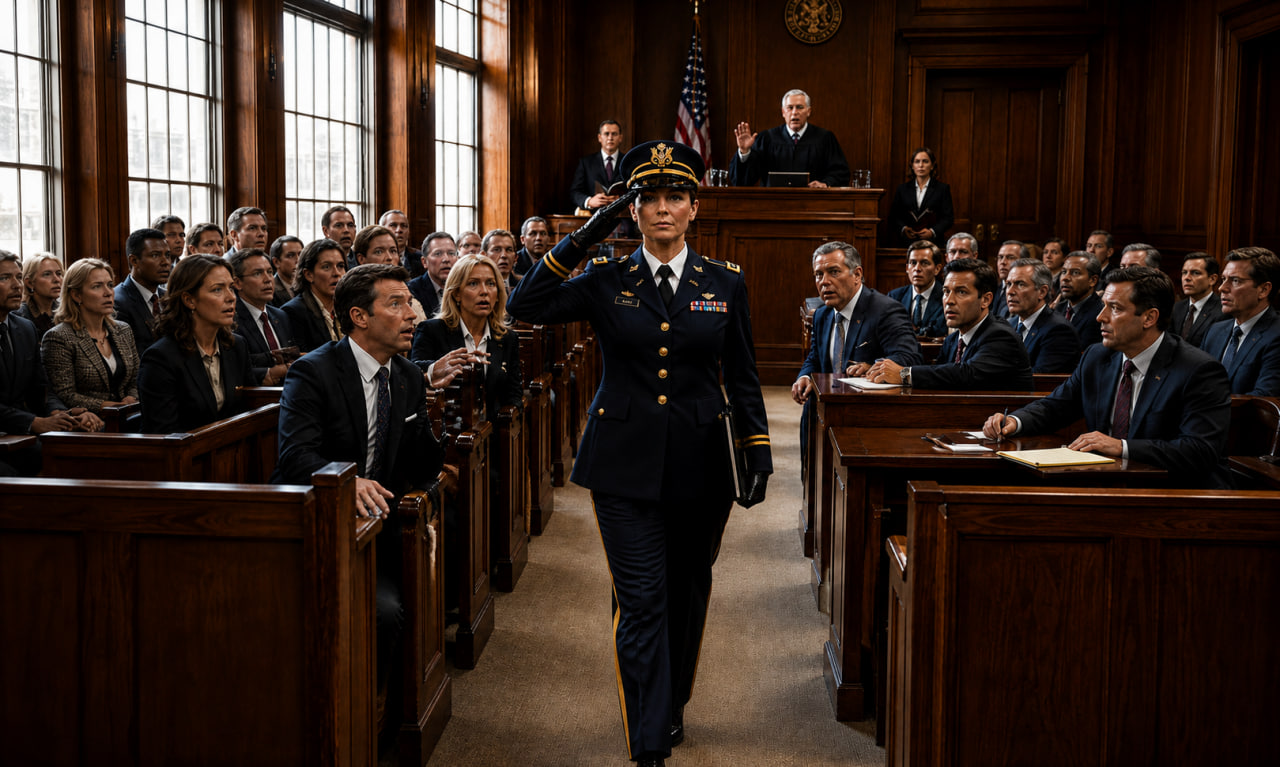
“My own father laughed when I walked into court.”
“You think that matters?”
“It mattered when I was twelve.”
His face changed.
“It mattered when I was twenty-two. Eventually I learned something you never did. Applause at home is not the same as respect.”
Then he said the words I knew were coming.
“We’re family.”
“Family doesn’t sell what isn’t theirs and ask relatives to lie about it.”
The verdict came two weeks later.
Guilty on the major counts.
Unauthorized acquisition of restricted defense information.
Conspiracy to transfer protected technical data.
Fraud involving government contracting disclosures.
There was no dramatic confession. No shouting. Just paper moving, a chair shifting, and a marshal giving instructions.
Adrian turned toward me.
“Emma, please. I messed up. I was scared. Tell them I’m not a bad person.”
I stared at him.
“That’s not my job.”
The marshal led him away.
Outside the courthouse, my mother called my name.
“Please don’t leave. We need you.”
Once, those words would have mattered.
“Why?”
“Because we’re your family.”
Dad finally spoke.
“We were wrong about Adrian.”
“That’s not the only thing you were wrong about.”
Mom reached for my hand.
I stepped back.
“I know you’re angry,” she said.
“I’m not.”
“Then what are you?”
I thought about it.
“Finished.”
Her face crumpled.
“You backed him when you thought he was innocent. I could understand that. But when you learned he wasn’t, you still asked me to bend the truth.”
“We were scared.”
“So was I.”
Mom cried harder.
“You don’t understand what it’s like to watch someone you love lose everything.”
I looked at her.
“I do.”
For the first time, she understood what I meant.
They had watched Adrian lose his company, reputation, and freedom.
I had watched my parents choose him over me long before any courtroom existed.
“You should have been proud before a courtroom full of people told you I mattered.”
Then I walked away.
For the first time, leaving my family did not feel like losing them.
It felt like putting down something I had carried for years.
Part 5: The Verdict I Gave Myself
A year later, I stood in a lecture hall in Newport, Rhode Island, teaching young officers about Harbor Veil.
The case had become a training example in conflict disclosure, digital preservation, and investigative independence.
“Being right doesn’t make perception irrelevant,” I told them. “Your job is to build a record strong enough that someone hostile to you can verify it.”
After class, a young officer asked if investigating someone I knew had been the hardest part.
“No,” I said. “The hardest part was realizing the people I spent my life trying to impress had already decided who I was, and no achievement would change their minds.”
“What changed their minds?”
“Consequences,” I said. “But by then, I didn’t need them to.”