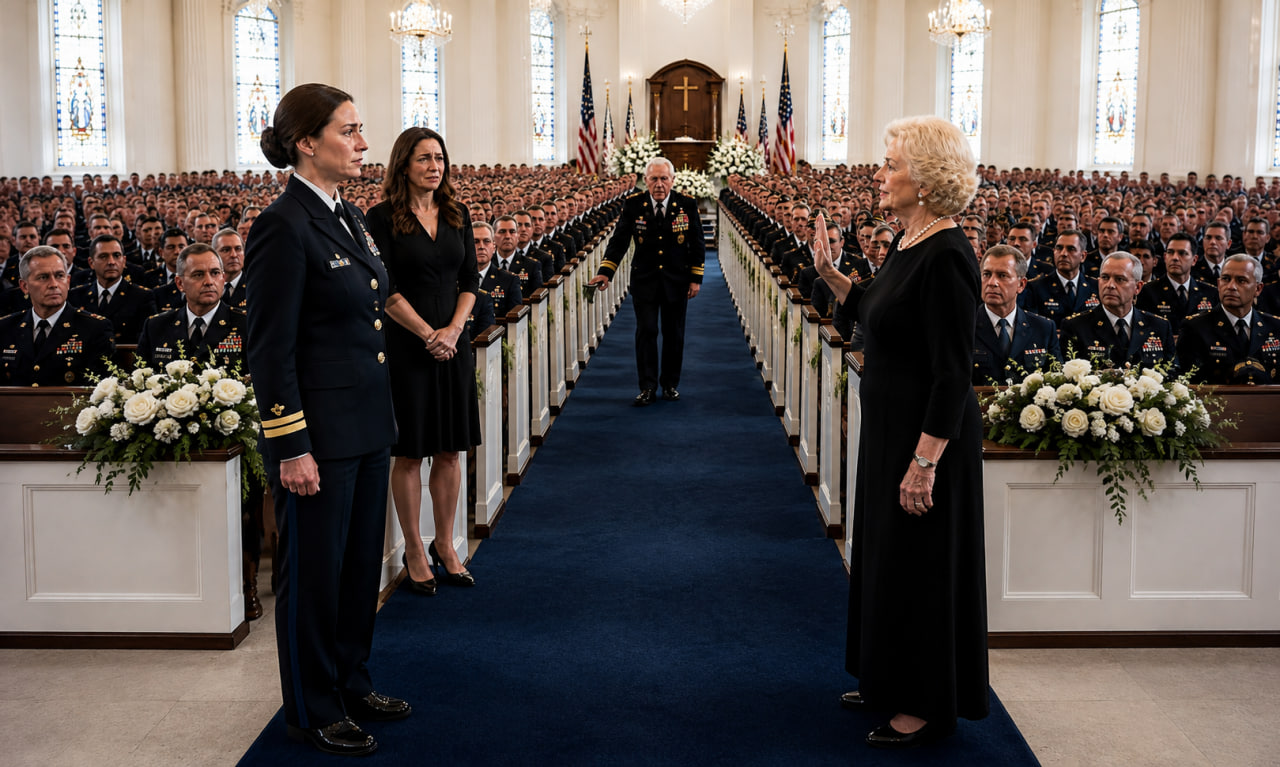
Part 3: The Truth in the Church
Anna wrapped her arms around me, then pulled back when I flinched.
“You’re hurt.”
“I’m recovering.”
“Why didn’t you tell me?”
“I tried to call.”
Her eyes moved toward our mother.
“She changed her number last year,” Anna whispered. “She said you already had it.”
“I didn’t.”
Our mother looked cornered, not sorry.
“I was trying to hold this family together.”
Anna’s voice shook.
“You separated us.”
Mom insisted I had left.
“I served,” I said.
“You left me.”
The words came from a place older than Dad’s illness or the church.
I saw the kitchen again, the day I received my academy appointment, when Mom held the letter and asked why I wanted to escape her.
“You were my mother,” I said. “I was not supposed to remain small so you would feel safe.”
For the first time, she had no answer.
When the service finally began, Anna took my hand.
“You sit with me.”
Mom sat alone in the third row.
I sat beside Anna in the first.
Major Hayes sat on my other side.
When he invited me to speak, I had prepared nothing.
So I told the truth.
“For twelve years, many people here believed I had forgotten where I came from. I allowed that belief to remain because military service is difficult to explain when much of it cannot be discussed. I also believed private family pain should remain private.”
I looked at Dad’s campaign box.
“My father reminded us today that silence can protect dignity, but it can also protect a lie.”
I took a breath.
“I did not abandon my father. I wrote. I called. I requested leave. I tried to come home.”
Then I looked at the people who had repeated my mother’s story without asking me.
“I am not asking anyone to choose sides. I am asking you to be careful with stories that make one person a villain simply because the explanation is convenient.”
My voice broke.
“My father asked me to wear this uniform because he did not want me to arrive ashamed.”
I looked at his photograph.
“I am not ashamed, Dad.”
The congregation rose.
The applause began softly, then grew.
I did not feel victorious.
I felt exhausted, exposed, and deeply loved by a man who had prepared to defend me after death because he had not been sure he could do it in life.
Part 4: The Cabin and the Notebook
After the service, apologies came carefully.
A former teacher admitted she had believed I refused to come home. A neighbor confessed she repeated the story at church. Two veterans asked about my recovery without demanding details.
Later, Major Hayes handed me the cedar box.
“It belongs to you.”
Inside my envelope, Dad had written:
Rebecca,
I knew you loved me. I should have defended you sooner. Your mother loves you, but she often confused love with possession. Do not let her fear become your prison.
The foundation is not a reward. It is work. Accept it only if that work has meaning for you.
The cabin by Millstone Lake is yours. Your mother has the house for the rest of her life, but the cabin was always where you and I told the truth.
There is one last box beneath the floorboard near my desk.
Take William.
Love, Dad.
The cabin.
Dad and I had spent weekends there when I was in high school. It had one bedroom, weak internet, and a porch overlooking dark water.
Mom hated it.
Dad called it quiet.
He had left it to me, not as a fortune, but as a place where truth had always felt safe.
The next morning, Major Hayes drove me there because my doctor had not cleared me for long drives.
Inside, Dad’s coffee mug still sat beside the sink. His reading glasses rested on the desk.