Gradually, she learned that access depended on respect.
Two years after the memorial, she visited the cabin.
She asked first.
Major Hayes and Anna were both there.
Mom stood on the porch, older than I remembered.
“I cannot change twelve years,” she said.
“No.”
“Do you believe I loved you?”
The question was harder than I expected.
“Yes,” I said. “But love did not make what you did safe.”
She nodded.
Maybe she understood.
Maybe she only understood enough to sit at Dad’s table without rewriting the past.
That was still something.
Part 7: Into the Light
My injuries changed my career.
I moved from operational assignments into training and strategic planning. At first, I considered it a failure.
Major Hayes reminded me that service does not end when a person stops standing closest to danger.
Eventually, I retired from active duty and accepted a civilian role helping military families through deployment, casualty notices, and emergency leave crises.
I knew what silence could do.
I knew how incomplete information could become poison inside frightened families.
I helped parents understand why a son could not call.
I helped spouses navigate emergency requests.
I told service members to preserve letters, name trusted contacts, and make expectations clear before crisis arrived.
Some lessons cost too much not to share.
Five years after Dad’s memorial, Major William Hayes died peacefully at home.
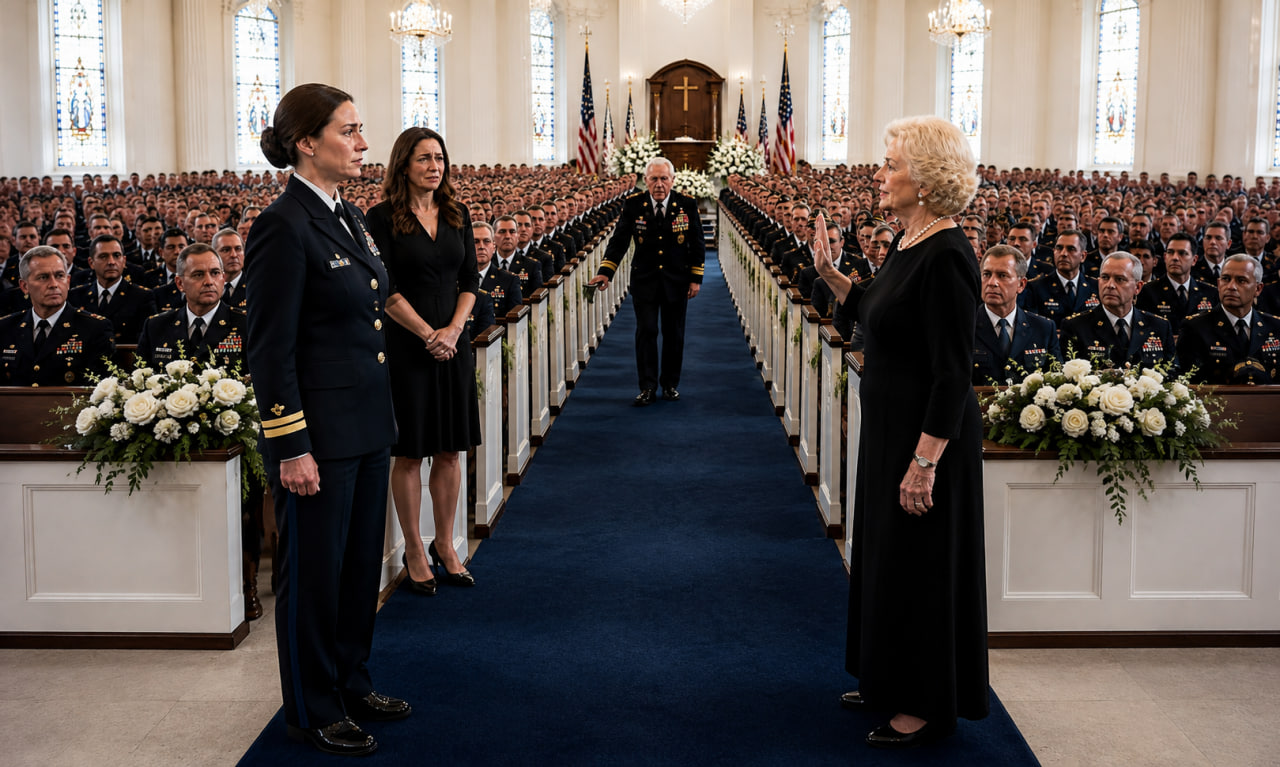
At his service, I wore my Navy uniform one final time.
His daughter asked me to speak.
I told the congregation that Major Hayes had carried my father’s truth when Dad could no longer carry it himself.
I told them courage is not always charging forward.
Sometimes courage is standing in a church and telling an old friend that her grief does not give her the right to destroy her daughter.
Mom attended.
When I walked to the lectern, she stood with the veterans.
Not because the past had disappeared.
Because she finally understood what the uniform meant.
After the service, she touched my sleeve.
“Your father would be proud.”
“He was,” I said.
She lowered her eyes.
“Yes.”
That single word contained years.
People in Willow Creek still tell the story of the day Major Hayes stood inside the church and defended Colonel Carter’s daughter.
They remember the silence.
The letter.
The recording.
The brass key.
Some versions make it sound like the whole town turned against my mother in one dramatic moment.
That is not exactly what happened.
Truth rarely transforms people that neatly.
What changed instantly was not the town’s loyalty.
It was my willingness to carry their judgment.
For twelve years, I thought I needed everyone to understand why I had been gone. I thought I needed my mother to admit I had not abandoned her. I thought I needed the town to recognize that service had cost me something too.
Then Dad’s voice filled the church.
Rebecca will think she failed me.
She did not.
Those words released me from a trial I had been attending in my own mind for years.
My mother believed the uniform represented the life that took me away.
My father understood it represented the life I had chosen with courage, sacrifice, and love.
I wore it for him.
And when Major Hayes handed me the brass key, I did not merely receive a box of letters.
I received my name back.
Not the daughter who abandoned everyone.
Not the selfish officer who stayed away from her father’s funeral.
Rebecca Carter.
Daughter.
Sister.
Officer.
Wounded veteran.
A woman who had loved her father across every mile placed between them.
The uniform did not make that true.
The truth had always been there.
The uniform only made me stand tall enough to stop apologizing for it.