Those lies usually had messy edges.
This answer did not.
It sounded like something repeated until it could be said automatically.
Valerie started to ask another question.
Lila’s face suddenly changed.
The color seemed to drain from it.
Her mouth opened slightly.
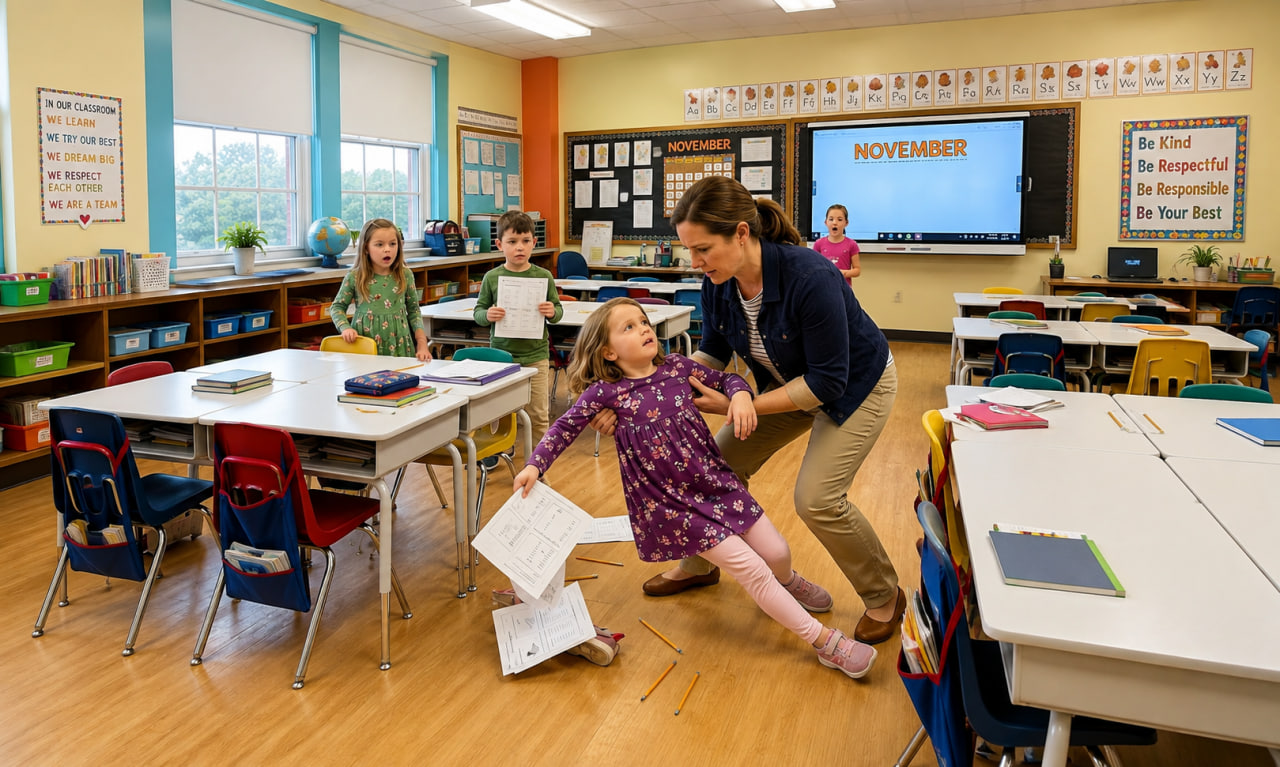
The papers slipped from her fingers.
Several worksheets fluttered toward the floor.
Then her knees buckled.
Valerie moved before she had time to think.
She lunged forward and caught Lila under the arms.
The little girl’s weight dropped against her.
Valerie lowered her as carefully as she could, keeping her head from striking the tile.
The classroom froze.
One child stood with a worksheet still held in both hands.
Another was halfway out of his chair.
The boy with the loose tooth covered his mouth.
Even the usual whispering stopped.
The pencil beneath the reading table rolled several more inches before touching a chair leg and coming to rest.
“Please call the nurse right now,” Valerie told the classroom aide.
Her voice remained controlled.
Twenty children were watching her face, trying to decide from her expression whether they should be scared.
Valerie refused to give them that answer.
But her jaw had tightened so hard it hurt.
She kept one hand behind Lila’s shoulders and asked if she could hear her.
Lila nodded faintly.
That helped.
It did not make Valerie feel better.
The nurse arrived quickly, and within minutes Lila was moved out of the classroom.
Valerie gave the aide instructions for the remaining students and followed.
By 9:03 a.m., Lila was lying on the narrow cot in the school nurse’s office.
The room smelled faintly of antiseptic and paper.
The disposable covering beneath Lila crinkled whenever she shifted.
A blood pressure cuff wrapped around one thin arm.
The nurse watched the digital monitor and then wrote something in the health office log.
“Her blood pressure is a bit low,” she said. “She may just be dehydrated.”
It was a reasonable explanation.
A child might skip breakfast.
A child might not drink enough water.
A child might feel faint during a busy school morning.
Valerie wanted that explanation to be enough.
She wanted a cup of water, a snack, and twenty minutes of rest to turn the entire morning back into something ordinary.
Then she looked at Lila’s hands.
The girl’s fingers were wrapped tightly around the edge of the blanket.
So tightly that her knuckles had gone pale.
Valerie’s eyes moved to the cardigan.
Lila always looked neat.
That morning, something was wrong with the buttons.
The bottom had been fastened incorrectly.
One button skipped its hole.
Another pulled the fabric awkwardly across her middle.
A faint crease ran across the cardigan as though something stiff had pressed against it earlier.
None of those details proved anything by themselves.
Valerie knew that.
Teachers were trained not to leap from concern to conclusion.
Children came to school with wrinkled clothes.
Buttons were missed during rushed mornings.
A strange crease in a cardigan could mean almost nothing.
But Valerie was not looking at one strange detail.
She was looking at a pattern.
The careful sitting.
The controlled expression.
The slow walk.
The hand braced against the desk.
The prepared answer.
The collapse.
And now the rigid little fingers gripping the blanket as though releasing it might let something worse happen.
On the nurse’s desk sat the ordinary paperwork of an ordinary school morning.
The attendance sheet Valerie had marked earlier.
Lila’s math worksheet.
The health office log.
Three records that, at first glance, said nothing dramatic.
Present at 8:17.
Math at 8:42.
Nurse’s office shortly after nine.
But together they marked a timeline Valerie could not stop thinking about.
Lila had arrived at school already hurting.
Whatever was wrong had not happened during recess.
It had not happened during gym.
It had not happened in the classroom.
The pain had come through the school doors with her.
Valerie pulled a chair closer to the cot.
She sat low enough that Lila did not have to look up at her.
For a moment, she did not ask anything.
Pressure could make children shut down.
So could fear.
Valerie kept her hands in her lap and her voice quiet.
“Lila, sweetheart, can you tell me what hurts?”
Lila stared at the ceiling tiles.
Her breathing changed.
Shorter breaths now.
Shallow ones.
The nurse glanced toward Valerie but did not interrupt.