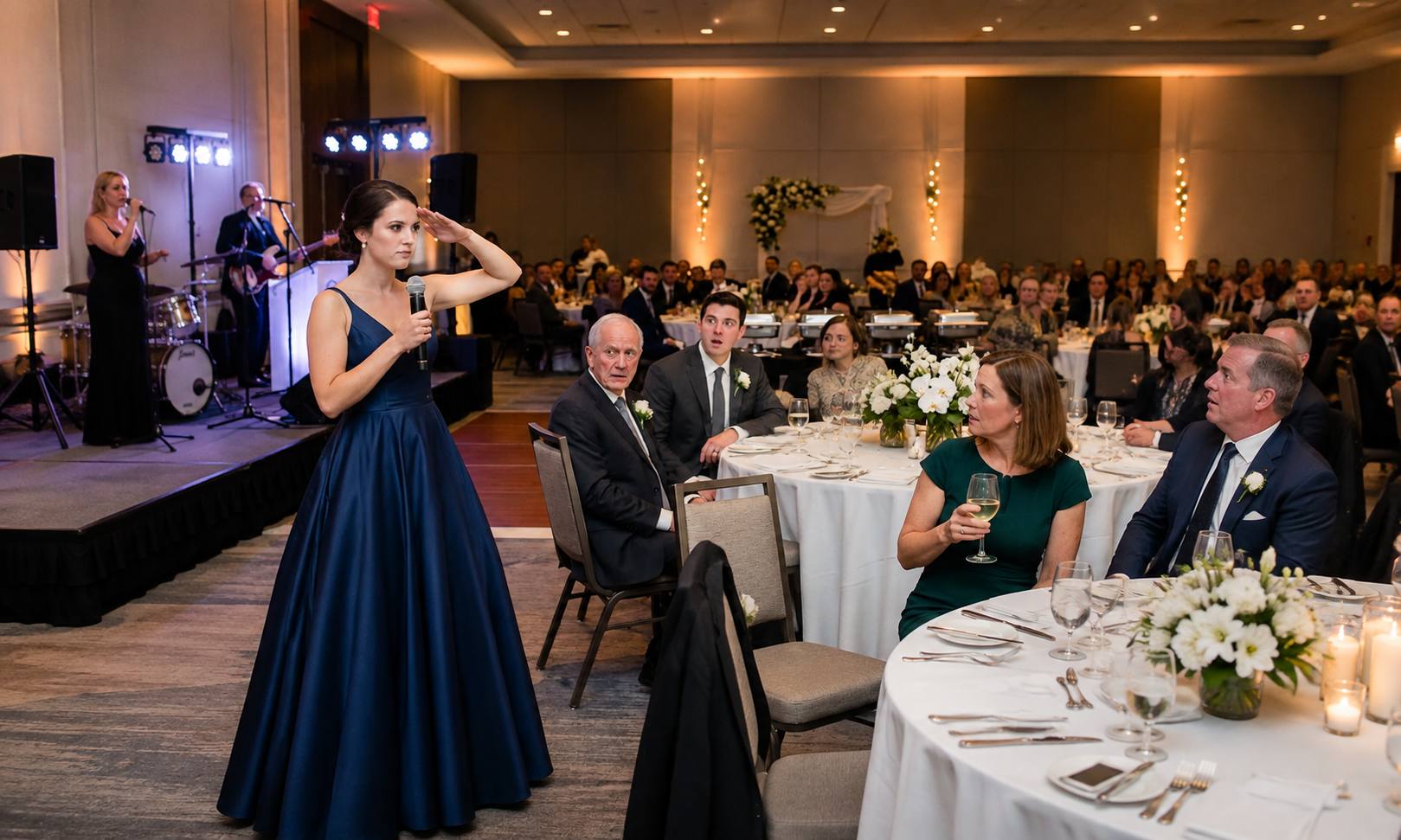
A woman wearing a black headset stepped into the corridor and introduced herself as Lena, the venue coordinator.
She held a tablet against her chest.
“Mr. Voss has canceled the remaining bar service, the band’s final set, and the late-night food station,” she said. “He believes the reception will conclude by nine thirty.”
Julian checked the time.
It was 8:16.
Lena said most guests would probably leave when the music stopped.
Mara looked toward the ballroom door.
Her jaw moved once.
“What has already been paid for?” she asked.
“Dinner, cake, coffee, the room through ten, and the photographer.”
“Then that is enough.”
Julian rubbed both hands over his face.
I took a bread roll from the cart, tore it in half, and handed part to Mara.
She ate it while standing in one shoe.
“We can still go out there,” Julian said.
Mara swallowed.
“We are going out there.”
He folded the agreement once and carried it at his side.
I stopped at the coatroom on our way back and pulled its locked handle twice for no useful reason.
When we returned, Conrad was already beside the microphone.
The applause for Mara’s announcement had ended, and he had arranged his expression into something warm and wounded.
“My granddaughter has always admired courage,” he said. “Even when complicated family history makes that admiration difficult.”
He opened one hand toward me.
“I am pleased Elise found her way back to us tonight.”
I remained near Table 42.
He wanted the room to believe he had permitted my return.
Several guests accepted the explanation because it was easier than questioning the man who had paid for their dinner.
Damian moved between tables, bending to whisper beside shoulders and refill glasses that did not need refilling.
Whenever he passed someone who had applauded, he showed them something on his phone.
Conrad continued.
“Families survive because each generation understands when personal preference must yield to responsibility.”
The same words had changed clothes.
At nineteen, responsibility had been Bennett Vale and a wedding I did not want.
Now it was a title, a house, and a contract waiting for Julian’s signature.
Conrad smiled toward his grandson.
“It is my honor to announce that Julian Voss will assume leadership of Voss Restoration Group on Monday morning.”
A few people clapped immediately.
Others followed because they thought they had missed an instruction.
Julian crossed the dance floor.
Conrad held out the microphone but kept one hand around it.
Julian reached for it.
The sound system went silent.
A small red light on the microphone disappeared, and the band members looked toward the technician’s empty chair.
Conrad lowered the useless microphone.
Julian faced the room without it.
“I’m not taking the job,” he said.
The nearest tables heard him first.
They stopped clapping, and the quiet moved outward.
Julian spoke again, louder.
“Mara is not leaving the Air Force. We are moving to Dayton next month, and I have accepted another position.”
Conrad’s face remained still.
His hand did not.
He crushed the folded cocktail napkin he had been holding until it disappeared inside his fist.
“My grandson is emotional,” he said. “Weddings can overwhelm young people.”
“I’m thirty-two.”
“You are being pressured in public.”
“No,” Julian said. “That was happening in private.”
Mara joined him.
She had put her shoe back on, though the strap remained unfastened.
Conrad addressed her in a soft voice.
“You have served with distinction, Mara, but you have also spoken often about wanting stability.”
“I wanted a home,” she said. “I did not ask you to manage it.”
Damian laughed from beside the nearest table.
“Listen to yourselves. One speech from Aunt Elise and suddenly everyone is escaping something.”
He lifted his phone.
“Before we turn her into a saint, maybe she should explain why she was relieved of command.”
The room shifted again.
Conrad did not look surprised.
Damian had found an old military news brief reporting that I had been removed from flight authority during an inquiry into the grounded transport.
He read the headline aloud.
Then he enlarged the screen and held it toward the guests nearest him.
The applause from minutes earlier now felt very far away.
Mara walked back to Table 42 and poured water into a clean glass.
A bridesmaid beside her peeled the label from a bottle in one long strip.
I ate the other half of the bread roll.
Then I stepped onto the dance floor.
“Yes,” I said. “I was relieved of command.”
Damian lowered the phone slightly.
I had stopped the aircraft after Mara reported the smell.
The maintenance supervisor accused her of inventing a problem because she had challenged him about incomplete inspection paperwork the previous week.
My commanding officer ordered me to identify the person who had caused the delay and recommend disciplinary action before the second inspection was finished.
Instead, I signed the decision as mine alone.
For eleven days, the official record described my judgment as unsupported.
On the twelfth day, technicians removed the panel beside the oxygen manifold.
The burned wiring was behind it.
The inquiry confirmed the aircraft was unsafe, but it also concluded that I had broken the chain of command by refusing the launch order and withholding Mara’s name.
Both findings remained in my file.
I was offered my position back after six months in an administrative assignment.
I declined it.
I finished my service training crews who were expected to question unsafe decisions before someone gave them permission.
Mara returned to my side.
She turned my wrist over.