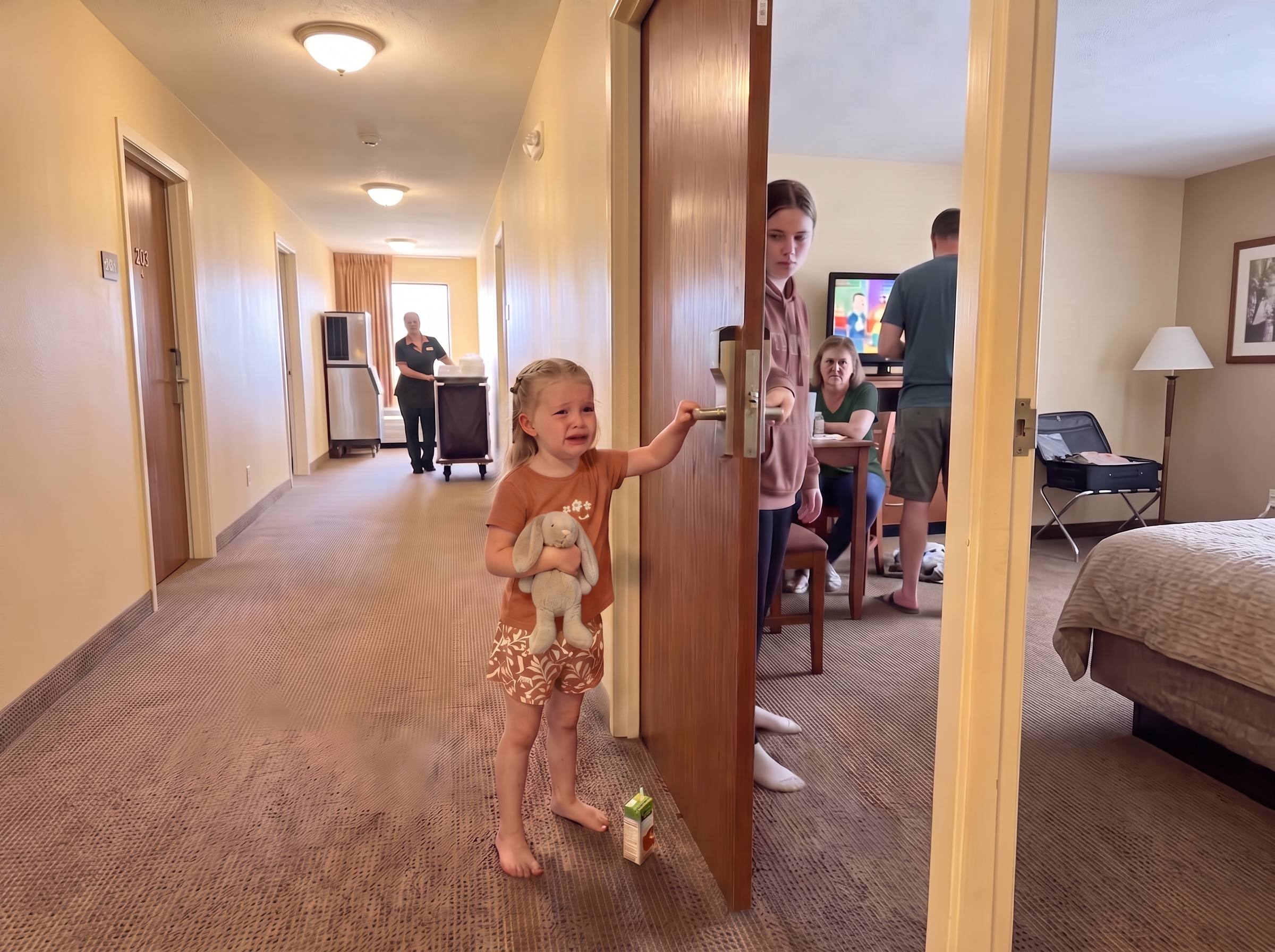
“Claire, don’t turn this into some huge drama,” he said. “She was completely safe.”
Safe.
He used the word as though safety meant only that Lily had not disappeared before I found her.
He ignored the locked door, the strangers, the bare feet, the hoarse voice, and the fact that the adults responsible for her had chosen television and family politics over a frightened child.
I looked at Vanessa.
“Why did you put her outside?”
She stared at me coldly.
“That room is for family only.”
For years, comments like that had been directed at me, usually with enough deniability that my parents could insist I was being sensitive.
This time, there was no softer interpretation available.
She had said it about my daughter after physically removing her from a room I had paid for.
My mother stepped in before I could answer.
She said Vanessa had been frustrated, that the boys needed space, and that Lily should have listened instead of making a scene in the hallway.
The logic was so twisted that arguing with it would have required accepting its premise—that a six-year-old child was responsible for the cruelty of the adults around her.
I refused to do that.
I did not yell.
I did not throw anything, threaten anyone, or give Vanessa the confrontation she appeared ready to use against me.
Instead, I carried Lily into the bathroom and locked the door behind us.
I set her on the closed toilet lid, ran warm water over a washcloth, and cleaned the dust from the soles of her feet.
She flinched each time someone moved outside the bathroom door.
I helped her into clean clothes, found her shoes, and placed her stuffed rabbit inside the open suitcase where she could still see it.
Then I packed everything we had brought.
Vanessa continued talking from the other side of the door, but I stopped listening.
My father repeated that I was overreacting, while my mother warned that leaving would ruin the vacation for everyone.
Neither of them asked whether Lily was all right.
That absence made my decision simple.
I booked another hotel on the other side of town and carried our bags out without asking anyone for help.
Lily held my hand all the way to the elevator.
She did not look back at her grandparents or her aunt.
At the new hotel, I checked the lock twice before bringing our things inside.
I showed Lily where the bathroom was, placed her rabbit on the bed, and let her choose which lamp would remain on.
That night, she refused to sleep unless every light in the room stayed lit.
She lay beside me with the stuffed rabbit tucked beneath her chin and watched the door each time the air conditioner clicked off.
Whenever footsteps passed in the hallway, her fingers closed around my sleeve.
I wanted to promise that she would never feel afraid again, but grief had already taught me not to make promises life could break.
So I gave her one I could keep.
I told her I would never knowingly leave her with anyone who treated her as though she did not belong.
She asked whether Grandma and Grandpa knew she was outside.
I could not lie to her, but I also would not make a six-year-old carry the full weight of what their silence meant.
I said they had made a very bad choice and that grown-ups were responsible for fixing the harm caused by their choices.
Lily was quiet for a while before asking whether she had done something wrong.
I held her closer and said no.
I repeated it until her breathing slowed.
While she rested, I made three phone calls.
The first was to hotel management.
I gave the manager our room number, the time I had gone downstairs, the location where I found Lily, and the name of the housekeeper who had witnessed her crying outside the locked door.
I kept my voice controlled because I wanted the facts recorded clearly.
The manager listened without interrupting, then pulled up the account.
He confirmed what the front desk employee had already told me: there had never been a billing problem.
No payment had failed.
No employee had asked anyone to send me downstairs.
There was no legitimate reason for my father’s call.
Someone in my family had deliberately removed me from that room.
The realization changed the shape of everything that had happened.
Vanessa had not simply lost her temper after I left.
Before Lily was pushed into the hallway, someone had created a false problem, called me from the lobby, and made sure I would be away from the room long enough for Vanessa to act without me there.
My father’s exact words returned to me: the front desk needed my credit card, and I had to come down immediately.
He had not sounded confused.
He had sounded prepared.
I looked across the bed at Lily, who was finally asleep beneath the light she had insisted remain on.
Her shoes sat together beside the suitcase, and her stuffed rabbit was still trapped beneath her chin.
Until that call, I had believed I was dealing with one cruel sister and two weak parents who had failed to stop her.
Now I had to consider something worse.
My parents had not merely watched what happened.
One of them may have helped arrange it.
And suddenly, Vanessa’s cruelty was no longer the only question.
THE END