PART 3
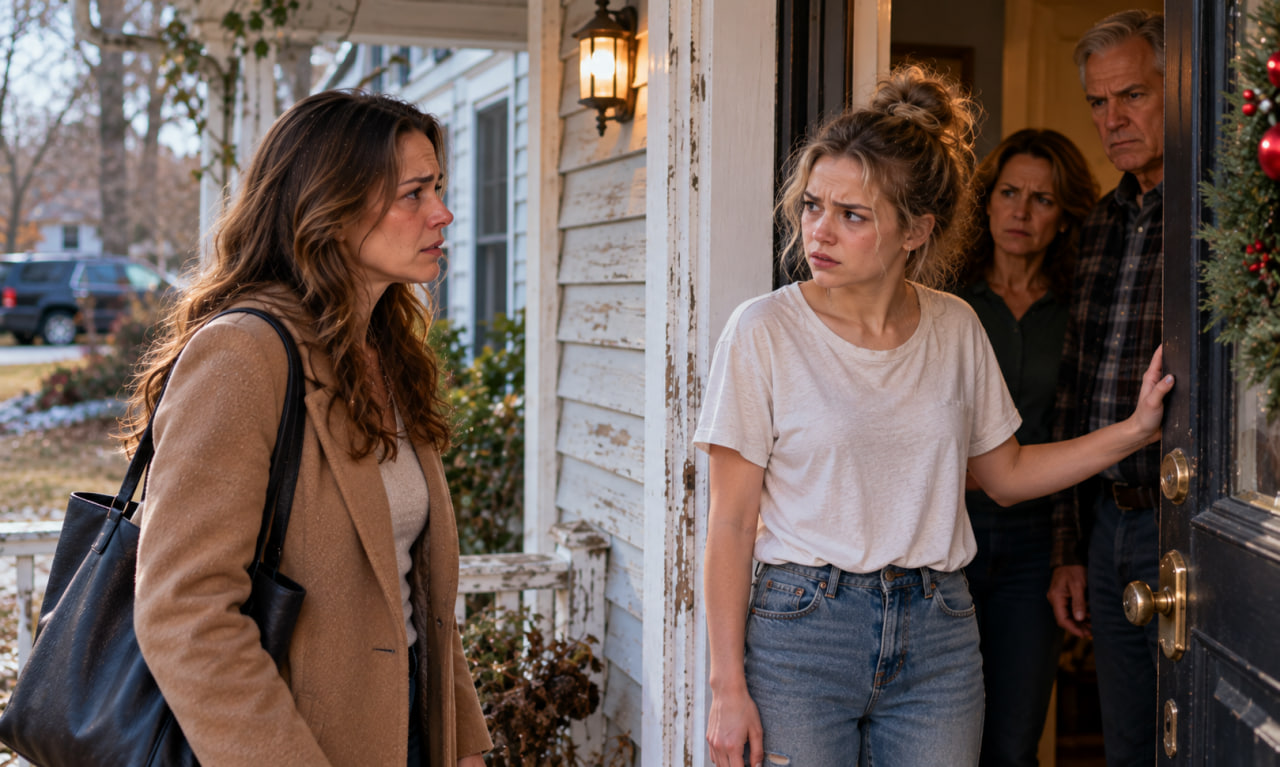
I glanced past her into the house. The hallway looked almost exactly as I remembered it. The same faded wallpaper. The same crooked family photograph hanging beside the stairs. The same wooden floor my mother used to polish every Saturday morning while playing gospel music from an old radio.
Only the photograph was different.
Someone had added a new picture frame to the wall.
Inside it was a photograph of my parents standing beside a teenage girl wearing a white graduation gown.
The girl in the photograph was the girl standing in front of me.
My stomach tightened.
“Your mother and father,” I said carefully. “I’m looking for Thomas and Margaret.”
The girl’s expression changed.
Not dramatically. Just enough for me to notice.
Her shoulders stiffened, and she looked at me as though I had suddenly spoken a language she didn’t understand.
“Why?”
“I’m an old acquaintance.”
It was the first lie that came to mind.
She studied my face for another moment.
Then she said something that made the blood drain from mine.
“That’s weird. My mom says Dad doesn’t have any family left.”
I gripped the strap of my handbag.
“Doesn’t have any family?”
“No.” She shrugged. “Apparently, everybody either died or moved away. That’s what he says, anyway.”
I could hear my heartbeat in my ears.
My father had once stood in our living room and declared that I was dead to him.
Now, twenty years later, his daughter was telling me that he had no family.
I wanted to laugh, but the sound wouldn’t come.
“What is your name?” I asked.
“Emily.”
Emily.
The name meant nothing to me, yet something about the way she said it made my chest ache.
“How old are you, Emily?”
She frowned.
“Why are you asking me all these questions?”
“Because you look familiar.”
That was an understatement so enormous that I almost laughed at myself.
Emily folded her arms.
“People say that sometimes. Maybe you’ve seen me around town.”
“Maybe.”
I looked toward the living room again.
“Is your father home?”
Before she could answer, a man’s voice came from inside.
“Emily? Who’s at the door?”
I froze.
Twenty years had passed, but I recognized that voice immediately.
It was deeper and rougher now, weakened by age, but it belonged to the same man who had once ordered his sixteen-year-old daughter into a thunderstorm.
My father.
Emily turned her head.
“Some woman asking for you, Dad.”
Footsteps approached.
Slow, deliberate footsteps.
Then he appeared behind her.
Thomas Carter had aged in ways I hadn’t expected.
His once-dark hair had turned almost entirely white. His shoulders sloped forward, and deep lines carved his forehead. He wore an old plaid shirt with the sleeves rolled up and held a pair of reading glasses in one hand.
For a moment, he didn’t recognize me.
His eyes moved over my face with the detached curiosity one might give a stranger asking for directions.
Then he looked at my eyes.
His expression changed.
The reading glasses slipped from his fingers and struck the floor.
They both stared at me.
My father opened his mouth.
Nothing came out.
Emily looked between us.
“Dad?”
He didn’t answer.
I had imagined this moment for twenty years. I had imagined myself standing tall, dressed in an expensive suit, with my company car parked behind me and every outward sign of my success.
I had imagined telling him that the daughter he had thrown away was now more successful than he could ever have dreamed.
But when I finally stood in front of him, I wasn’t thinking about my company.
I wasn’t thinking about my money.
I was sixteen again, standing in the rain with a backpack full of wet clothes.
My voice trembled.
“Hello, Dad.”
His face turned ashen.
He took a step backward.
“No.”
One word.
That’s all he said.
“No,” he repeated, shaking his head. “No, that can’t be.”
Emily looked alarmed.
“Dad, what’s going on?”
He reached for the door, but his hands were shaking so badly that he struggled to grasp the handle.
I stepped forward.
“Twenty years, Dad.”
He stared at me.
“Twenty years since you told me I was dead to you.”
His lips parted.
“And yet here I am.”
For a moment, I thought he might collapse.
Then my mother appeared at the end of the hallway.
“Thomas, what’s all the commotion?”
She walked toward us, wiping her hands on a kitchen towel.
Her hair was now a soft silver, and her face had grown thinner. She looked older than I had expected, but I recognized the familiar set of her mouth and the way she held her chin when she was irritated.
She glanced at me.
Then she stopped.
The kitchen towel fell from her hands.
“Oh, my God.”
I waited.
I waited for the apology.
For the tears.
For some indication that the years had finally taught her what it meant to abandon a child.
Instead, she whispered a sentence that hurt more than I thought anything could.
“You’re not supposed to come back.”
I felt something inside me go very still.
Not because I was surprised.
Because, after twenty years, I finally understood that I had spent too much of my life hoping these people would become someone they had never been.
I straightened my shoulders.
“I’m not here to ask permission.”
Emily looked at my mother.
“Mom, who is she?”
My mother closed her eyes.
For several seconds, nobody spoke.
Then Emily asked again, more insistently this time.
“Mom?”
My mother opened her eyes and looked at her daughter.
“This,” she said quietly, “is your sister.”
The word struck me like a physical blow.
Sister.
I turned toward Emily.
She was staring at me with her mouth slightly open.
“What?”
My mother swallowed.
“She’s your older sister.”
Emily shook her head.
“No. No, that doesn’t make sense.”
She looked at my father, searching his face for reassurance.
“Dad?”
My father said nothing.
Emily took a step backward.
“You’re telling me I have a sister I’ve never heard about?”
I watched the girl absorb the news, and an unexpected wave of sadness washed over me.
She hadn’t done anything wrong.
She was just another child who had grown up inside the walls of this house, believing the version of the family her parents had given her.
And now she was discovering that the story was incomplete.
My mother stepped forward.
“Please,” she said to me. “Let’s not do this on the doorstep.”
I almost laughed.
“Why? Are you worried the neighbors might see?”
Her face tightened.
I continued before she could respond.
“That’s what you told me twenty years ago, remember? You threw my backpack onto the lawn and told me to get out before the neighbors saw me.”
My mother lowered her eyes.
“I know what I said.”
“No,” I replied. “You know the words you said. You don’t know what it was like to walk away from this house with nowhere to go, carrying your grandchild inside me.”
My father flinched.
Emily looked at me.
“Grandchild?”
I nodded.
“I had a baby when I was sixteen.”
Her expression shifted from confusion to shock.
“You’re a mother?”
“Yes.”
I held her gaze.
“And I raised my child without the help of the two people who were supposed to love me first.”
For the first time since I had arrived, my father looked directly into my eyes.
“Where is the baby?”
I felt my jaw tighten.
“Her name is Lily.”
My voice softened when I said it.
“She’s twenty years old now. She’s in college, studying architecture. She’s kind, intelligent, stubborn when she believes she’s right, and she has a laugh that fills an entire room.”
I paused.
“And she has never met you.”
My father’s face crumpled.
My mother pressed a hand against her mouth.
But I wasn’t finished.
“She grew up without grandparents. She didn’t have anyone to call when she was sick except me. She didn’t have anyone to sit in the audience at her school events except the people I worked hard enough to bring into our lives.”
I felt tears gathering, but I refused to let them fall.
“Every time she asked why she didn’t have grandparents like the other children, I had to figure out how to explain that sometimes the people who are supposed to love you the most are the ones who hurt you.”
Emily’s eyes filled with tears.
My mother began to cry.
I looked at her, and for the first time, I didn’t feel the urge to comfort her.
I had done that too many times as a child, apologizing whenever she was upset, taking responsibility for emotions that had never been mine to carry.
Not anymore.
My father stepped toward me.
“Please come inside.”
I looked past him into the house.
For twenty years, I had dreamed of walking back through that doorway.
But now that I had the opportunity, I realized something important.
I didn’t need to enter my childhood home to prove I had survived it.
Still, there were questions I needed answered.
“Fine,” I said. “But I want the truth.”
My mother nodded quickly.
“Of course.”
I walked into the living room and stopped in front of the old family photograph.
My younger face smiled back at me from the frame.
I was wearing a yellow sundress, my hair in two braids, with my father’s arm wrapped around my shoulders and my mother’s hand resting on my head.
I had been twelve when that photograph was taken.
I remembered the day clearly.
We had spent the afternoon at a county fair. My father had bought me a stuffed bear, and my mother had made us all pose in front of a wooden fence before we went home.
I had believed, with the absolute certainty only a child can possess, that nothing could ever break our family apart.
I stared at the photograph for a long time.
Then I turned toward my parents.
“Why is Emily here?”
My mother exchanged a look with my father.
It was quick, but I noticed it.
The kind of look people share when they know a conversation is about to become dangerous.
My father lowered himself onto the sofa.
“Emily is our daughter.”
“I gathered that.”
My voice was colder than I intended.
“What I want to know is why you have another daughter who looks exactly like me, while telling her you have no family.”
My mother sat in the armchair opposite him.
“Emily was adopted.”
I stared at her.
“What?”
“We adopted her when she was a baby.”
My mind raced.
“You adopted a child?”
My father nodded.
“Several years after you left.”
I looked toward the hallway where Emily had disappeared.
She was standing just out of sight, listening.
“Why?”
My mother began twisting the tissue in her hands.
“Because we wanted another chance to raise a child.”
I felt my stomach turn.
Another chance.
They had wanted another chance to raise a child.
While their first child was sleeping on a stranger’s floor, working two jobs, and trying to survive a pregnancy without medical care, they had decided they deserved another child.
My laugh came out sharp and joyless.
“You wanted another chance?”
My mother began crying harder.
“We made mistakes.”
“Mistakes?”
I leaned forward.
“A mistake is forgetting someone’s birthday. A mistake is saying something cruel during an argument. You threw me out of your home when I was sixteen and pregnant.”
My father looked down at his hands.
“You have to understand the circumstances.”
I stared at him.
“Then explain them.”
He rubbed his forehead.
“People were talking. The church was talking. Our neighbors were talking. Your mother couldn’t even go to the grocery store without someone looking at her.”
I felt a chill travel down my spine.
There it was.
The truth I had suspected for twenty years.
“You were embarrassed.”
My father didn’t deny it.
“We were ashamed,” he said.
“Of me?”
He finally looked up.
“Of what had happened.”
I shook my head.
“No. You were ashamed of what people would think of you. You were so concerned about protecting your reputation that you decided your own daughter was disposable.”
My mother whispered, “We thought you would go to the father of the baby.”
I stared at her.
“You knew he had left town.”
“We thought he might come back.”
“He didn’t.”
My voice cracked.
“And you knew that. You knew he wasn’t coming back, and you still opened the front door and watched me walk into the storm.”
My mother covered her face.
My father sat motionless.
I could hear the old wall clock ticking above the fireplace.
Tick.
Tick.
Tick.
Twenty years of silence seemed to live inside that sound.
Finally, I asked the question I had carried across two decades.
“Did either of you ever look for me?”
My mother lowered her hands.
Her eyes were red.
“We asked around at first.”
“How many times?”
She hesitated.
I already knew the answer would hurt.
“How many times, Mom?”
“Three,” she whispered.
Three times.
I had spent years wondering whether they had searched for me, whether they had called hospitals, whether they had driven down highways looking for a teenage girl who had nowhere to sleep.
I had imagined that perhaps they had been too proud to contact me directly but had secretly checked on me through other people.