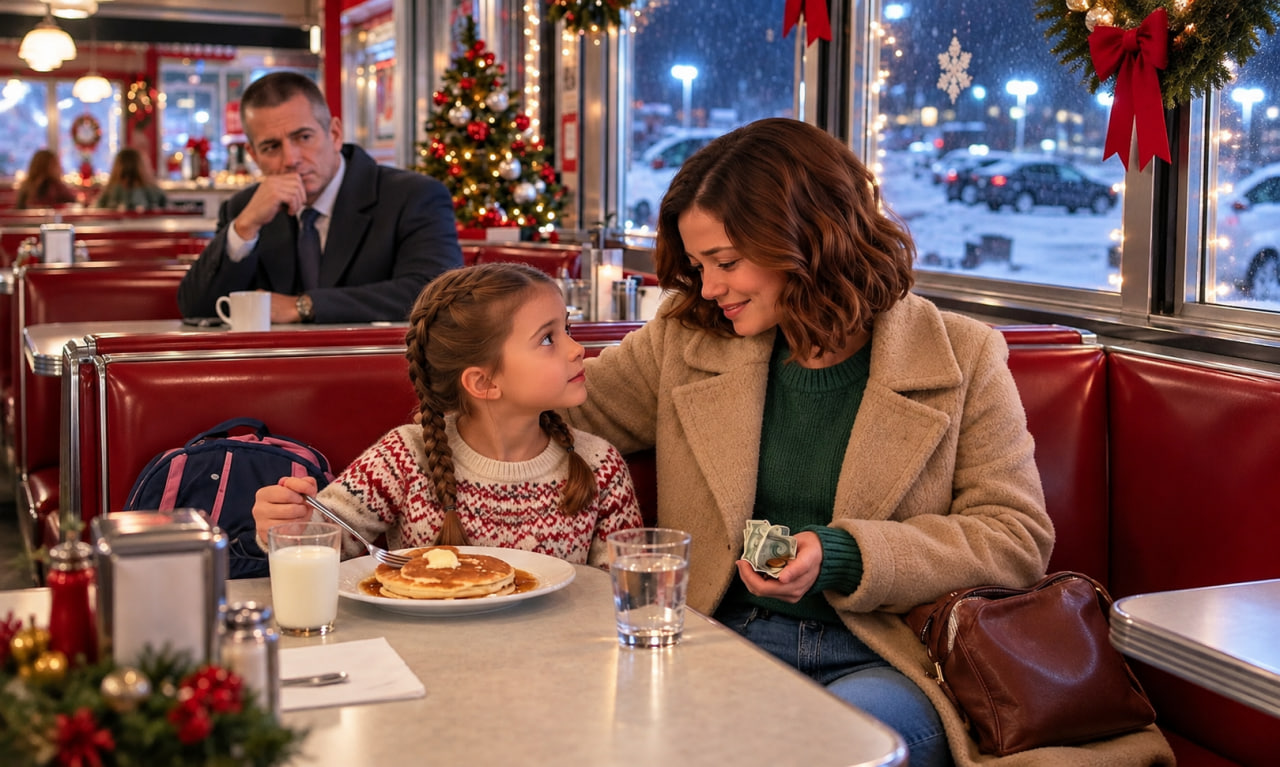
On Christmas Eve, a wealthy businessman sat alone in a small Pennsylvania diner when he noticed a young mother counting the coins in her hand.
She counted them once.
Then again.
And a third time, as though the total might somehow change.
Beside her sat a little girl, no older than seven, wearing a faded winter coat and watching the colorful Christmas lights hanging above the counter.
“Just the children’s pancakes, please,” the mother told the waitress quietly. “And a glass of water.”
When the food arrived, she cut the pancakes into small pieces and pushed the plate toward her daughter.
“Eat while they’re warm, sweetheart.”
The little girl looked up.
“What about you, Mommy?”
Her mother smiled.
“I already ate earlier. I’m not hungry.”
But the businessman had seen the coins.
He knew the truth.
She didn’t have enough money to buy dinner for both of them, so she’d chosen to feed her daughter.
He quietly called the waitress over and asked her to bring the woman a hot meal, adding both orders to his bill.
He had no idea that this simple gesture would lead to an unexpected invitation, a second chance at love, and the family he’d spent his entire life wishing he had.
PART ONE: THE MAN AT THE WINDOW
Nathaniel Whitmore was fifty-nine years old.
He owned a successful commercial construction company, employed hundreds of people, and lived in a beautiful estate outside Lancaster, Pennsylvania.
His business had completed shopping centers, office buildings, hotels, and residential developments across several states.
People described him as accomplished, disciplined, and extraordinarily successful.
By almost every financial measure, Nathaniel had built an enviable life.
But on that Christmas Eve, he sat alone beside the back window of a roadside diner, staring at a dinner he had barely touched.
Three years earlier, he’d lost his wife, Caroline, after a sudden illness.
They’d been married for twenty-four years.
She was warm, funny, thoughtful, and the one person who could make him forget about business for an entire afternoon.
For years, they’d discussed having children.
They imagined family vacations, noisy Christmas mornings, and teaching their children all the things they’d learned about life.
But Nathaniel had always been busy.
There was another contract to negotiate.
Another construction project to complete.
Another business expansion that required his attention.
“After this year,” he would promise Caroline. “Once things settle down, we’ll make more time for ourselves.”
But things never seemed to settle down.
And eventually, Caroline was gone.
Nathaniel had inherited a terrible understanding of the years he’d spent working.
He’d earned enough money to buy almost anything.
But he could never purchase another ordinary morning with his wife.
He couldn’t return to the evenings she’d waited for him while he finished work.
And he couldn’t recover the family life they’d postponed for so long.
After her death, he filled his calendar with meetings.
He worked late.
He traveled constantly.
He told colleagues that staying busy kept him productive.
The truth was simpler.
He couldn’t bear returning to a house where nobody was waiting for him.
That Christmas Eve, his younger sister had invited him to dinner with her family.
He’d declined.
The thought of sitting among happy couples and excited children while remembering everything he’d lost felt unbearable.
Instead, he’d driven aimlessly until he noticed a small diner with Christmas lights in the windows.
He went inside, ordered dinner, and took a seat alone.
Then Hannah Bennett and her daughter entered.
PART TWO: A MOTHER’S QUIET SACRIFICE
The diner was nearly empty.
Paper snowflakes decorated the windows.
A small artificial Christmas tree stood beside the cash register.
An old holiday song played softly through the speakers.
Nathaniel was looking out at the dark parking lot when he noticed the young woman and little girl settling into a booth.
The mother appeared exhausted.
Her coat was worn, her hair was loosely tied back, and she moved with the careful restraint of someone trying not to reveal how worried she felt.
But whenever her daughter spoke, her expression softened.
The girl talked excitedly about Christmas.
She pointed toward the miniature tree and asked whether Santa visited diners.
Her mother smiled and patiently answered every question.
Nathaniel found himself watching them.
Not because they were loud or unusual.
But because their affection seemed so genuine.
The little girl kept leaning against her mother’s shoulder.
And despite her obvious exhaustion, the woman never appeared too busy to listen.
Then the waitress approached.
The mother studied the menu for a long time.
Finally, she ordered a children’s pancake plate and water.
Nathaniel watched her carefully arrange the coins in her palm before placing them back inside her purse.
When the pancakes arrived, she cut them into smaller pieces.
“Here you go, Sophie.”
The girl picked up her fork.
Then hesitated.
“Aren’t you eating, Mommy?”
“I already had something earlier.”
Sophie frowned.
“But you said you were hungry in the car.”
Her mother paused for only a moment.
“That was before, sweetheart. I’m fine now.”
Nathaniel looked down at his own expensive dinner.
He’d barely touched it.
Across the room, a mother was pretending she wasn’t hungry because she wanted her daughter to have enough.
Something tightened in his chest.
He’d spent decades making decisions involving millions of dollars.
Yet he’d rarely witnessed a sacrifice that seemed so simple and so profound.
He raised his hand and quietly called the waitress over.
“Could you bring that woman a proper dinner?” he asked.
The waitress followed his glance.
Nathaniel continued.
“Chicken, vegetables, mashed potatoes, bread—whatever you recommend. And please put their entire bill on mine.”
The waitress smiled.
“That’s very kind of you.”
“I’d prefer they didn’t know who paid.”
“Of course.”
He returned to his coffee.
A few minutes later, the waitress carried a steaming plate to the woman’s table.
The mother looked startled.
“Oh, I’m sorry. I didn’t order this.”
“It’s been taken care of,” the waitress explained gently.
The woman stared at the food.
“Taken care of?”
“Yes, ma’am.”
“By whom?”
The waitress hesitated.
Then, almost accidentally, she glanced toward Nathaniel.
The woman followed her eyes.
Their gazes met.
For a second, he expected her to look embarrassed.
Instead, she smiled through tears and silently mouthed two words.
Thank you.
Nathaniel nodded.
He thought that would be the end of their encounter.
He was wrong.
PART THREE: THE QUESTION THAT CHANGED EVERYTHING
After Sophie finished her pancakes, the mother approached Nathaniel’s table.
She held her daughter’s hand.
“Excuse me, sir. I hope we’re not disturbing you.”
Nathaniel stood immediately.
“Not at all.”
“I wanted to thank you properly,” she said. “That dinner meant more than you realize.”
“I’m glad I could help.”
She introduced herself as Hannah Bennett.
Her daughter was Sophie, a bright-eyed seven-year-old who greeted Nathaniel with a cheerful smile.
“Hi! I’m Sophie!”
“It’s a pleasure to meet you, Sophie.”
The little girl glanced at his table.
There was one plate.
One coffee cup.
And several empty chairs.
She looked puzzled.
“Are you having Christmas dinner all by yourself?”
Hannah gently touched her shoulder.
“Sophie, sweetheart, that’s a personal question.”
Nathaniel laughed.
He couldn’t remember the last time he’d laughed so easily.
“It’s all right. Yes, I suppose I am.”
Sophie studied him.
“Don’t you have a family?”
“I have relatives,” he replied. “They’re spending Christmas together somewhere else.”
“Why aren’t you with them?”
Nathaniel hesitated.
How could he explain loneliness to a seven-year-old child?
He finally answered, “I thought I’d rather have a quiet evening.”
Sophie considered that.
Then she said something he would never forget.
“But nobody should have to be alone on Christmas.”
Nathaniel felt a sudden ache in his chest.
He’d spent years surrounded by employees, business partners, and acquaintances.
People called him constantly.
They wanted meetings, decisions, advice, and investments.
But very few seemed concerned about whether he was lonely.
And here was a child who apparently had very little herself, worrying about a stranger sitting alone.
He smiled.
“That’s very thoughtful of you, Sophie.”
She shrugged.
“Christmas is for being together.”
Hannah smiled apologetically.
Then she thanked him again and began gathering their belongings.
As they prepared to leave, Nathaniel noticed something.
Her daughter’s backpack looked packed with more than ordinary school supplies.
Hannah kept glancing toward the parking lot.
And when Sophie asked where they were going next, her mother answered vaguely.
“Come on, sweetheart. Let’s get your coat.”
Nathaniel hesitated.
Then he asked, “Hannah, do you and Sophie have somewhere warm to stay tonight?”
She became very still.
“We’ll manage,” she replied.
He recognized the answer.
It was the kind people gave when they were frightened of being pitied.
“I don’t want to pry,” he said gently. “But if you’re having a difficult time, I’m willing to listen.”
Hannah looked down.
For several moments, she seemed determined to remain composed.
Then her shoulders dropped.
“It’s been a very difficult year,” she whispered.
Nathaniel pulled out a chair.
“Would you like to sit for a moment?”
She looked at Sophie.
Then nodded.
PART FOUR: THE TRUTH ABOUT HANNAH
Hannah was thirty-four.
Eleven months earlier, her husband, Andrew, had passed away.
He’d worked as a maintenance supervisor at a local manufacturing plant.
He was an affectionate father who loved making pancakes on Saturdays, singing old country songs, and helping Sophie build imaginative houses from cardboard boxes.
His death had left Hannah facing a future she never expected.
At first, she’d managed.
She worked as an administrative coordinator for a regional property management company.
She handled office schedules, vendor appointments, customer inquiries, and personnel records.
It wasn’t glamorous work, but it paid the bills.
As long as she remained employed, she believed she could keep their little family together.
Then, three weeks before Christmas, the company announced staff reductions.
Her position was eliminated.
Hannah immediately began searching for another job.
She contacted former colleagues, submitted applications, and accepted temporary assignments whenever possible.
But the household expenses continued.
Rent.
Utilities.
Food.
Transportation.
Her savings disappeared.
Five days before Christmas, she and Sophie had to leave their apartment.
Nathaniel listened without interrupting.
Finally, Hannah whispered, “We’ve been sleeping in my car.”
He looked at Sophie.
The little girl was resting quietly against her mother’s shoulder.