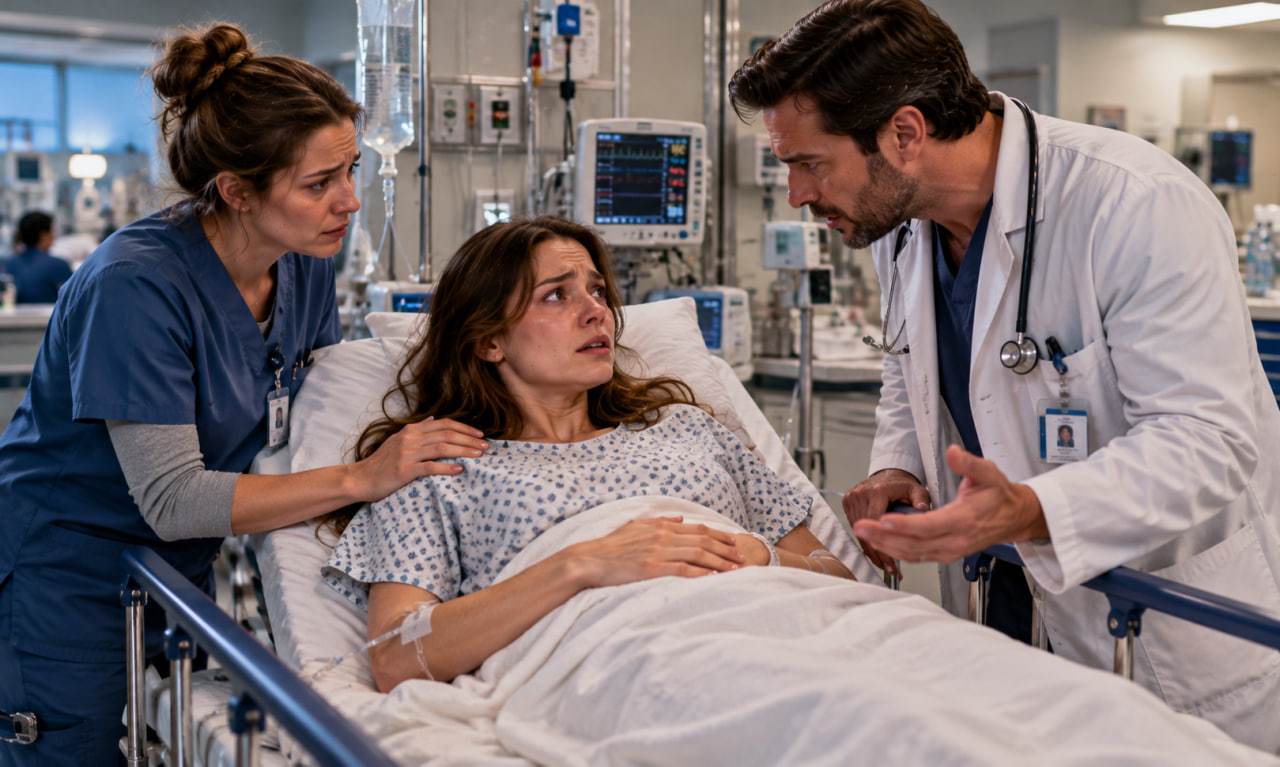
PART 3: The Man My Family Tried to Erase
My mother had once driven forty minutes through a storm because I’d forgotten my lunch at school. My father had stayed awake beside my bed when I had pneumonia as a child.
Those memories were what I held on to as the nurse stepped away to make the calls.
A few minutes later, she returned with an expression I couldn’t quite read.
“Your mother’s phone is switched off.”
I frowned.
“Try my father. He usually keeps his phone on.”
She nodded and left again.
When she came back, she was holding the clipboard against her chest.
“I’m sorry, Harlo. His phone is switched off too.”
For a moment, I simply stared at her.
Both phones?
At the same time?
My parents lived together. They weren’t traveling. They weren’t on vacation. And neither of them had mentioned anything about being unreachable that day.
“Maybe they’re driving,” I said, trying to convince myself. “Could you try again?”
“We will.”
The nurse squeezed my shoulder before leaving.
I watched the clock on the wall.
Every minute seemed longer than the last.
My abdomen hurt so badly that I could barely think, but beneath the physical pain, another feeling was growing.
Fear.
Not the fear of surgery.
The fear of discovering that the people I had trusted my entire life might not be there when I needed them most.
Twenty minutes later, the anesthesiologist arrived.
He introduced himself, explained what would happen, and asked whether I had any allergies.
I answered his questions mechanically.
Then he asked, “Is someone coming to stay with you afterward?”
I opened my mouth.
Nothing came out.
The nurse beside him looked down at my chart.
“There is another emergency contact listed here,” she said slowly. “It’s an older entry. The number is still active, apparently.”
I barely heard her.
“Who?”
She studied the page.
“Elias Vane.”
My entire body went cold.
For a moment, I forgot the pain.
I forgot the hospital room.
I forgot the surgeon waiting for me.
All I could hear was that name.
Elias Vane.
My older brother.
The man my family hadn’t spoken to in almost two years.
The man my parents had taught me to blame for everything that went wrong in our family.
The man whose name had become forbidden at our dinner table.
“Don’t call him,” I whispered.
The nurse looked at me. “Are you sure?”
“Yes.”
But even as I said it, I realized I wasn’t sure of anything anymore.
Because Elias was the one person who had never abandoned me.
Not when I was frightened as a child.
Not when I failed my first university examination.
Not when I cried in the bathroom after my father told me I was too weak to succeed in life.
Elias had always been there.
Until the night our family fell apart.
I turned my face toward the wall.
“Just put me to sleep,” I said. “Please.”
The anesthesiologist glanced at the nurse.
She hesitated, then lowered the clipboard.
“Of course.”
But as she began preparing the medication, my mind returned to the last conversation I had ever had with my brother.
It had happened in our parents’ living room.
Elias stood near the front door, holding a small suitcase. His face was pale, and his eyes were red.
My father stood between him and the rest of us.
“You are no longer welcome in this house,” Dad had said.
My mother was crying, but not the way mothers cry when they are about to lose a child.
She was angry.
“You betrayed this family,” she told him. “After everything we’ve done for you.”
Elias looked at me.
I was twenty-seven then, standing beside the staircase, too frightened to say anything.
“Har, you know me,” he said. “You know I would never do what they’re accusing me of.”
I wanted to believe him.
But my father had shown us documents. Bank statements. Transfers. Messages taken from Elias’s phone.
He claimed Elias had stolen money from the family business and secretly planned to leave us with its debts.
My brother insisted the documents had been manipulated.
My parents called him a liar.
Then Elias looked at me one last time.
“You don’t have to defend me,” he said quietly. “But someday, when you discover the truth, I hope you remember that I gave you a chance to listen.”
I had lowered my eyes.
He left that night.
And I never called him.
Not once.
Now, lying on a hospital bed with my life suddenly uncertain, I wondered whether he had ever stopped waiting for me to do so.
“Your blood pressure is dropping slightly,” the anesthesiologist said. “We’re going to proceed.”
A nurse adjusted my oxygen mask.
I closed my eyes.
And then I heard hurried footsteps outside the curtain.
“I’m looking for Harlo.”
The voice was deep, breathless, and painfully familiar.
I opened my eyes.
The curtain moved.
A man stepped into the room wearing a dark jacket over a gray shirt. His hair was shorter than I remembered, and there was a faint scar near his left eyebrow that hadn’t been there two years earlier.
He looked older.
Tired.
But the moment his eyes found mine, his expression changed completely.