My sixteen-year-old daughter disappeared from a busy beach without her phone, her sandals or any explanation.
Eight years later, the first real clue I found wasn’t a police phone call or a message.
It was a faded turquoise piece of clothing worn by a stranger.
And the moment I saw the crooked yellow sun embroidered near the hem, I knew exactly who it had once belonged to.
My daughter, Nora.
Eight years earlier, we’d spent the day on a busy beach.
Nora told me she was walking to the ice cream stand at the far end of the street.
I watched her leave.
I remember thinking how much taller she’d gotten that year.
Twenty minutes passed.
Her towel was still beside mine.
Her sandals were neatly on top.
Her phone was still in her bag.
At first, I was irritated.
Then confused.
Then terrified.
Rescue workers searched the water.
Police checked the restrooms, parking lots, nearby hotels and roads leading away from the beach.
They found the ice cream stand.
But none of the employees remembered seeing Nora.
There were no usable camera images.
No witness could explain where she’d gone.
Nothing.
The Crooked Yellow Sun
The last thing Nora had been wearing was a turquoise beach cover-up my mother had sewn for her that spring.
It was lightweight cotton, loose enough to wear over her swimsuit.
My mother had embroidered Nora’s initials, NV, inside the lower hem.
During the first day of our vacation, Nora caught a corner of the fabric on a piece of driftwood and tore it.
My mother repaired it herself.
Instead of hiding the damaged spot, she stitched a small yellow sun over it.
The sun was slightly crooked.
“It looks weird now,” Nora said.
My mother smiled.
“It looks unique.”
Nora rubbed the stitching between her fingers.
“I think I like it better this way.”
I remembered those words for eight years.
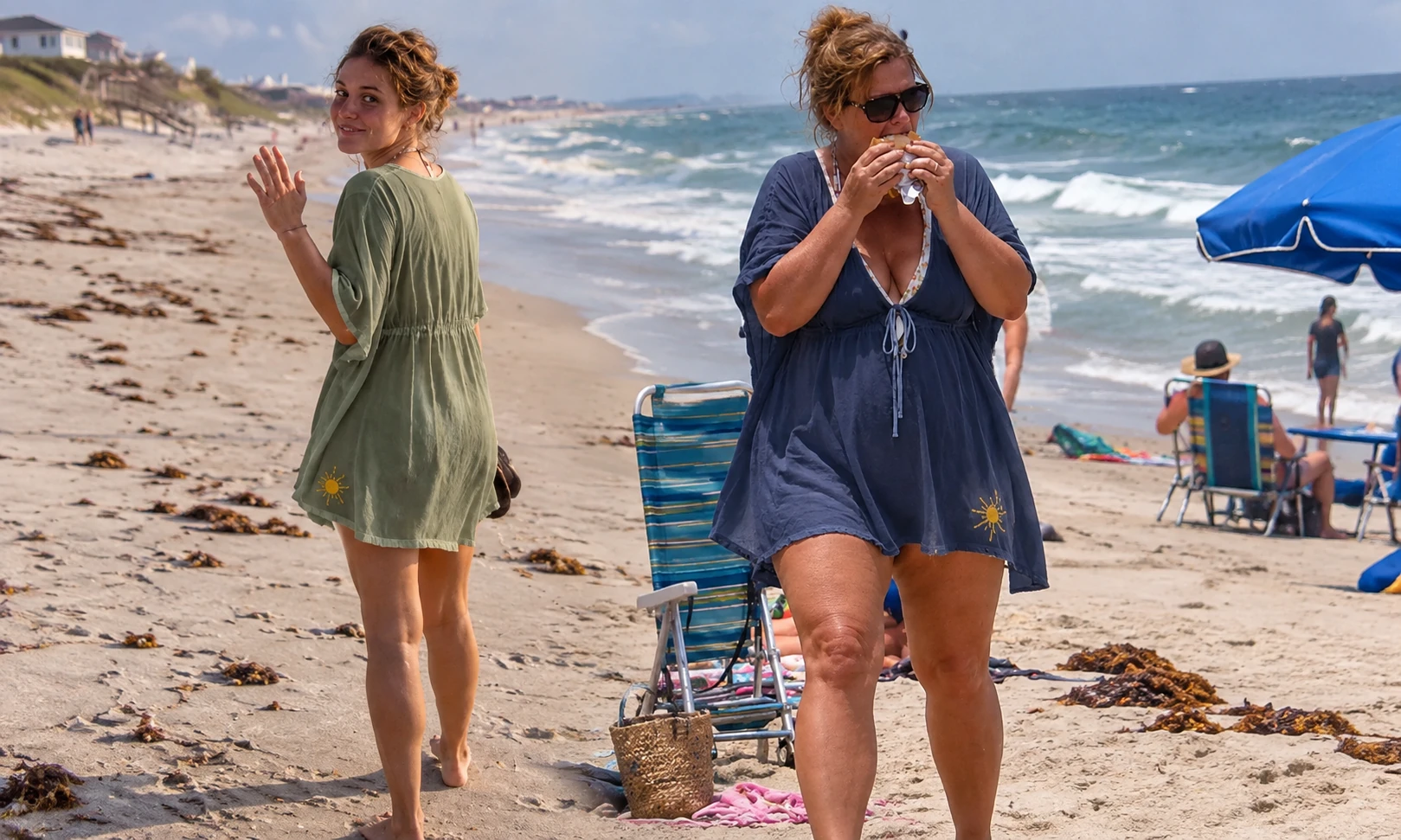
About forty minutes before Nora disappeared, I’d taken a photograph of her wearing that cover-up.
She stood barefoot in the sand, squinting against the sun and holding up one hand because she wanted me to stop taking pictures.
That photograph became the image everyone knew.
Police enlarged it.
News stations used it.
Volunteers printed it on flyers.
For years, I studied every detail.
Her face.
Her hair.
The turquoise fabric.
That crooked yellow sun.
None of it brought her home.
Eventually, organized searches ended.
The calls became less frequent.
People who’d once asked what they could do gradually stopped asking.
For everyone else, life continued.
For Michael and me, time simply reorganized itself around Nora’s absence.
My husband became quieter.
I became obsessed with details.
Every report of an unidentified young woman caught my attention.
Every supposed sighting.
Every stranger claiming they’d seen Nora in a supermarket, train station or bus station.
Most led nowhere.
Some were cruel.
Eventually, I stopped going near beaches.
I couldn’t hear waves without being transported back to the afternoon Nora disappeared.
Eight Years Later
When Michael suggested spending a weekend in a coastal town almost six hundred miles from home, I immediately said no.
“It doesn’t necessarily have to be about the beach,” he said.
“It’s literally a seaside resort.”
“We can eat. Walk around. Sit somewhere. If you don’t like it, we’ll leave.”
I looked at him.
He looked exhausted.
We were both in our forties by then.
And we’d spent eight years building our lives around someone who was gone.
So I agreed.
The first day was difficult.
I refused to go near the water.
We stayed on the boulevard.
Michael bought coffee.
I pretended not to notice families passing with towels and beach toys.
Then we walked past a café with an outdoor terrace.
A woman stood near the railing talking to a waiter.
She looked around fifty, perhaps older.
She was wearing faded turquoise fabric around her shoulders.
My body reacted before my mind did.
I stopped.
There must be thousands of turquoise beach clothes in the world.
I knew that.
Then the wind lifted one corner.
And I saw it.
A tiny yellow sun.
Crooked.
Hand-stitched.
Exactly where my mother had repaired Nora’s cover-up.
I crossed the terrace before I even realized I was moving.
“Excuse me.”
The woman turned.
“Where did you get that?”
She glanced down.
“This?”
“Yes.”
Her expression changed.
“I’ve had it for years.”
“Where did you get it?”
My hands were already shaking.
Michael called my name behind me.
I barely heard him.
I pulled out my phone.
It took several attempts to find the photograph because my fingers wouldn’t cooperate.
Then I held it out to her.
Nora.
Sixteen years old.
Standing barefoot on the beach in that exact turquoise cover-up.
The crooked yellow sun was clearly visible near the hem.
The woman stared at the photograph.
Then at me.
Then over my shoulder.
Suddenly, she grabbed my wrist.
“Put that away.”
Her voice dropped.
“She can’t know you’re here.”
It felt as if the ground disappeared beneath me.
“Who?”
The woman looked frightened.
Or maybe sad.
Then she whispered one word.
“Nora.”
The Daughter I Hadn’t Seen in Eight Years
I turned around.
At first, I couldn’t find her.
There were too many people.
Then I looked through the café window.
A young woman in a black apron was carrying two plates toward a table.
Her dark hair was pulled into a low ponytail.
She was thinner than the girl I remembered.
Older, obviously.
Her face had changed.
But not enough.
I knew her.
A mother knows.
My knees nearly gave out.
Michael caught my arm.
“What is it?”
I couldn’t speak.
The woman beside me grabbed my other hand.
“Please don’t go in there.”
“That’s my daughter.”