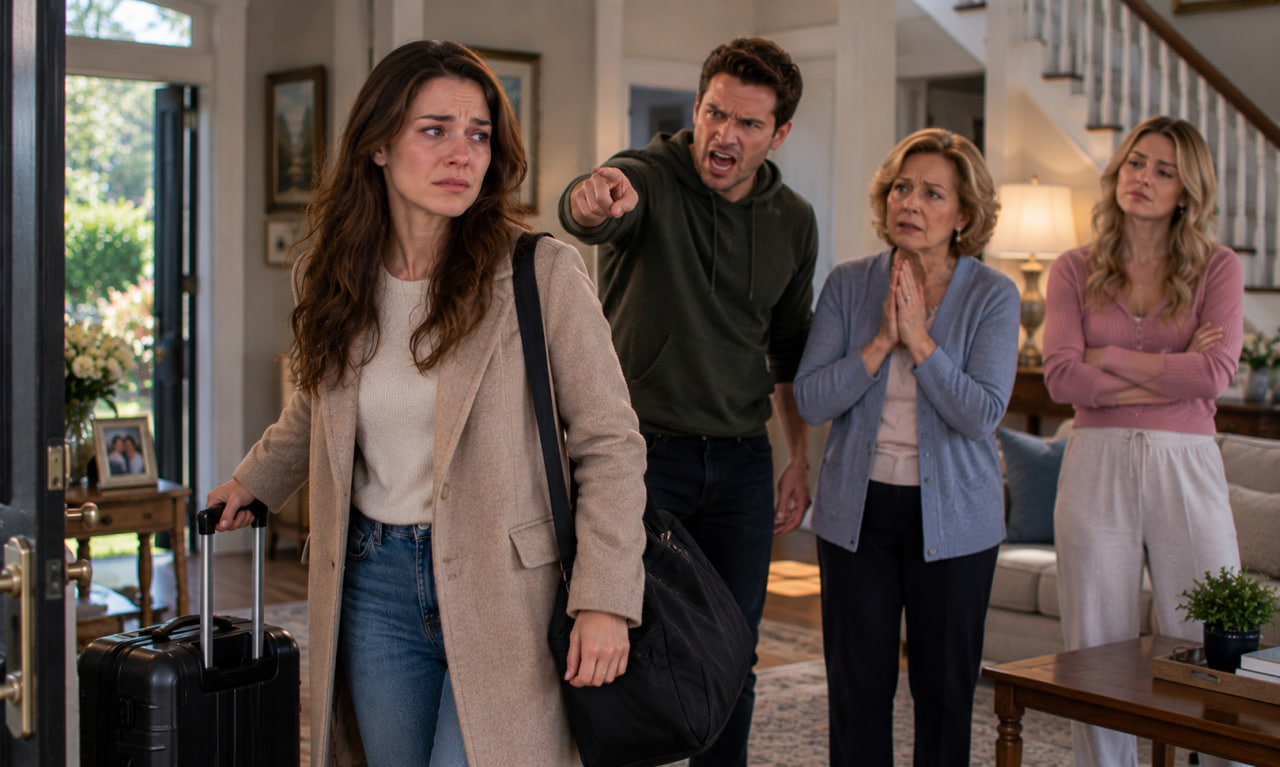
My grandmother left me her house, roughly $600,000 in investments, and almost everything else she owned. Within hours, my sister insisted I should give her half because she had children, and my mother sent one final message: “Transfer it to her or don’t bother coming home.” I refused, booked a flight to Minnesota, and by midnight had 43 missed calls plus an angry voicemail from my father warning me about coming to Grandma’s house. I forwarded it to her attorney. His response made my stomach drop: “Do not meet your family alone at the property.” Then he added that Grandma had left something for me privately—and that she had expected this exact conflict before she died.
PART 3
“Amelia,” he said quietly, “your grandmother specifically instructed me that this recording was to be played for you before you entered the house.”
My mother’s face changed.
“Lawrence, that’s ridiculous. We’re her parents.”
“And I am her attorney,” Whitfield replied.
His tone wasn’t rude.
It was worse.
It was final.
My father stepped forward.
“This is a family matter.”
“No,” Whitfield said. “The estate is a legal matter. And Mrs. Ruth Whitfield was exceptionally clear about how she wanted her final instructions handled.”
My father’s face darkened.
I looked at the leather case in his hand.
“What did she record?”
Whitfield glanced toward my family.
“Not here.”
My mother immediately protested.
“Why not?”
“Because she asked me to make sure Amelia heard it privately.”
Olivia gave a small laugh.
“This is insane. Grandma probably recorded something sentimental. Why are you making it into some kind of secret?”
Whitfield looked at her.
“I would suggest you refrain from guessing what a deceased person’s final wishes were.”
That silenced her.
He turned back to me.
“There’s a small conference room at my office ten minutes from here. We can listen there.”
I looked at the house.
The place I’d come to see.
The place where I’d spent every Christmas morning with Grandma. Where she’d taught me how to make apple pie. Where she’d kept a jar of peppermint candies on the kitchen counter even though she knew I was too old for them.
I had imagined walking through that front door.
Instead, I was standing outside while my family watched me like I was an intruder.
“Can we listen now?” I asked.
Whitfield nodded.
“Yes.”
My father stepped forward.
“I’m coming.”
“No.”
The word came from Whitfield so quickly that Dad actually stopped.
“You don’t understand,” Dad said.
“I understand perfectly.”
“You can’t keep me away from my mother’s house.”
“I am not keeping you away. I’m advising Amelia not to enter the property until we resolve several legal matters.”
“What legal matters?”
Whitfield looked at him.
“That is precisely what we’re going to discuss.”
My stomach tightened.
There were legal matters.
Plural.
And Grandma had anticipated them.
I followed Whitfield to his car.
As I passed my mother, she grabbed my wrist.
Her fingers tightened around me.
“Amelia.”
I looked down at her hand.
Then at her face.
“Let go.”
She did.
But her eyes were no longer angry.
They were afraid.
That frightened me more than anything else.
Because my mother was rarely afraid.
I walked away.
Whitfield’s office was small, quiet, and lined with shelves of old legal books. He closed the door behind us and placed the leather case on the table.
He removed a small digital recorder.
“I received this from your grandmother six days before she passed.”
He pressed a button.
Static filled the room.
Then I heard her voice.
My grandmother.
Older than I remembered.
A little breathless.
But unmistakably her.
“Amelia, sweetheart.”
My throat closed.
I hadn’t heard her voice since the hospital.
I gripped the edge of the chair.
The recording continued.
“If you’re hearing this, then I’m gone. And if Lawrence is doing what I asked, you’re probably sitting somewhere wondering why your grandmother needed to leave you a recording at all.”
A soft chuckle.
“You always did overthink everything.”
I smiled despite myself.
Then her voice became serious.
“I know what your parents will ask you to do.”
I stopped breathing.
“I know Olivia will say she needs the money more than you. I know your mother will tell you that you’re selfish because you’re unmarried and don’t have children. And I know your father will tell you that family comes first.”
My eyes burned.
Whitfield remained silent.
Grandma continued.
“They’ve been saying those things for years.”
A pause.
Then:
“But Amelia, I want you to understand something.”
Her voice softened.
“You are not being selfish.”
I closed my eyes.
“You are not responsible for fixing the life your sister chose. You are not required to sacrifice your future because other people decided theirs was more important.”
A tear slipped down my cheek.
Then she said something that made my heart stop.
“And there is something you don’t know.”
The recording crackled.
“I didn’t leave you everything because I loved you more.”
My eyes opened.
“I left it to you because you are the only person in this family I trust to protect what I built.”
Whitfield looked at me.
I stared at the recorder.
Grandma continued.
“The money isn’t the important part.”
A long pause.
“The house isn’t the important part either.”
My heart began pounding.
“What matters is what happened in this house.”
The recording stopped.
I looked at Whitfield.
“What does that mean?”
He didn’t answer immediately.
Instead, he reached into the leather case and removed a second envelope.
It was thick.
Cream-colored.
My name was handwritten across the front.
AMELIA.
I recognized the handwriting instantly.
My grandmother’s.
“She gave me this at the same time,” Whitfield said. “She told me not to open it. It belongs to you.”
My fingers trembled as I took it.
There was another instruction written underneath my name.
OPEN ONLY AFTER HEARING THE RECORDING.
I broke the seal.
Inside was a single sheet of paper.
My grandmother had written:
Amelia,
If you’re reading this, they have probably already started asking you to give away what I intentionally left to you.
Please don’t.
Not yet.
There are things you don’t know.
Things I should have told you years ago.
The house is yours.
The accounts are yours.
But more importantly, the truth is yours.
Ask Lawrence for the blue folder.
Then ask him why your father has been afraid of this house for twenty-seven years.
Love,
Grandma Ruth
I read the final sentence twice.
Then a third time.
“Why is my father afraid of this house?”
Whitfield leaned back.
“That,” he said, “is the question your grandmother wanted you to ask.”
I looked at him.
“What happened twenty-seven years ago?”
He sighed.
“Your grandmother gave me strict instructions not to tell you until after her death.”
“What happened?”
He opened the leather case again.
This time he pulled out a blue folder.
It was old.
The edges were worn.
There was a faded date stamped on the front.
I stared at it.
“My father was afraid of this house?”
“Your grandmother believed he was.”
“Why?”
Whitfield hesitated.
Then he said something I never expected.
“Because twenty-seven years ago, your father tried to convince your grandmother to sell this property.”
“Why?”
“He needed money.”
My stomach dropped.
“For what?”
Whitfield slid the folder toward me.
“That is where things become complicated.”
I opened it.
The first document was a bank statement.
Then another.
Then another.
All in my father’s name.
Large withdrawals.
Cash advances.
Loans.
Payments.
But the dates were what caught my attention.
And then I saw a familiar name.
Olivia.
I stared at it.
“She was born in 2001.”
Whitfield nodded.
“Yes.”
My hands went cold.
There were hospital bills.
Medical records.
Insurance claims.
But none of them were for Olivia.
They were for someone else.
A baby.
A child whose name had been blacked out.
I looked at Whitfield.
“Who is this?”
He didn’t answer.
I turned another page.
There was a police report.
My eyes moved down the page.
Then stopped.
I couldn’t breathe.
The report was dated October 14, 1999.
The location was my grandmother’s house.
I read the first line.
My father had reported a break-in.
But Grandma had written a note across the top in red ink.
FALSE REPORT.
I looked up.
“Why would Dad report a fake break-in?”
Whitfield folded his hands.
“Because something disappeared from the house.”
“What?”
He looked directly at me.
“A safe.”
I frowned.
“What was inside it?”
“Records.”
“What records?”
He was quiet for several seconds.
“Financial records. Property records. And one document your grandmother considered extremely important.”
“What document?”
“A letter.”
“From whom?”
Whitfield’s expression hardened.
“Your father’s first wife.”
The room seemed to tilt.
“My father was married before my mother?”
Whitfield nodded.
I stared at the folder.
My father had never mentioned another marriage.
Not once.
Not even casually.
My mother had never mentioned it either.
“Who was she?”
“Her name was Rebecca.”
“What happened to her?”
Whitfield didn’t answer.
Instead, he reached into the folder and pulled out a photograph.
He placed it on the table.
A young woman stood beside my father.
She was smiling.
She looked happy.
And in her arms was a baby.
I stared at the baby’s face.
There was something strangely familiar about the shape of her eyes.
I looked at the woman’s name written on the back.
Rebecca Hale.
And beneath it:
Amelia — 6 months.
My heart stopped.
“No.”
The word barely came out.
Whitfield watched me carefully.
“That’s you.”
I looked at him.
“No.”
“Your grandmother believed your parents had lied to you about your birth.”
I shook my head.
“My parents are my parents.”
“Biologically, your mother may not be.”
I couldn’t speak.
The room suddenly felt too small.
I looked back at the photograph.
The baby.
Me.
My father.
A woman I’d never heard of.
“Where is she?”
Whitfield lowered his eyes.
“Dead.”
“When?”
“Twenty-seven years ago.”
The exact number.
Twenty-seven.
The same number Grandma had written.
I stood so quickly my chair scraped backward.
“How?”
Whitfield didn’t answer.
I slammed my palm against the table.
“How did she die?”
He finally looked at me.
“Your grandmother believed your father knew more than he ever admitted.”
I felt sick.
“Are you saying my father killed her?”
“No.”
The answer came firmly.
“I am saying your grandmother suspected your father was involved in circumstances surrounding her death. She never had enough evidence to prove it.”
I stared at him.
“And my mother?”
“Your mother became part of your father’s life shortly afterward.”
My hands were shaking.
“How shortly?”
“Three months.”
I sat down again.
Three months.
A dead woman.
A new wife.
A baby.
A missing safe.
A false police report.
And my entire childhood suddenly felt like a story someone else had written.
Whitfield pushed another document toward me.
“This is the letter your grandmother mentioned.”
I unfolded it.
The paper was brittle.
The handwriting was hurried.
I read:
Ruth,
If anything happens to me, please protect my daughter.
Daniel knows about the account.
He knows about the house.
He knows I won’t give him what he wants.
If I disappear, don’t believe what he tells you.
Please don’t let him raise her.
She deserves better.
Rebecca
My vision blurred.
I read the final line.