I stood in that doorway for what felt like a long time before I said anything. The cold was coming in around her, the particular sharp cold of October that smells like wet leaves and ending things, and she stood on my front step with her handbag held in front of her like a prop and her careful clothes and her face that had aged in ways I recognized because I had my own mirror and we shared the same bone structure, the same jaw, the same eyes that I had always considered mine and now, looking at her, had to reckon with as borrowed. “What are you doing here,” I said. It was not a question. The inflection was flat, the kind of flat that comes not from coldness but from having no energy left for the performance of a reaction. She had caught me at the bottom of everything. I had nothing left to arrange my face into. She said she had heard about Grandma. She said she was sorry for my loss, and the phrase landed with the hollow thud of language that has been used so many times it has worn through to nothing, and I thought about Grandma’s hand over mine in the back seat of the car and the slow circles her thumb made on my knuckles and the word loss did not begin to approach it. I asked her how she had heard. She said a cousin had called. I did not know which cousin and did not ask. I stepped back from the door because the cold was getting in and because my legs were tired and because some part of me that I could not fully argue with needed to know what came next, needed to hear the rest of it, the way you need to hear the end of a story even when you already know it will not be the ending you wanted. She came inside and looked around the way people look around when they are trying to read a room for information and I watched her take in Grandma’s furniture, the photographs on the wall, the sympathy cards spread across the kitchen table, and I watched her register that this had been a life fully lived and fully witnessed and that she had not been part of it. I did not offer her tea. I sat down at the kitchen table and she sat across from me in the chair that had been Grandma’s chair for thirty years and I noticed that and said nothing about it and she began to talk. She talked for a long time. She talked the way people talk when they have prepared what they are going to say but are discovering, in the saying of it, that it does not hold together the way it did in their head. She said she knew she had made mistakes. She said those years were complicated, that she had been young and overwhelmed and that Daniel had needed her in ways she hadn’t anticipated and that Marcus had been a difficult baby and that she had told herself I was resilient, that children are resilient, that I had Grandma and Grandma was wonderful and I would be fine. She said she had thought about reaching out many times. She said she had drafted letters she never sent. She said she had followed my life from a distance through the cousin network that apparently still operated without my knowledge, had known about my job and a relationship that had ended badly at twenty-seven and a move I had made two years ago to the house I was sitting in now, and the idea of this — of being observed from a distance by someone who had chosen the distance — made something in me go very still and cold in a way that had nothing to do with the October air. She was crying by the time she finished, or close to it, the particular careful crying of someone who is aware they are being watched. I sat with my cold coffee and I listened to all of it and when she was done I said, “Why now.” She looked at her hands. She said Marcus was getting married in the spring. She said it was important to her that the family be whole for it, that she wanted him to have a sister present on his wedding day, that she had always imagined her children together at the important moments and this was an important moment and she felt it was time to repair things. I heard the word children and I heard the word repair and I heard the word things and I thought about a craft store and thick paper with a soft texture and pressed flower stickers and gold ink and my most careful handwriting practiced first on notebook paper so I wouldn’t make mistakes and seven words said without malice by a woman who simply meant them and I said, very quietly, “You want me there for him.” She looked up. “For both of you,” she said quickly. “For the family.” “You want me there for Marcus,” I said again, not as a question this time, just as a fact I was placing on the table between us the way you place something down when you want to look at it clearly. She did not correct me a third time. She looked at her hands again and I had my answer, which was not a new answer, only the same answer she had been giving me since I was ten years old and she had simply stopped finding new language for it. I thought about Grandma then, specifically and suddenly, the way grief ambushes you in the middle of things. I thought about what she would have said, sitting in her own chair at this table, watching this scene unfold. She would not have told me what to do. She was not that kind of woman. She believed that people had to arrive at their own truths in their own time and that the most you could do for someone you loved was stay close enough that they didn’t have to travel the whole distance alone. She had stayed close for twenty-two years without ever once making me feel like a burden for needing her, and I had held her hand after she was gone for longer than made sense and now she was three weeks in the ground and her chair was occupied by the woman who had made her necessary, and I was thirty-two years old and more tired than I had words for. My mother was still looking at her hands. The sympathy cards were still spread across the table. Outside the window the October light was doing what October light does, going gold and sideways and beautiful in the way of things that are almost finished, and I thought about the card I had made at eleven, the pressed flower stickers and the stick figures holding hands, and I thought about how I had taken it back without crying, had held it all the way home in my lap, had not cried until I was in my room at Grandma’s with the door closed and the yellow curtains letting in the last of the evening light, and I thought about how even then, even at eleven, some part of me had already understood that the loss was not new. That it had happened earlier, maybe the moment Daniel’s laugh filled the room for the first time, maybe earlier still, and that what happened at the dinner table was just the moment she said it out loud in a language simple enough that even a child couldn’t soften it into something else. I stood up. She looked up at me, uncertain. I went to the counter and poured my cold coffee down the sink and stood there for a moment with my back to her, looking out the window at the yard Grandma had tended for decades, the rosebushes still there, still thorned and stubborn and alive in the way of things built to outlast people. Then I turned around and I looked at my mother — this woman who had given me her jaw and her eyes and absolutely nothing else I could name — and I told her the truth, not cruelly, not with the performance of damage, just plainly, the way Grandma had always said difficult things, like they were simply facts that deserved to be spoken clearly. I told her that I was glad she had come because there were things I had needed to say for a long time and I had not known how to begin them and her sitting in this kitchen had given me a place to start. The crying lasted a long time. I am not someone who cries easily or often — Grandma used to say I had learned to hold things in the way people do when they have had to be sturdy from an early age, and she was right, though she always said it with a gentleness that made it sound less like damage and more like adaptation. But that night, alone in her house with the October dark pressing against the windows and the sympathy cards still spread across the kitchen table and her chair still slightly pulled out from where my mother had sat in it, I cried with the full weight of everything I had been carrying since that Thursday morning three weeks earlier when the nurses said peaceful and I had held her hand anyway because I was not ready. I cried for Grandma and for the eleven-year-old with the handmade card and for every Christmas I had stopped looking for a name in the mailbox and for the version of a mother I had built in my head from movies and other kids’ lives and slowly, over decades, had learned to stop needing. I cried until there was nothing left to cry and then I sat on the kitchen floor in the particular emptied quiet that follows that kind of grief, the kind that has finally said everything it needed to say, and I felt, underneath the exhaustion and the loss and the strange bruised tenderness of the evening, something I had not expected. Something that felt, cautiously and incompletely, like solid ground.
I stayed in Grandma’s house that week and the week after. I had planned to go through her things methodically, the way responsible adults go through the belongings of the people they have lost, sorting and donating and deciding, but I found I could not be methodical about it and stopped trying. Instead I moved through the rooms slowly, picking things up and putting them down, reading the spines of her books, opening the recipe box on the counter and finding her handwriting on index cards in the particular looping cursive she had used her entire life. Her handwriting was so fully hers that the first time I found a card I had to put it down and walk away and come back. By the end of the week I had read every recipe in the box. I could not have told you what most of them were for. I just needed to see her writing. I needed evidence of her, everywhere, while I still had it in its original form, before time and distance did what they do. Her lawyer called on a Friday morning, a pleasant woman named Helen who had handled Grandma’s affairs for fifteen years and who spoke to me with the warmth of someone who had heard a great deal about me secondhand and was meeting me under circumstances she wished were different. She asked if I could come to her office the following week to go through the estate. I said yes. I wrote down the address on the notepad by the phone, the one with Grandma’s grocery lists on the first several pages, and I sat with the notepad in my lap for a while after I hung up, reading the lists. Bread. The good butter. Chamomile tea. Oranges if they look good. The ordinariness of it was its own kind of undoing, the evidence of a life that had expected to continue, that had made plans for next week’s breakfast table, that had not known October was coming. I tore the lists out carefully and folded them and put them in the pocket of my cardigan and wore the cardigan for the rest of the day.
Helen’s office was warm and book-lined and smelled like coffee and old paper in a way that reminded me, unexpectedly, of Grandma’s study. Helen brought out the estate documents and walked me through them with quiet efficiency, pausing to answer questions and checking my face periodically the way good lawyers do when they are delivering information they know carries more weight than information usually does. The house came to me. The savings, modest and carefully tended over decades of sensible living, came to me. A small investment account I had not known existed came to me. And there was a letter, in an envelope with my name on it in the looping cursive from the recipe cards, which Helen placed on the table in front of me and said Grandma had left with instructions that it be given to me in person at this meeting, after the practical matters had been addressed, because she had wanted me to have context before comfort. I looked at the envelope and thought that this was so entirely her — practical first, feeling after, everything in its right order — that I had to press my lips together for a moment before I could pick it up. Helen excused herself to get more coffee and I understood that this was deliberate and was grateful for it and opened the envelope alone. She had written it six months before she died. Her handwriting was slightly less steady than the recipe cards, the letters a little more careful in the way of someone who knows they are writing something that will be read after, but it was still entirely hers, still the same voice I had been hearing my whole life, and reading it felt like being in the same room with her and also like the room being very empty, both at once, which is the paradox of the letters people leave behind. She said she was not going to waste the letter on things I already knew, like how much she loved me, because I knew, she was certain I knew, and she had made sure to show me rather than simply say it and she trusted the showing had taken hold. She said she wanted to tell me something she had never said out loud because she believed some things were better carried quietly until the person was ready to put them down. She said she had been angry at my mother for a very long time. Furious, she wrote, in the specific and enduring way of someone who has watched a child be failed by the person most responsible for not failing them, and she had made a decision early on that she would not let that anger live in the house where she was raising me because children absorb the emotional weather of their homes and I had already weathered enough. So she had kept it outside, had carried it somewhere else, and inside the house she had built something different — not a performance of peace but an actual one, constructed deliberately, maintained by choice, the way you maintain a garden, which is to say by showing up every day whether you feel like it or not. She said this not for credit but because she wanted me to understand that love is not a feeling that arrives and stays without effort. It is a practice. It is the decision made again every morning to show up for someone, to put their flourishing above your own convenience, to be the kind of person who opens the door wider and says your room is the one with the yellow curtains and means it without reservation. She said she had made that decision the night I arrived with two garbage bags and she had never once had cause to question it. She said I had been, without a doubt, the greatest privilege of her life. She said she hoped I would be gentle with myself in the time ahead, that grief was not a problem to be solved but a space to be moved through, and that I was more capable of moving through hard things than I gave myself credit for, and that she would be watching with the particular satisfaction of someone who already knew how the story ended. She signed it simply, the way she had always signed birthday cards and notes left on the counter and the small folded pieces of paper she used to put in my lunch when I was small and Daniel had learned about from Grandma without ever knowing why I lit up every day at the lunch table. She signed it Mom.
I sat in Helen’s office and held the letter and let the word settle into me, that one word at the bottom of the page that was both the simplest thing she could have written and the largest.
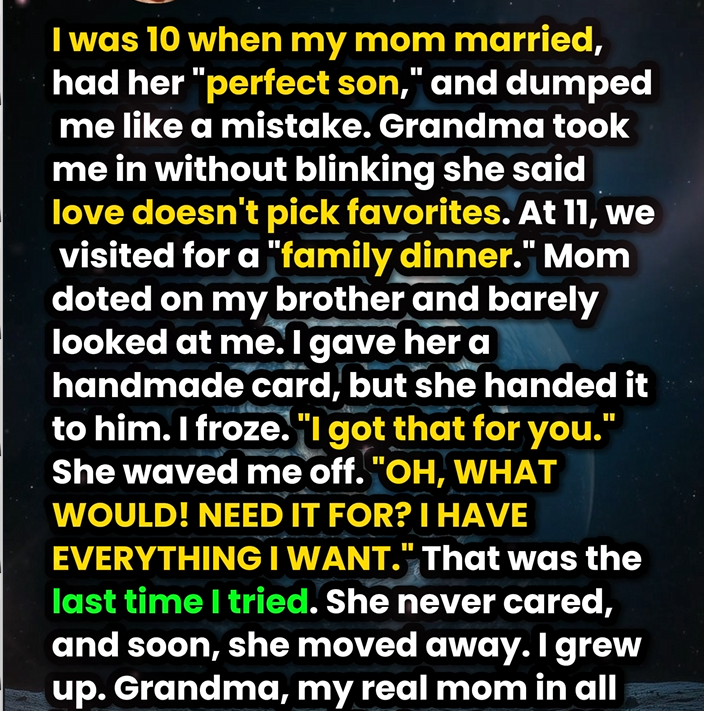
I was 10 when my mom married, had her “perfect son,” and dumped me like a mistake.