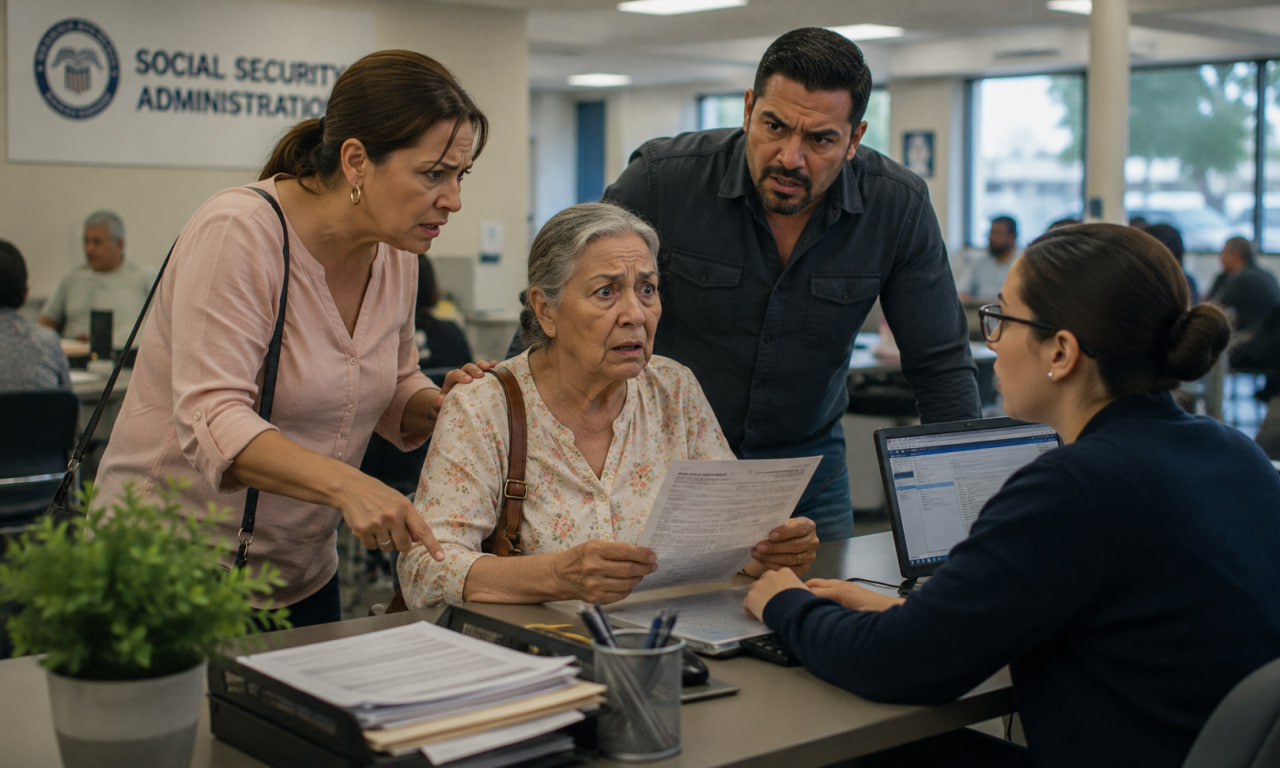
My daughter Paula took me to the Social Security office saying she wanted to “help” me apply for benefits, but the moment the clerk entered my number, her expression changed. She checked my ID twice, closed the laptop halfway, and quietly told me, “Ma’am… according to our records, you died three years ago.” Paula immediately tried to pull me out of the office. I refused. Then the clerk revealed something worse: a benefits card had already been issued in my name, and nearly $1,800 a month had been paid out while I struggled to keep my electricity on. When I asked where the card had been mailed, the clerk hesitated before turning the screen toward me. I recognized the address instantly—and suddenly, Paula wouldn’t meet my eyes.
PART 3
She finally turned the screen slightly toward me.
I read it.
My hands went cold.
It was an address I knew.
Not because I had ever lived there.
Because I had spent twenty years believing it was the place where my husband had disappeared.
“That’s impossible.”
Paula suddenly grabbed my shoulder.
“Mom, we need to go.”
I pulled away.
“No.”
“Mom.”
“No.”
My voice was louder this time.
People in the waiting area turned toward us.
Brenda immediately closed the laptop.
“Mrs. Miller, please don’t leave until you speak with the supervisor.”
Paula’s face tightened.
“There is obviously some computer error.”
Brenda looked directly at her.
“Computer errors don’t usually include three years of payments.”
Silence.
I felt as if someone had punched me in the stomach.
“Three years?”
Brenda nodded.
“Payments were issued monthly.”
“How much?”
She looked at the screen.
Then at me.
“Approximately one thousand eight hundred dollars per month.”
I couldn’t breathe.
One thousand eight hundred dollars.
Every month.
For three years.
That was more than sixty thousand dollars.
Money I had never seen.
Money someone had collected while the government believed I was lying somewhere in a grave.
I thought about my electricity being shut off twice.
I thought about eating toast for dinner.
I thought about skipping my blood pressure medication because I couldn’t afford to refill it until Friday.
I thought about my grandchildren wearing shoes with holes in the soles.
And someone had been receiving nearly two thousand dollars every month in my name.
I turned slowly toward Paula.
She was staring at the floor.
“Who?”
She didn’t answer.
“Paula.”
Nothing.
“Look at me.”
She finally raised her eyes.
And there it was.
Fear.
Not confusion.
Not surprise.
Fear.
My stomach twisted.
“You knew.”
“No.”
“You knew.”
“Mom, I swear—”
“You knew I was listed as dead.”
“I didn’t!”
“Then why aren’t you surprised?”
Her lips trembled.
“I am surprised.”
“No, you’re scared.”
Jared suddenly appeared beside us.
“What’s going on?”
Paula looked at him.
For half a second, they communicated without speaking.
I saw it.
The look between them.
The look of two people who had just realized their secret was no longer safe.
Jared stepped closer.
“Mrs. Miller, let’s just go home and figure this out.”
I stared at him.
“How do you know what happened if you just got here?”
He froze.
“You called me.”
“I didn’t.”
Paula immediately interrupted.
“I called him.”
“When?”
“This morning.”
I looked at Brenda.
She was watching them carefully.
Then Brenda said something that changed everything.
“Ma’am, there is one more issue.”
I almost laughed.
“Of course there is.”
She lowered her voice.
“The death record was reported by a funeral home.”
I frowned.
“A funeral home?”
“Yes.”
“Which one?”
She read the information from the screen.
Then she said the name.
I knew it.
Everyone in Pontiac knew it.
It was the funeral home where I had buried my mother.
I had been there countless times.
I had stood in that building beside my mother’s coffin.
But there was something impossible about it.
“I never went there three years ago.”
Brenda nodded.
“I believe you.”
“Then who did?”
“We don’t know yet.”
I stared at the folded paper in my hand.
Something inside me had gone strangely calm.
Fear had burned itself out.
What remained was anger.
Cold, quiet anger.
“Can I get a copy of everything?”
Brenda shook her head.
“Not everything from this terminal. But I can tell you what steps to take.”
She wrote down a number.
“Inspector General.”
Then another.
“Identity theft division.”
Then she wrote:
DO NOT SIGN ANYTHING.
She underlined it twice.
Paula reached for my arm again.
I moved away before she could touch me.
“I’m going home.”
“Mom—”
“Alone.”
Her face changed.
“Don’t be ridiculous.”
“I said alone.”
Jared stepped forward.
“You don’t understand what you’re dealing with.”
I looked at him.
“Neither do you.”
He smiled.
It was the first time I had ever seen his smile disappear so quickly.
We walked outside.
The August heat hit my face.
I stood on the sidewalk with my tote bag pressed against my chest.
Paula followed.
“Mom, listen to me.”
I didn’t turn around.
“This isn’t what you think.”
I stopped.
“Then tell me what it is.”
Silence.
“Tell me.”
She couldn’t.
That was the answer.
I started walking toward the bus stop.
Paula grabbed my wrist.
“You can’t just leave.”
I pulled free.
“Apparently I already did.”
She stared at me.
“What does that mean?”
I turned.
“It means the government thinks I’m dead.”
I pointed at my chest.
“But I’m standing right here.”
Then I walked away.
I didn’t go home immediately.
I sat at a small diner three blocks from the office.
I ordered coffee.
Black.
No sugar.
The waitress brought it with a piece of pie I hadn’t ordered.
“On the house,” she said.
I almost cried.
Not because of the pie.
Because kindness felt strange after what had just happened.
I sat there for almost two hours.
I kept thinking about that address.
The address connected to Sam.
My husband.
The man I believed had abandoned us.
The man I had mourned without a body.
For twenty years, I told Paula that her father probably died alone somewhere.
She hated when I said that.
“Then why didn’t he come back?” she once asked.
I didn’t have an answer.
I always told her the same thing.
“Maybe he couldn’t.”
Maybe he didn’t want to.
Maybe he was dead.
Maybe he had another family.
I had imagined every possibility except this one.
I pulled the paper Brenda had given me from my bag.
There was the address.
I stared at it.
Then I realized something.
The address was only twelve miles from my house.
How had I never known?
Because Sam disappeared when Paula was nine.
Back then, we lived in another part of Michigan.
I had spent years searching.
Hospitals.
Police stations.
Missing-person databases.
Even newspapers.
Nothing.
Then eventually I stopped.
Life became too expensive to keep searching for a man who had chosen to disappear.
But now the government had connected my identity to an address tied to his past.
I needed answers.
So I did something I hadn’t done in twenty years.
I searched for Sam.
I found nothing.
Then I searched the address.
An old property listing appeared.
The house had been sold three years ago.
Three years.
The exact same year I had supposedly died.
My hands began shaking.
I called the number on the listing.
A woman answered.
“Hello?”
“Hi. I’m calling about the house on Maple Street.”
“Which one?”
I gave her the address.
“Oh, that property sold a while ago.”
“Do you remember who bought it?”
“Are you a relative?”
“Yes.”
She paused.
“I might have the old records.”
My heart began racing.
“Please.”
There was silence.
Then typing.
“I have the buyer’s name.”
“Who?”
She hesitated.
“Samuel Miller.”
I nearly dropped the phone.
“That’s my husband.”
“Your husband?”
“Yes.”
“But that’s impossible.”
“Why?”
“Because Mr. Miller told us his wife was dead.”
The diner seemed to disappear around me.
I could hear only my own breathing.
“What did you say?”
“He said his wife died several years ago.”
My fingers went numb.
“Did he have a daughter?”
“Yes.”
“What was her name?”
Another pause.
“Paula.”
I closed my eyes.
My daughter.
My husband.
The house.
The death record.
The benefits.
Everything suddenly connected.
But there was one piece I couldn’t understand.
If Sam was alive…
Why had he never contacted me?
And why had he needed me to be declared dead?
I didn’t tell Paula what I had discovered.
I went home and locked the door.
For the first time in twenty years, I checked every window before going to bed.
At 10:47 p.m., someone knocked.
Three times.
I didn’t move.
Then I heard Paula.
“Mom?”
I stayed silent.
“Mom, please open the door.”
I didn’t.
She knocked again.
“Please.”
I finally spoke through the door.
“What do you want?”
“I want to explain.”
“Then explain from there.”
Silence.
“I didn’t know about the death record.”
“You’re lying.”
“I’m not.”
“Then tell me why you and Jared wanted my Social Security card.”
She didn’t answer.
I waited.
Finally she whispered:
“Because we needed it.”
My stomach dropped.
“Why?”
“Mom, I can’t explain here.”
“You can explain now.”
Another voice came from behind her.
Jared.
“Paula, let’s go.”
I stepped away from the door.
“Why are you afraid of me?”
No answer.
Then Jared spoke.
“You need to stop digging.”
My heart froze.
“What did you say?”
“You’re making this worse.”
“Who are you protecting?”
Silence.
“Jared.”
He didn’t answer.
“Are you protecting my husband?”
No response.
That was enough.
I opened the door.
Paula looked terrified.
Jared looked furious.
“Where is Sam?”
Paula began crying.
Jared grabbed her arm.
“Get in the car.”
I shouted.
“Where is my husband?”
He looked at me.
Then he said four words I’ll never forget.
“He’s not your husband anymore.”
I stared at him.
“What does that mean?”
Jared pulled Paula toward the car.
I followed them to the driveway.
“Paula!”
She stopped.
She turned around.
And through her tears, she whispered:
“Mom… Dad isn’t dead.”
Then she got into the car.
They drove away.
I stood in the driveway under the porch light.
Twenty years.
Twenty years believing my husband was dead.
Twenty years telling my daughter her father had abandoned us.
And now I knew he was alive.
But I still didn’t understand the biggest question.
Why had my own daughter helped him erase me?