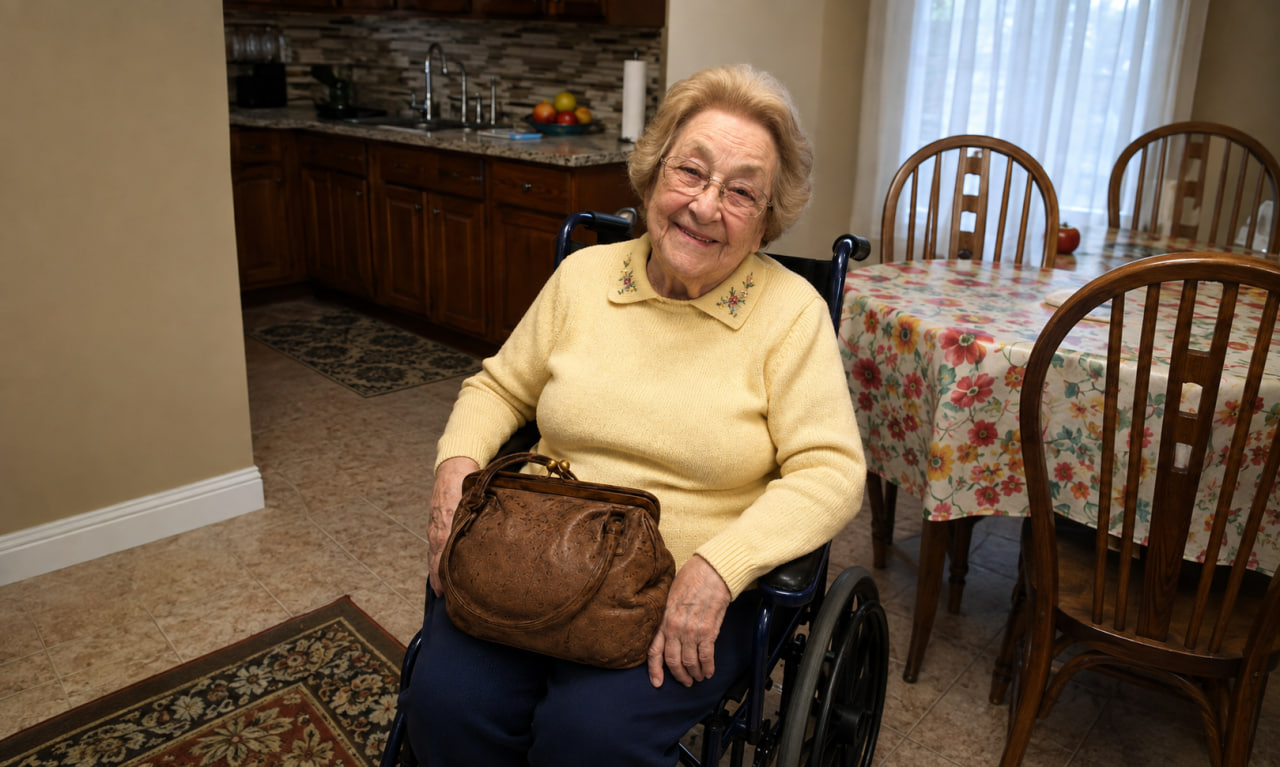
Minutes before my grandmother’s funeral ended, I suddenly remembered the faded brown handbag she had guarded for years and made us promise to bury with her. I rushed back to her empty house, pulled it from the highest closet shelf, and finally opened it. Inside were 11 envelopes, a locked wooden box, and a tiny brass key engraved 1974. Then I noticed an old black-and-white photograph hidden beneath the lining. Grandma Nancy stood beside a little boy I had never seen before. On the back were the words: “Nancy. David. October 1974.” Before I could understand what it meant, my mother called from the church. My uncle had recognized the boy. Then she lowered her voice and said, “Emily… he was supposed to have died in 1974.”
My hands were trembling so badly that I nearly dropped the bag.
There was something about those envelopes that frightened me more than anything else.
They weren’t addressed to the grandchildren as a group.
Grandma had written each name individually.
Daniel.
Sarah.
Michael.
Rachel.
Thomas.
Jessica.
One by one, the names of every grandchild stared back at me.
And then mine.
But that wasn’t what made my heart stop.
At the very bottom of the handbag was another envelope.
It was larger than the others.
And unlike the rest, it had no name on it.
Only three words.
FOR THE FAMILY.
I sat completely still.
The funeral.
My family was waiting for me.
Grandma’s casket was waiting for the handbag.
And I had just discovered something she had apparently spent years preparing.
I remembered her final conversation with me.
It had happened only two weeks before she died.
She had been sitting beside the bedroom window, wrapped in her blue cardigan, watching the rain.
“Emily,” she’d said softly, “people think secrets are always meant to be hidden.”
I had smiled.
“Isn’t that what a secret is?”
She shook her head.
“No, sweetheart. Sometimes a secret is simply something that isn’t ready to be understood.”
At the time, I thought she was talking about the handbag.
Now I wasn’t so sure.
I reached for my envelope.
My name was written in Grandma’s unmistakable handwriting.
I turned it over.
There was no seal.
No warning.
Nothing to stop me.
Yet I couldn’t open it.
My fingers hovered above the flap.
A strange fear had settled over me.
What if I discovered something about Grandma that changed the way I remembered her?
What if the woman I had adored all my life wasn’t the woman I thought she was?
Then I remembered her words.
“Because the moment you open it, everything will finally make sense.”
I broke the seal.
Inside was a single sheet of paper.
I unfolded it slowly.
The first line made my heart pound.
Dear Emily, if you are reading this, then I am already gone.
I stopped.
My eyes filled with tears.
I continued.
I know you will be frightened. You will probably be angry with me. You may even wish you had never opened this handbag. But I need you to understand something before you judge me.
My breathing became shallow.
Then I read the next sentence.
What you are about to learn began long before you were born.
I looked at the wooden box.
For the first time, I noticed a tiny brass key sitting beside it.
I picked it up.
It was cold.
On the key was a small engraving.
1974.
That year meant nothing to me.
At least, not yet.
I returned to the letter.
There is one thing I never told the family. Not your mother. Not your uncles. Not your cousins. No one.
And now that I am gone, the truth belongs to all of you.
But before you open the box, you must promise me one thing.
Do not open it alone.
I stared at those words.
My first instinct was to laugh.
I was already alone.
The house was empty.
The rest of my family was at the church.
But then I noticed another line written beneath it.
If Emily is the one who finds this first, she must bring the box back to the funeral. Open it only when all eleven grandchildren are together.
I felt a chill move through me.
Why eleven?
Why did Grandma need every grandchild present?
And what could possibly be inside that box?
I looked again at the eleven envelopes.
Suddenly, I understood.
The handbag wasn’t meant to be buried because of what was inside it.
It was meant to be buried because Grandma had been terrified that someone would discover its contents before she was ready.
I quickly gathered everything and put the envelopes back inside.
But before closing the handbag, I noticed something underneath the lining.
A corner of paper was sticking out.
I pulled it gently.
It wasn’t paper.
It was a photograph.
An old black-and-white photograph.
There were three people standing in front of a small house.
A young woman.
A little boy.
And a man whose face had been scratched away with something sharp.
I recognized the young woman immediately.
Even decades younger, there was no mistaking her.
It was Grandma Nancy.
My heart began racing.
But I didn’t recognize the boy.
I turned the photograph over.
Written on the back were five words.
Nancy. David. October 1974.