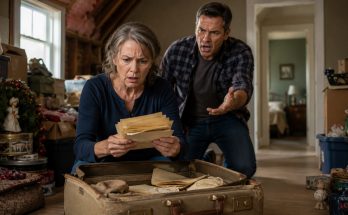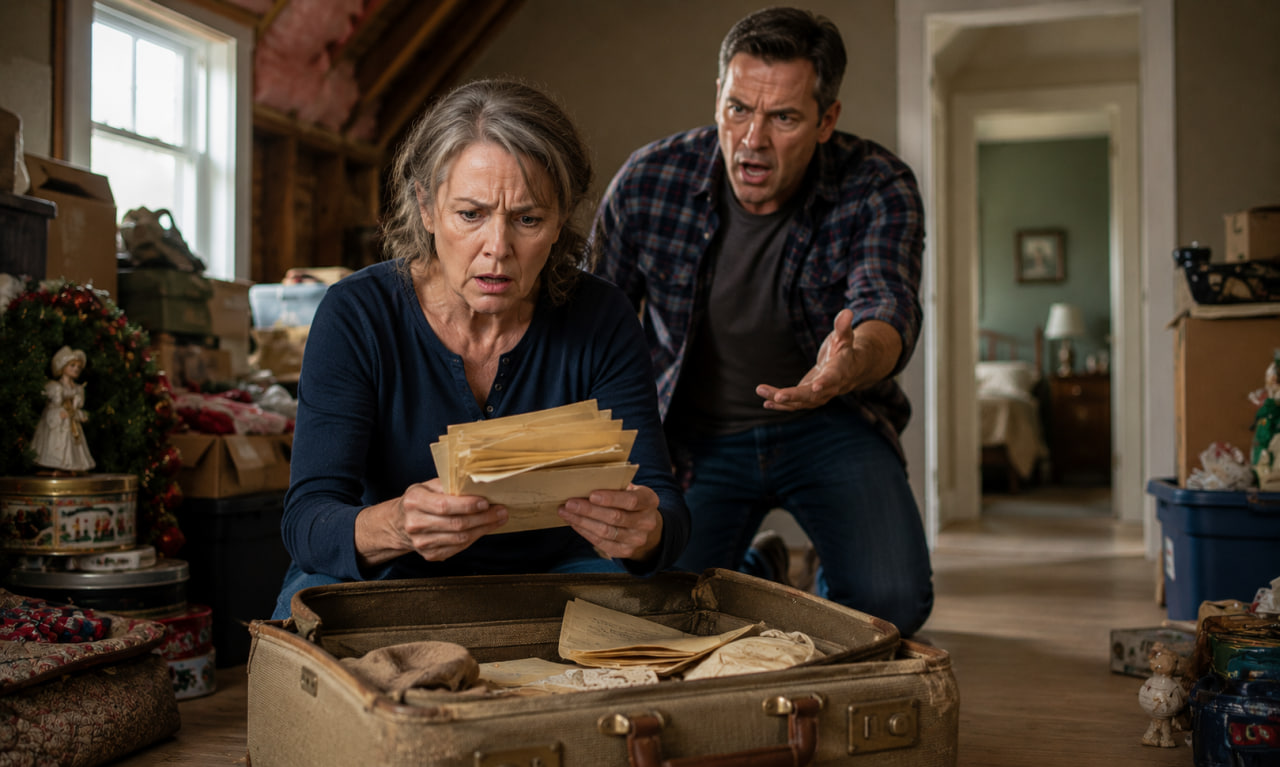
I was clearing out Aunt Ruth’s attic eighteen days after her death when my brother Calvin pointed at an old tan suitcase and said, “Burn that one. It’s junk.” Something about the way he said it made me open it instead. At 3:48 p.m., the lining split beneath my thumb and 17 yellow envelopes slid onto the floor, every one addressed to me in Aunt Ruth’s handwriting. The first contained a $5,000 bearer bond from 1986. Calvin saw it and went pale. Then he said the sentence that changed everything: “You were never supposed to find those.” I gathered the envelopes, locked myself in the bathroom, and opened the last one first. Its opening line told me to call a woman I hadn’t heard of in decades.
PART 3
I searched the old contact list on my phone, but I already knew I wouldn’t find her. Ruth had retired twenty years earlier.
I opened the second envelope.
Another bond.
The third contained a bank receipt.
The fourth contained a handwritten note.
The fifth contained a photocopy of a deed.
By the time I reached the seventh envelope, I understood that this wasn’t a collection of old investments.
It was a record.
Aunt Ruth had been documenting something.
And whatever it was, she had been documenting it for decades.
Calvin hit the bathroom door again.
“Maggie, I’m warning you.”
I pressed the phone closer to the door so the recording could catch his voice.
“You’re warning me about what?”
Silence.
Then he said:
“You don’t know what you’re holding.”
I looked down at the papers.
“No,” I answered. “But I’m beginning to think you do.”
At 4:21 p.m., Calvin stopped knocking.
I waited.
Nothing.
I slowly removed the laundry basket from the door and listened.
The house was silent.
I opened the door two inches.
The hallway was empty.
His coat was gone from the chair downstairs.
So was his truck.
I locked the front door.
Then I called the number on an old county website.
After several transfers, I finally reached someone who knew the name Helen Garcia.
“She retired years ago,” the woman said.
“Do you know how I can contact her?”
There was a pause.
“Is this about Ruth Whitmore?”
My heart stopped.
“Yes.”
Another pause.
Then the woman gave me a number.
I wrote it down with trembling fingers.
I called.
A woman’s voice answered.
“Hello?”
“Is this Helen Garcia?”
“Yes.”
“My name is Margaret Porter. Ruth Whitmore was my aunt.”
Silence.
Then Helen whispered:
“Oh.”
She knew.
Not just Ruth’s name.
The reason I was calling.
“Where are you?” she asked.
“At Aunt Ruth’s house.”
“Are you alone?”
“Yes.”
“Lock the doors.”
I looked toward the front entrance.
“They’re locked.”
“Good.”
Her voice lowered.
“Did you find the suitcase?”
I closed my eyes.
“Yes.”
Helen exhaled.
“Then Ruth knew she was running out of time.”
Helen arrived forty minutes later.
She was eighty-one, short, gray-haired, and carried a leather briefcase that looked older than I was.
When I opened the door, she didn’t hug me.
She looked over my shoulder first.
Then she stepped inside.
“Is Calvin gone?”
“Yes.”
“Did he see the envelopes?”
“Yes.”
She closed her eyes.
“Then we’re already late.”
We sat at Ruth’s kitchen table.
I placed all seventeen envelopes in front of her.
Helen didn’t touch them.
Instead, she looked at me.
“Your aunt loved you very much.”
I swallowed.
“I loved her too.”
“She was afraid you would never learn the truth.”
“What truth?”
Helen opened her briefcase.
Inside were old county records, photographs, and a yellow legal pad covered in Ruth’s handwriting.
She turned it toward me.
At the top, Ruth had written:
THE PORTER PROPERTY — 1986 TO PRESENT
I stared at it.
“What property?”
Helen looked at me.
“Your parents’ farm.”
I felt the room tilt.
My parents had owned forty acres outside Mason City.
When they died, Calvin had told me there was nothing left.
Nothing worth fighting over.
He said the bank had taken the land.
I had believed him.
I was twenty-six.
I had just lost both parents.
I signed everything he put in front of me.
Helen watched my face.
“Calvin lied.”
The farm had not been worthless.
It had been sold.
For $480,000.
My share should have been half.
I stared at the photocopy.
Sale price: $480,000.
Buyer: Porter Agricultural Holdings LLC.
I looked at Helen.
“Porter?”
“Your mother’s maiden name.”
My mouth went dry.
“Who owned the company?”
Helen slid another page toward me.
The company had been created two months before my father died.
The registered agent was Calvin.
The listed owner was…
Margaret Elaine Porter.
My name.
My signature.
But I had never created it.
I felt sick.
“He forged my name.”
Helen nodded.
“And Ruth found out.”
In 1994, Aunt Ruth had gone to the county recorder’s office to correct a tax discrepancy.
She found the company.
She found the property transfer.
And she found something else.
A second deed.
The farm had been sold again.
This time for $1.7 million.
Then again.
Then again.
Each transaction had been connected to development companies.
The land that my parents had farmed was now part of a commercial development on the outskirts of Mason City.
I stared at the numbers.
“How much is it worth now?”
Helen didn’t answer immediately.
Then she said:
“Approximately eighteen million dollars.”
I laughed.
It wasn’t because anything was funny.
It was because my mind couldn’t process the number.
Eighteen million.
My brother had spent thirty-six years telling me there was nothing left.
Meanwhile, the land had become worth eighteen million dollars.
I looked at the seventeen envelopes.
“Why didn’t Ruth tell me?”
“She tried.”
“What?”
“Seventeen times.”
Helen tapped the envelopes.
“Those letters were mailed to you.”
I stared at her.
“I never received them.”
“I know.”
“Where did they go?”
Helen looked toward the kitchen window.
“Calvin intercepted them.”
The next morning, I drove to the post office.
I brought the first envelope.
The postmark was clear.
I asked the clerk whether there was any record of returned mail.
There wasn’t.
But Helen had given me something else.
A copy of an old forwarding request.
Someone had filed a request to redirect my mail.
My signature appeared at the bottom.
It wasn’t mine.
The forwarding address was Calvin’s house.
For thirty-six years, my brother had controlled what I received.
Bills.
Bank statements.
Letters.
Legal notices.
Everything.
I sat in my car afterward and cried.
Not because of the money.
Because I suddenly remembered how often I had wondered why Aunt Ruth stopped writing.
She hadn’t.
She had written.
Seventeen times.
That afternoon, I opened the remaining envelopes.
The letters became increasingly desperate.
One from 1998:
Calvin came to see me today. He says Maggie doesn’t want anything from the farm. I know that isn’t true.
Another from 2003:
The property has been sold again. Maggie’s signature appears on another document.
Another from 2011:
I confronted Calvin. He told me if I tell Maggie, he will say I am confused and have dementia.
The final letter was dated only three months before Ruth died.
I am running out of time.
If Maggie finds these, she must know one thing.
I did not abandon her.
I pressed the paper to my chest.
For eighteen days, I had thought Aunt Ruth’s death left me with nothing but an attic full of junk.
Instead, she had left me the truth.
That evening, Helen called me.
“You need an attorney.”
“I have one.”
“Not the kind you need.”
She gave me a name.
Daniel Reeves.
A forensic attorney who specialized in property fraud and financial crimes.
I called him.
He agreed to meet the next morning.
But before I could leave the house, someone knocked on my door.
I looked through the camera.
Calvin.
I didn’t open it.
He held a folder.
“Maggie,” he called.
I stayed silent.
“I know you spoke to Helen.”
My heart began pounding.
He looked directly at the camera.
“I know what Ruth left you.”
I stepped backward.
Then he said something that made my blood run cold.
“You’re not the only person whose name is on those documents.”
I opened the door halfway.
“What does that mean?”
He held up the folder.
“Because if you take this to the police, you’re going to destroy someone who had nothing to do with any of this.”
“Who?”
He looked at me.
“Dad.”
I stared at him.
“Our father died twenty years ago.”
“I know.”
“Then what are you talking about?”
Calvin lowered his voice.
“The farm wasn’t the only thing he left behind.”
He slipped the folder through the opening.
Then walked away.
I closed the door and locked it.
Inside the folder was one photograph.
My father.
Standing beside Calvin.
And between them was a man I had never seen before.
On the back of the photograph, Aunt Ruth had written four words:
He knows where everything is.
I turned the photograph over again.
There was one more thing.
A date.
August 21, 2026.
Today’s date.
My stomach dropped.
Aunt Ruth had known exactly when I would find the suitcase.
And somehow…
she had known this day would matter.
End of Part 2.
PART 4
I didn’t sleep that night.
I kept the photograph on the kitchen table and stared at it until the faces began to blur.
My father.
Calvin.
And the stranger.
Three men standing beside a pickup truck in front of a building I didn’t recognize.
On the back, Aunt Ruth had written:
He knows where everything is.
Underneath that, in smaller handwriting:
If Maggie finds this on August 21, do not trust Calvin’s story.
I checked the date twice.
August 21.
The exact day.
There was no way Aunt Ruth could have predicted when I would open the suitcase.
Unless she hadn’t been predicting anything.
Unless she had arranged it.
My phone rang at 6:12 a.m.
Helen.
“You found the photograph?”
“Yes.”
“Then we need to move quickly.”
“Who is the man?”
“I don’t know.”
“You said you knew everything.”
“I know what Ruth told me.”
“Then tell me.”
Helen took a breath.
“His name is Walter Crane.”
The name meant nothing.
“He worked for your father.”
“My father never had employees.”
“That is what Calvin told you.”
I closed my eyes.
Another lie.
Helen continued.
“Your father was part owner of a construction company before he bought the farm.”
I sat down.
“What construction company?”
“Crane & Porter Development.”
The same last name as the company that later appeared on the property documents.
“Walter Crane wasn’t just an employee,” Helen said.
“He was your father’s business partner.”
Daniel Reeves’ office was on the fourth floor of an old brick building downtown.
He listened to everything without interrupting.
When I finished, he looked at the documents.
Then he looked at me.
“Did you sign this?”
“No.”
“Did you authorize this company?”
“No.”
“Did you receive any money from the sale?”
“No.”
“Then this isn’t a family dispute.”
“What is it?”
“Potential identity theft, fraud, forged signatures, and possibly a much larger financial scheme.”
He pointed to the dates.
“This happened over decades.”
“Can they still prosecute it?”
“Some parts may be difficult.”
I felt my hope fall.
“But,” he continued, “property rights are different.”
He tapped the original deed.
“If someone fraudulently transferred your property, the clock doesn’t necessarily start when the fraud occurred. It can depend on when you discovered it.”
I stared at him.
“So I may still have a claim?”
“You may have a very serious claim.”
He asked for every document.
I gave him the envelopes.
All seventeen.
He examined them carefully.
“Your aunt was thorough.”
“She worked with records.”
“No.”
He shook his head.
“She was building a case.”
At 11:30, Daniel called me into another room.
“There is something strange.”
“What?”
He showed me a bank statement.
A payment had been made to a trust account in 1994.
Amount:
$240,000.
Half of the original sale.
“That’s your share,” he said.
“But I never received it.”
“I know.”
“Where did it go?”
He pointed to the account holder.
Margaret Elaine Porter Trust.
My name.
Again.
Someone had created a trust using my identity.
The money had then been transferred into another account.
This time, the beneficiary was…
Calvin Porter.
I couldn’t breathe.
“He stole my inheritance.”
“Yes.”
“For thirty-six years.”
“Yes.”
I stood.
“I want to report it.”
“We will.”
“Today.”
Daniel nodded.
“But before we do, there’s one thing I need to know.”
“What?”
“Who is Walter Crane?”
We found him that afternoon.
Not through the internet.
Not through old business directories.
Through Ruth.
She had left his address inside the seventeenth envelope.
A retirement community in Cedar Rapids.
I stared at the paper.
“He’s alive?”
“According to this,” Daniel said.
We drove there.
The receptionist told us Walter Crane was expecting us.
That was the first thing that frightened me.
“Expecting us?”
She smiled.
“He said someone would come eventually.”
Walter was ninety-one.
He sat beside a window overlooking a small garden.
He was thin, but his eyes were sharp.
When I walked in, he looked at me for several seconds.
Then he smiled.
“You have your mother’s eyes.”
I nearly cried.
“You knew my mother?”
“I knew your whole family.”
He looked at Daniel.
“Attorney?”
“Yes.”
Walter nodded.
“Good.”
Then he looked at me.
“Did you find Ruth’s suitcase?”
“Yes.”
His expression changed.
“Then she finally got her wish.”
“What wish?”
“To tell you the truth.”
Walter told us everything.
My father had been an ambitious man.
He started a small construction company with Walter in the late 1970s.
The company made money.
A lot of it.
But my father didn’t trust banks.
He believed land was safer.
So he purchased forty acres outside Mason City.
The farm became collateral for several development loans.
Then my father died unexpectedly.
Calvin was twenty-eight.
I was twenty-six.
My mother died six months later.
Calvin convinced me the farm was drowning in debt.
He told me signing the documents would protect me.
I believed him.
Walter had tried to stop it.
“But Calvin threatened me,” Walter said.
“With what?”
“He knew I had hidden financial records.”
“What records?”
Walter pointed to a locked cabinet.
“Those.”
Daniel opened it.
Inside were account ledgers dating back to 1984.
There were payments.
Loans.
Transfers.
Names.
And one account that appeared again and again.
M. Porter Trust.
My fake trust.
I touched the ledger.
“This proves it.”
Walter nodded.
“But there’s more.”
He pulled out a cassette tape.
I stared at it.
“A recording?”
“Your father made it.”
“Why?”
Walter looked toward the window.
“Because he knew Calvin was stealing.”
My heart stopped.
“My father knew?”
“He discovered it shortly before he died.”
Daniel inserted the tape into an old player.
Static filled the room.
Then my father’s voice.
Older.
Tired.
Terrified.
“If anything happens to me, Ruth knows what Calvin has done.”
I covered my mouth.
The recording continued.
“I don’t believe my son intends to stop.”
Then another voice.
Calvin.
Young.
Angry.
“You promised me the land.”
My father’s voice answered.
“It doesn’t belong to you.”
A chair scraped.
Then the recording ended.
No one spoke.
My father had known.
Aunt Ruth had known.
Walter had known.
And Calvin had spent thirty-six years making sure I never knew.
I thought that was the worst discovery.
It wasn’t.
Walter reached into the cabinet again.
He removed a sealed envelope.
“This is for you.”
My name was written across it.
My father’s handwriting.
I opened it with shaking fingers.
Inside was one page.
Margaret,
If you’re reading this, I failed to protect you.
Your brother will tell you I was broke.
I wasn’t.
The farm is worth more than I have told anyone.
Half belongs to you.
I placed the original documents with Ruth.
Trust her.
Do not trust Calvin.
At the bottom was one final sentence.
And whatever happens, don’t let him convince you that you are the difficult child.
I began crying.
Because that was the lie that had lasted the longest.
Not the money.
Not the property.
Not the forged documents.
The belief that I was the problem.
That evening, Daniel filed the initial report.
The investigation began.
Calvin disappeared.
His phone went straight to voicemail.
His house was empty.
His truck was gone.
And for three days, there was no sign of him.
Then, on the fourth night, I received a text from an unknown number.
You want the truth? Come to the old farm tomorrow at 9. Come alone.
I showed Daniel.
He immediately shook his head.
“No.”
“I have to go.”
“You absolutely do not.”
“He knows where everything is.”
Daniel stared at the message.
Then he said:
“Maybe.”
I looked at him.
“What?”
He zoomed in on the photograph.
The building behind my father.
The same building where Walter had stored the records.
Daniel pointed to a faded sign.
“That’s not your old farm.”
I leaned closer.
He was right.
The building was somewhere else.
Then I recognized it.
The old Porter construction warehouse.
The one Calvin had told everyone burned down in 1997.
Daniel looked at me.
“It didn’t burn down.”
My phone buzzed again.
Another message.
9 a.m. Don’t bring the lawyer.
Then another.
And Maggie… bring Aunt Ruth’s suitcase.
I stared at the screen.
Someone else knew about the suitcase.
Someone who had been watching.
And suddenly I realized something.
Calvin hadn’t run away.
He had been waiting for me to find the final piece.
I did not go to the warehouse alone.
I let Calvin believe I had.
At 8:42 the next morning, I parked two blocks away and walked the rest of the distance carrying Aunt Ruth’s tan suitcase.
Daniel’s car remained out of sight.
So did Detective Brooks.
I had learned something important during the past week.
Truth was powerful.
But evidence was more powerful when the person telling the truth didn’t know you were collecting it.
The warehouse stood behind a chain-link fence at the end of an abandoned industrial road.
The sign above the entrance was nearly gone.
PORTER & CRANE CONSTRUCTION
The letters were rusted.
The windows were broken.
Weeds pushed through cracks in the pavement.
I stood outside for several seconds.
This was the place my family had supposedly lost twenty-nine years ago.
Yet Calvin had somehow known exactly where to find it.
The door opened before I knocked.
Calvin stood inside.
He looked terrible.
His shirt was wrinkled.
His eyes were red.
He had lost the confident expression he’d worn for most of my life.
“You came.”
I held up the suitcase.
“You asked for it.”
He looked at it.
Then at me.
“Did you bring anyone?”
“No.”
It was the first lie I had ever told my brother.
He stepped aside.
“Come in.”
The warehouse smelled like dust, oil, and wet concrete.
Old machines stood beneath plastic sheets.
A broken desk sat in one corner.
There were boxes everywhere.
I looked around.
“This place was never destroyed.”
“No.”
“Why did you tell everyone it burned?”
Calvin looked away.
“Because it was easier.”
“Easier than what?”
“Explaining.”
I set the suitcase down.
“Explain now.”
He walked toward an old metal cabinet.
“Dad kept everything.”
“Everything?”
“Receipts. Contracts. Account books. Property records.”
“Why didn’t you destroy them?”
His face tightened.
“I tried.”
I waited.
He continued.
“Ruth found some before I could.”
“So she built the seventeen envelopes.”
“Yes.”
“Why did you let her live?”
The question came out before I could stop it.
Calvin looked at me with genuine shock.
“I didn’t kill Ruth.”
“I didn’t say you did.”
He looked away.
But his silence said more than his words.
He opened the cabinet.
Inside were dozens of folders.
One had my name.
Another had Ruth’s.
Another had my father’s.
I stepped closer.
“What is all this?”
“The original records.”
“You kept them for thirty-six years?”
“I kept them because I was afraid.”
“Of what?”
“You.”
I almost laughed.
“Me?”
“No.”
He swallowed.
“Of what you’d become if you knew.”
I stared at him.
“You stole my inheritance.”
“Yes.”
“You forged my signature.”
“Yes.”
“You intercepted Aunt Ruth’s letters.”
“Yes.”
“You created a trust in my name.”
“Yes.”
“You took nearly half a million dollars.”
His eyes filled with tears.
“Yes.”
“And you’re afraid of me?”
He sat down.
“I was afraid you’d become like Dad.”
That made no sense.
“My father was honest.”
Calvin shook his head.
“You don’t know what happened.”
He opened another folder.
Inside were photographs.
My father with investors.
My father at the warehouse.
My father signing documents.
Then one photograph made me freeze.
My father.
Calvin.
Walter.
And a fourth man.
I recognized him.
Not from memory.
From a name.
Richard Vale.
The developer who purchased the farm.
The man who had eventually turned the land into the commercial district.
“What does he have to do with this?”
Calvin stared at the photograph.
“He was never just a buyer.”
“What was he?”
Calvin whispered:
“My father’s partner.”
He told me the story.
After my father’s death, Richard Vale approached Calvin.
He knew about the debts.
He knew about the land.
He offered Calvin a deal.
Transfer the farm through a shell company.
Take the money.
Make it appear that the property had been sold to cover debts.
Calvin would keep a portion.
Richard would control the land.
The rest would disappear through companies and trusts.
“But why use my name?”
Calvin looked down.
“Because you were the clean one.”
The words cut deeper than I expected.
“You weren’t married.”
“You had no debt.”
“You had no criminal record.”
“You had no reason to suspect anything.”
“So you used me.”
“Yes.”
“And Dad?”
“He found out.”
My heart pounded.
“What happened to him?”
Calvin closed his eyes.
“He confronted Richard.”
“And then?”
“He threatened to expose everything.”
“And then?”
Calvin looked at me.
“Three days later, Dad died.”
I couldn’t breathe.
“You said he had a heart attack.”
“He did.”
“That doesn’t answer my question.”
Calvin’s voice dropped.
“I don’t know if Richard caused it.”
“You were there.”
“I wasn’t.”
“Then who was?”
He didn’t answer.
I stepped toward him.
“Calvin.”
He finally whispered:
“Mom.”
The room seemed to go silent.
“Our mother?”
“She was there when Dad confronted Richard.”
I shook my head.
“No.”
“She knew everything.”
“No.”
“She signed some of the documents.”
“No.”
I backed away.
My entire childhood was changing in front of me.
“My mother loved us.”
“I know.”
“Then why?”
“Because she was afraid.”
I stared at him.
“Everyone was afraid.”
Calvin nodded.
“That was how Richard controlled people.”
Then I heard something outside.
A car door.
Calvin looked toward the broken window.
His face changed.
“They’re here.”
“Who?”
He didn’t answer.
A black SUV rolled slowly past the warehouse.
Then stopped.
Calvin grabbed my arm.
“We have to go.”
I pulled away.
“I’m not going anywhere with you.”
“Margaret, listen to me.”
He looked genuinely terrified.
“Richard knows you found the records.”
My phone vibrated inside my pocket.
A message from Detective Brooks.
We’re outside. Stay inside. Do not engage.
I almost smiled.
For the first time, I wasn’t alone.
The warehouse doors suddenly slammed open.
Three men entered.
One of them was old.
Gray hair.
Expensive coat.
Walking cane.
But I recognized him immediately from the photograph.
Richard Vale.
He looked at me.
Then at the suitcase.
“You found Ruth’s letters.”
I didn’t answer.
He smiled.
“Your aunt was a stubborn woman.”
Calvin stepped between us.
“Leave her out of this.”
Richard laughed.
“After thirty-six years, you suddenly grow a conscience?”
Calvin’s jaw tightened.
“You said it would end.”
“It did.”
“No.”
Calvin shook his head.
“It ended when Ruth died.”
Richard’s smile disappeared.
“What did you say?”
Calvin looked at me.
Then at Richard.
“Ruth didn’t die naturally.”
My heart stopped.
Richard’s face went completely still.
Calvin continued.
“She knew you were coming after Maggie.”
I stared at him.
“You knew?”
He nodded.
“She called me three days before she died.”
“Why didn’t you tell me?”
“Because Richard threatened to kill you.”
A voice came from the warehouse entrance.
“That’s enough.”
Detective Brooks stepped inside with two officers.
Richard froze.
Calvin raised both hands.
The other men backed away.
Detective Brooks looked directly at Richard.
“Richard Vale?”
“Yes.”
“You’re under investigation for financial fraud, conspiracy, and suspected elder exploitation.”
Richard laughed.
“You don’t have anything.”
I lifted my phone.
“I have everything.”
His face changed.
The recording had captured every word.
Including his admission that Ruth knew.
Including Calvin’s confession.
Including Richard’s involvement.
Detective Brooks nodded.
“Thank you, Claire.”
Richard stared at me.
“You think this changes anything?”
I looked at him.
“It changes everything.”
The investigation lasted almost a year.
It uncovered more than any of us expected.
Richard had manipulated dozens of property transactions.
Calvin had participated.
Several accountants had helped conceal the money.
And Aunt Ruth had spent thirty-two years quietly preserving evidence.
But there was one final mystery.
Her death.
The medical examiner reviewed the old records.
Nothing could be proven conclusively.
But investigators found that Ruth’s medication had been tampered with shortly before her death.
The case was reopened.
Richard was charged with additional crimes.
Calvin cooperated fully.
He eventually pleaded guilty to fraud and identity theft.
He lost almost everything.
But unlike Richard, he never stopped telling the truth.
One afternoon, he asked to see me.
We sat across from each other in a visiting room.
He looked older.
Much older.
“I don’t expect forgiveness,” he said.
“I know.”
“I destroyed your life.”
“No.”
He looked confused.
“You changed it.”
He lowered his eyes.
“I don’t deserve that.”
“Maybe not.”
I stood.
“But I’m not going to carry your guilt for you.”
Before leaving, I placed something on the table.
One of Aunt Ruth’s yellow envelopes.
He stared at it.
“Why?”
“Because she wanted both of us to know the truth.”
He picked it up with shaking hands.
On the front, she had written:
For Calvin, if he ever chooses honesty.
He began crying.
I walked away.
Two years later, the farm was legally returned to me and the remaining rightful heirs.
The land had become worth more than twenty million dollars.
I could have sold everything.
Instead, I kept forty acres.
Not because I wanted to become wealthy.
Because I wanted one piece of my parents’ life to remain untouched.
I restored the old farmhouse.
Repaired the barn.
Planted apple trees along the fence.
And in the attic, I placed Aunt Ruth’s suitcase inside a glass cabinet.
Not as a treasure.
As a reminder.
One afternoon, I opened the suitcase one last time.
There was something beneath the torn lining I had never noticed.
A tiny envelope.
My name was written across it.
Inside was a single note.
Margaret,
If you’ve made it this far, then you finally know.
I couldn’t protect you from what Calvin did.
I couldn’t change the past.
But I could preserve the truth.
Please don’t spend the rest of your life angry at him.
Anger is another kind of inheritance.
You don’t have to accept it.
Take the land.
Take the truth.
Take your life back.
Leave the rest.
Love, Ruth.
I cried so hard I had to sit on the attic floor.
For thirty-six years, I had believed my family had left me nothing.
I had been wrong.
They had left me a farm.
A fortune.
Seventeen letters.
And a truth worth more than all of it.
The following spring, I stood beneath the apple trees as they began to bloom.
Helen sat on the porch beside me.
Daniel, my attorney, was helping organize the final property documents.
And in the field beyond us, children from the local community center were planting seedlings.
I had decided the farmhouse would become a small community center for women who needed help rebuilding their lives after financial abuse.
I named it:
The Ruth Whitmore House.
Helen cried when she saw the sign.
“She would have loved this.”
I smiled.
“She would have complained about the spelling.”
Helen laughed.
Then she looked at me.
“Do you ever think about the suitcase?”
“All the time.”
“What do you think would have happened if you hadn’t opened it?”
I looked toward the farmhouse.
“I’d probably still be believing my brother.”
Helen nodded.
“Funny how truth sometimes hides in the ugliest places.”
I smiled.
“It wasn’t the suitcase that saved me.”
“What was?”
I thought about Calvin telling me to burn it.
About the way he had looked when he saw the envelopes.
About Aunt Ruth writing my name seventeen times.
About my younger self signing papers she didn’t understand because she trusted her brother.
Then I answered.
“I finally asked why.”
Helen smiled.
And that was the truth.
The suitcase hadn’t been the beginning.
The money hadn’t been the beginning.
Even Calvin’s betrayal hadn’t been the beginning.
The beginning was the moment I stopped accepting the story everyone had told me about myself.
I wasn’t careless.
I wasn’t difficult.
I wasn’t the family member who couldn’t be trusted.
I had simply trusted the wrong person.
And when the truth finally came out, I learned something Aunt Ruth had known all along:
You can lose money.
You can lose property.
You can lose years.
But if you still have the courage to open the envelope marked with your own name, you can begin again.
I closed the suitcase.
Locked it.
And placed the key beside Aunt Ruth’s photograph.
Then I walked outside into the sunlight.
For the first time in thirty-six years, the land beneath my feet belonged to me.
And for the first time in my life, so did I.
PART 5
For the next six months, I thought the story was over.
The court had ruled in my favor.
The farm had been returned.
Richard Vale was facing the consequences of the crimes he had spent decades hiding.
Calvin had pleaded guilty.
The Ruth Whitmore House was almost ready to open.
And the tan suitcase sat safely inside a locked glass cabinet in the farmhouse attic.
I had finally begun to believe that there was nothing left to discover.
Then Helen called me one rainy Tuesday morning.
“Maggie,” she said, “I found something.”
I smiled.
“I thought we found everything.”
“So did I.”
Her voice was different.
Serious.
“Where are you?”
“At the farmhouse.”
“Don’t leave.”
Twenty minutes later, Helen arrived carrying a cardboard box.
She placed it on the kitchen table.
“I found this in the county archives.”
I opened it.
Inside was a folder with my father’s name.
Thomas Porter — Private Correspondence, 1985–1987.
I looked at Helen.
“Why was this never part of the investigation?”
“Because it wasn’t filed with the property records.”
She pulled out the first letter.
My father’s handwriting.
The date was three months before his death.
I read it.
Then I stopped.
My father had written to Aunt Ruth:
Ruth, if Calvin asks you about the money, tell him nothing.
I know he believes the farm belongs to him.
It doesn’t.
But there is another reason I cannot transfer it.
I looked up.
“Another reason?”
Helen nodded.
I kept reading.
The farm contains something that belongs to Maggie.
My heart started pounding.
“What?”
Helen shook her head.
“Keep reading.”
The next sentence changed everything.
It isn’t money.
The farm had a hidden room.
I had lived there as a child.
Played hide-and-seek there.
Ran through the fields.
Helped my father repair the fence.
But I had never known about a hidden room.
The clue was in the letter.
Behind the old fireplace.
Helen and I drove to the farmhouse.
The fireplace was original.
Stone.
Heavy.
Covered in decades of dust.
Daniel helped us move the furniture.
Behind the fireplace was a narrow wooden panel.
I pushed it.
Nothing.
Helen tried.
Nothing.
Then I noticed a tiny brass keyhole.
I remembered Aunt Ruth’s suitcase.
The key was still attached to the ring beside her photograph.
I ran back upstairs.
When I returned, my hands were shaking.
The key fit.
The panel opened.
Behind it was a small room.
Inside were boxes.
Dozens of them.
Photographs.
Letters.
Tax records.
And one wooden chest.
I opened it.
Inside was my mother’s jewelry.
My father’s watch.
Family photographs.
And a sealed envelope.
My name was written on it.
Again.
I laughed through my tears.
“Ruth really knew me.”
Helen smiled.
“She knew you’d find it.”
I opened the envelope.
Inside was a letter from my mother.
My mother had written it the week before she died.
I read it slowly.
My sweet Maggie,
If you are reading this, then Ruth decided it was finally time.
I want you to know something I was too frightened to tell you.
Your father discovered Calvin’s theft.
He planned to confront him.
But I asked him not to.
I stopped.
My mother had known.
I was afraid of losing both of my children.
That fear made me weak.
I told myself silence would protect our family.
It didn’t.
Silence never protects a family.
It only protects the person causing the damage.
I pressed the letter to my chest.
The final paragraph was only three lines.
If Calvin ever hurts you, don’t protect him because he is your brother.
If anyone tells you that family means accepting betrayal, remember that I was wrong.
Love should never require you to disappear.
I cried.
Helen held my hand.
That evening, I sat alone on the farmhouse porch.
The rain had stopped.
The fields were dark.
For the first time, I understood why Aunt Ruth had waited.
She hadn’t been hiding the truth because she was afraid.
She had been preserving it until I was strong enough to carry it.
I thought about the woman I had been at twenty-six.
The woman who signed documents she didn’t understand.
The woman who believed her brother because she had no reason not to.
The woman who spent thirty-six years wondering why life always seemed harder for her than everyone else.
I wanted to go back and warn her.
But I couldn’t.
So instead, I forgave her.
She had done the best she could with the information she had.
That was enough.
The Ruth Whitmore House opened in October.
More than two hundred people came.
There was no ribbon-cutting ceremony.
No politicians.
No newspaper photographers.
Just women from the community, their families, and people who had helped restore the farmhouse.
Above the front door was a simple wooden sign:
RUTH WHITMORE HOUSE
Underneath:
A safe place to begin again.
I gave a short speech.
I didn’t mention the twenty million dollars.
I didn’t mention Calvin.
I didn’t mention Richard.
I simply said:
“My aunt taught me that sometimes the truth takes years to arrive.”
I looked around the room.
“But when it does, you have a choice.”
“You can spend the rest of your life asking why nobody protected you.”
“Or you can become the person who protects someone else.”
Then I stepped away from the microphone.
Helen was crying.
Ethan hugged me.
And from the back of the room, a familiar voice said:
“Ruth would have been proud.”
I turned.
Calvin stood near the doorway.
He looked older.
Thinner.
His hair had turned almost completely gray.
He wasn’t allowed to approach me without permission, but he had received approval to attend the opening.
For a moment, neither of us spoke.
Then I walked toward him.
Not because I had forgotten.
Because I hadn’t.
“I don’t know what to say,” he whispered.
“You don’t have to say anything.”
“I am sorry.”
“I know.”
He looked around the room.
“You really did this with the farm?”
“Yes.”
He nodded.
“She would have loved it.”
“I think so.”
He wiped his eyes.
Then he reached into his coat and pulled out a small envelope.
“I found this in my old house.”
My heart stopped.
I recognized the handwriting immediately.
Aunt Ruth.
Calvin handed it to me.
“I never opened it.”
I looked at him.
“Why?”
He gave a sad smile.
“Because for once, I was afraid of what the truth might say.”
I took the envelope.
He left without another word.
I opened it that night.
There was only one sentence.
Margaret,
When you finally stop asking what your family took from you, ask yourself what you want to give the world.
That was it.
No explanation.
No instructions.
No apology.
Just a question.
I sat at the kitchen table until midnight.
Then I knew.
One year later, the Ruth Whitmore House had helped more than three hundred women.
Some needed financial advice.
Some needed legal referrals.
Some simply needed somewhere to sit and hear another person say:
“I believe you.”
I understood that sentence now.
Sometimes that is all someone needs to begin rebuilding.
The farmhouse fields became a community garden.
The old barn became a workshop.
And every September, we held an apple harvest in Ruth’s memory.
I planted a tree beside the porch.
Underneath it, I placed a small stone.
It read:
Ruth Whitmore
She kept the truth safe until someone was ready to hear it.
Five years after I found the suitcase, I returned to the attic.
The tan suitcase was still there.
The leather had cracked.
The brass buckle had turned green.
I opened it one final time.
There were no hidden envelopes.
No secret documents.
Nothing left to discover.
Just the empty lining.
I ran my fingers across the tear where the seventeen yellow envelopes had fallen through.
I smiled.
Then I closed it.
I didn’t need the suitcase anymore.
The truth wasn’t inside it.
The truth was inside me.
I carried it everywhere.
On the anniversary of Aunt Ruth’s death, I sat beneath the apple tree with a cup of coffee.
The sky was turning gold.
For a moment, I imagined Ruth sitting beside me in her old cardigan.
I could almost hear her saying:
Stop worrying, Maggie.
You’ve done enough.
I smiled.
“I know.”
I looked across the fields.
My fields.
My home.
My life.
For thirty-six years, my brother had convinced me that I had inherited nothing.
He was wrong.
I inherited more than money.
I inherited the courage to ask questions.
The courage to say no.
The courage to stop protecting people who hurt me.
And most importantly, I inherited the truth.
Aunt Ruth had spent decades hiding seventeen yellow envelopes in an old tan suitcase.
She thought she was protecting me.
But in the end, she gave me something much greater.
She gave me the chance to stop being the little sister everyone had decided was too naive to understand.
I was sixty-two when I found those envelopes.
I thought that was the age when people were supposed to settle into the life they had already built.
Instead, it became the age when I built a new one.
And if there was one lesson I carried from everything that happened, it was this:
Never let someone convince you that asking questions makes you difficult.
Sometimes the question you are afraid to ask is the one that saves your life.
Sometimes the truth is waiting behind a locked door.
Sometimes it is buried inside an old suitcase.
And sometimes, after thirty-six years of silence, it arrives in seventeen yellow envelopes with your name written on every single one.
I picked up my coffee.
The sun disappeared behind the trees.
And for the first time, there was nothing left to fear.
I had found the truth.
I had reclaimed my life.
And I finally understood what Aunt Ruth had wanted me to know all along:
What they took from me was money and time.
What they could never take was who I became after I found the truth.
I smiled toward the empty chair beside me.
“Thank you, Aunt Ruth.”
Then I went inside.
And closed the door on the past—not because I had forgotten it…
but because I no longer needed to live there.