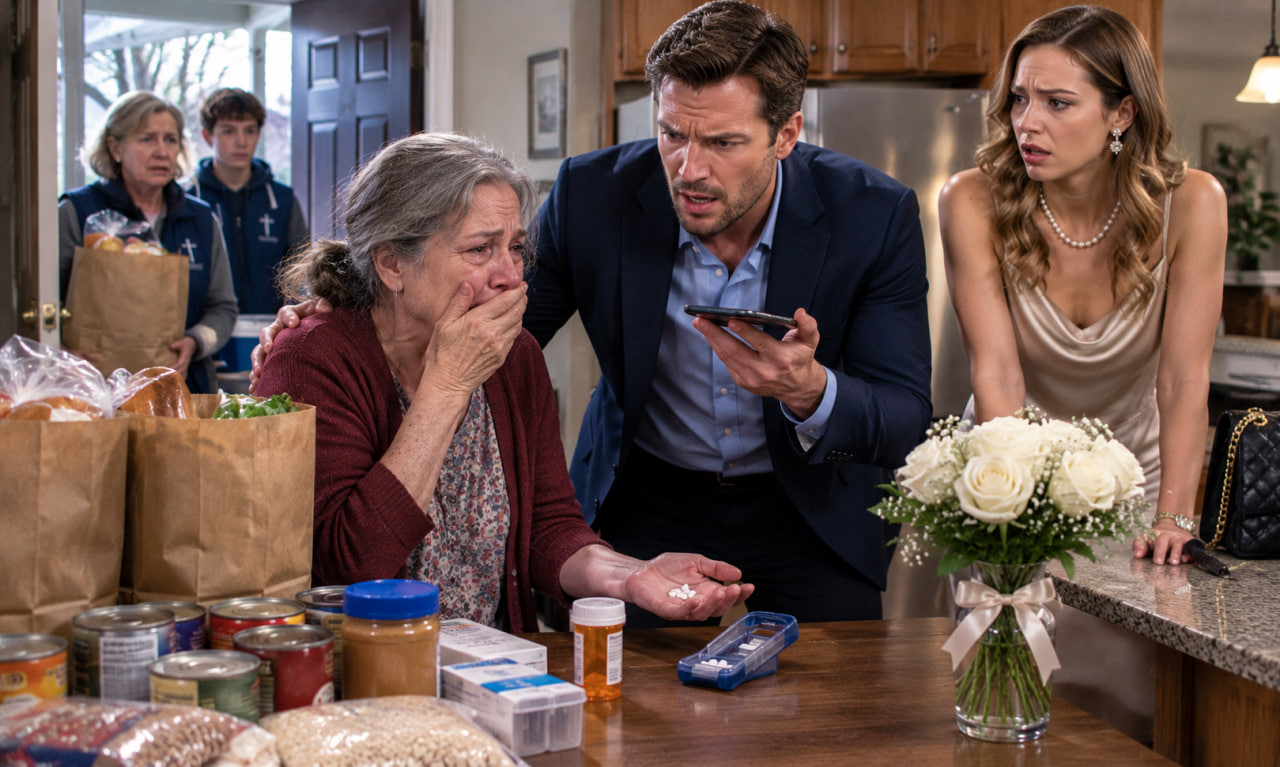
On Mother’s Day, my wealthy son Harrison walked into my kitchen holding white roses and casually asked, “Mom, is the $5,000 Vanessa sends you every month enough?” I felt my chest tighten. For eight months, I had received nothing. I had been relying on a church pantry for groceries and cutting my heart medication in half just to make it last. Before I could explain, my daughter-in-law Vanessa stepped into the kitchen wearing silk and pearls, smiling as if everything were perfectly normal. Then the doorbell rang. A church volunteer arrived carrying my weekly food bags and prescriptions from the free clinic. Harrison looked from the donated groceries to my halved pills, then turned slowly toward his wife. “Open the bank app.”
“Whose name is on that account?”
There was a heavy pause on the line.
“Vanessa Sterling.”
The kitchen fell dead silent.
Harrison hung up the phone and set it face-down on the table.
“Why is my mother’s living expense money being routed into your personal account?”
Vanessa took a slow, shaky breath.
“It was just a temporary fix.”
“For eight months?”
“I was planning to put it back.”
“Using what?”
“The kitchen remodel went drastically over budget. My sister needed a loan. We had that ski trip to Aspen. The charity gala tables cost more than we expected.”
“You siphoned forty thousand dollars.”
“I borrowed it.”
“From my elderly mother.”
“She never used to need that much money anyway.”
Her voice was soft, which somehow made the cruelty worse.
Vanessa kept going, “Clara owns this property outright. She collects Social Security. She doesn’t have a mortgage. Five grand a month was excessive.”
“That wasn’t your decision to make,” Harrison snapped.
“She was just going to let it sit there.”
“I spent the entire Chicago winter wearing two sweaters indoors,” I interjected.
Vanessa looked at me.
“I didn’t know that.”
“You never bothered to ask.”
Harrison pulled up the digital statements Marcus had just emailed him.
“Three thousand dollars at a luxury spa. Twelve hundred at a country club. Six thousand at a downtown jeweler.”
His eyes slowly drifted up to the pearls resting against Vanessa’s collarbone.
“Did you buy those with this account?”
She defensively touched the necklace.
“I needed an accessory for the firm’s holiday dinner.”
“My mother skipped her heart medication so you could parade around in pearls?”
“Stop making it sound like that.”
“How exactly should I make it sound?”
“I am your wife.”
“And she is the woman who gave me life.”
Vanessa’s jaw tightened.
“See? There it is. That is always your answer.”
“What is that supposed to mean?”
“It means I am constantly standing in her shadow. Every time you lecture me about sacrifice, it’s about her. Every time I slip up, I have to hear a speech about how your saintly mother would never do such a thing.”
I looked at Harrison. He looked down at the floor.
Perhaps he had compared us. But jealousy doesn’t put food in the fridge. Jealousy doesn’t force a woman to slice her pills with a kitchen knife.
Harrison looked his wife dead in the eye.
“Did you cut off her transfers because you were punishing her?”
“At first, I just diverted one month’s payment. I genuinely thought I’d replace it.”
“And then?”
“Then nothing happened.”
I understood perfectly.
No one checked. No one held her accountable. So she just kept doing it.
Harrison’s voice dropped to a terrifyingly quiet register.
“What else did you do?”
Vanessa clamped her mouth shut.
“What else?”
My mind flashed to Christmas. I had set the dining table for three people. Harrison never showed up. Vanessa had called me that morning claiming he had caught a severe flu.
“Did you tell him I didn’t want company?” I asked.
Harrison whipped his head toward me.
“What?”
“Last Christmas eve, she called and said you were running a high fever.”
“I wasn’t sick.”
Vanessa had told him I wanted to spend the holidays alone because I was feeling fatigued.
“I never asked to be alone,” I whispered.
Harrison stared at his wife as if she were a stranger.
“I tried to call you twice that day.”
“My phone didn’t ring once.”
Vanessa slumped against the counter.
The guilt was painted all over her face.
“You blocked my phone number,” I said, stunned.
“Just for the holiday weekend.”
Harrison lunged for her phone.
She yanked it away.
“Give that to me.”
“Unlock the screen.”
“No.”
Harrison pulled his own phone back out and dialed Marcus.
“Freeze every single financial account, credit card, and asset linked to my name that Vanessa has access to.”
All the blood rushed out of her face.
“You can’t legally do that.”
“Watch me.”
He disconnected the call.
“Did you impersonate Mom over email, too?”
Vanessa stared at the linoleum floor.
“Yes.”
“What did the emails say?” I asked.
Harrison’s voice was barely a rasp.
“She sent me emails saying you needed space and didn’t want me dropping by unannounced.”
“I would never write that.”
“I see that now.”
There was so much agony in his expression that my instinct was to step in and comfort him. That had always been my role. Shield Harrison. Shield his marriage. Absorb the damage so no one else had to feel uncomfortable.
But this time, I didn’t move an inch.
Vanessa began to sob.
“I was just so exhausted feeling like I was competing for you.”
“You didn’t have to steal my son to win,” I said.
“I didn’t steal him.”
“You intercepted his calls, canceled his visits, and pocketed the money he sent to keep me alive. What word would you prefer to use?”
“I felt totally invisible in my own marriage.”
“So your solution was to make me invisible in my son’s life.”
Her face crumpled into her hands.
Harrison sat heavily in a chair across from her.
“Did it ever cross your mind that she might be starving?”
Vanessa remained silent.
“Did you ever stop to wonder why she stopped accepting our invitations to dinner?”
“She told us the drive into the city was too exhausting.”
“I said that because I couldn’t afford a tank of gas,” I corrected her.
Harrison squeezed his eyes shut.
I recalled every single lie I had spun. The weather is too bad. My arthritis is acting up. The sedan needs new tires. Every excuse was built to spare him the guilt. And every excuse provided Vanessa the perfect cover.
He turned his heartbroken eyes to me.
“Why didn’t you just pick up the phone and tell me?”
“Because you run a company. You were busy.”
“I would have dropped everything.”
“You were opening the new corporate branch.”
“I would have come.”
“You sounded so stressed.”
“I would have come, Mom.”
His voice cracked completely on the last word.
I looked down at my worn hands.
“When your father walked out, you were nine years old. You heard him scream that we were too much of a financial burden. From that day on, I swore to God I would never make you feel like you were responsible for my survival.”
Harrison stood up, walked around the table, and knelt on the floor beside my chair.
“You are my mother. You are not a burden.”
“That is a very easy thing to say when you aren’t the one begging for charity.”
He gently took my hands in his.
“Mom, you went hungry.”
I gave a small nod.
“You cut your heart pills in half.”
I nodded again.
“And you still refused to call me.”
“I thought suffering in silence was an act of love.”
Tears spilled over his lashes.
“It wasn’t.”
“No,” I agreed softly. “It wasn’t.”
Harrison stood back up.
“Take the necklace off.”
Vanessa sniffled, looking up.
“What?”
“The pearls. Take them off.”
“They were an anniversary gift.”
“They were purchased with my mother’s grocery money.”
Her fingers were shaking so badly she could barely undo the clasp. She let the string of pearls slide onto the cracked wooden table.
Then, Harrison gripped his left hand and slid his wedding band off his finger.
Vanessa’s crying stopped instantly.
“What are you doing?”
“I need you to get out of this house.”
“Harrison, please don’t do this.”
“Go stay with your sister.”
“You’re throwing away our marriage over a financial mistake?”
“No. I am demanding you leave because you stood by and watched me believe my mother was secure. You watched her fade out of my life, and every single day you woke up and chose to maintain the lie.”
“I swear I was going to pay it back.”
“You can’t refund the Christmas I missed with her.”
She turned to me pleadingly.
“Clara, please, say something to him.”
I looked at the brown paper bags from the church.
I remembered standing in the freezing cold in the pantry line behind people I had known for decades, praying to God nobody would ask me why I was there. I remembered sitting at this very table, slicing a pill with a steak knife, praying half a dose would keep my heart beating.
“You need to leave,” I said.
Vanessa stared at me, aghast.
“I made one bad decision.”
“No. You made a conscious choice on the first of every month. And then you made a hundred smaller choices to cover your tracks.”
She snatched her designer purse off the chair.
As she reached the front door, she paused and looked back.
“I hope ruining us was worth it.”
I looked at her expensive silk dress, her bare collarbone, and the stolen pearls resting on my scuffed dining table.
“No,” I replied. “Absolutely none of this was worth it.”
And then she walked out.
For a long time, Harrison and I just sat in the quiet.
Eventually, he stood up, walked over to my refrigerator, and pulled open the door.
Inside sat three brown eggs, a bottle of yellow mustard, a half-empty jar of applesauce, and a plastic container of vegetable soup from the church.
He gripped the top of the fridge door so hard his knuckles went white.
“This is literally all the food you have?”
“I was scheduled to visit the pantry again tomorrow morning.”
He gently pushed the door shut.
“I bought myself a ten-thousand-dollar Rolex last month.”
I looked out the kitchen window.
“I debated the dial color for an hour while you were surviving on three eggs.”
“Harrison, please—”
“No. Don’t shield me. Let me feel how disgusting this is.”
He wiped his eyes with the back of his hand.
“I am so incredibly sorry.”
“You couldn’t have known.”
“I should have made it my business to know.”
“I actively helped you not know.”
“Why?”
“Because I convinced myself that my silence was protecting your happiness.”
He reached out and held my hand tight.
“It only protected her lies.”
That same afternoon, Harrison drove me to the local pharmacy and paid cash for a three-month supply of every single prescription I needed.
Next, he drove us to the supermarket.
I instinctively reached for the cheapest bulk oatmeal and generic canned soup.
He took them out of my hands and put them back on the shelf.
“What do you actually want to eat?”
“I just need basic food.”
“That’s not the question I asked.”
For eight agonizing months, I had strictly purchased whatever was on clearance. The very concept of wanting something had started to feel like a sin.
Slowly, hesitantly, I picked up a plastic clamshell of fresh strawberries.
Harrison offered a sad, broken smile.
“You used to buy a carton of these every Sunday morning.”
“They got too expensive.”
He grabbed four cartons and placed them gently in the cart.
We walked down every aisle. We bought fresh bakery bread, organic chicken, vibrant vegetables, premium coffee, thick yogurt, and the frosted lemon cookies I used to bake for him when he was a little boy.
When the cashier started scanning the mountain of food at the register, I broke down crying.
The teenage cashier looked panicked.
Harrison wrapped a strong arm around my shoulders and pulled me close.
“I’m sorry,” I sobbed into his coat. “I just forgot what a full grocery cart looked like.”
Over the next week, the full scope of the deception unraveled.
Vanessa had rerouted the direct deposit while Harrison was out of town on a business trip. She had created a fake Gmail address using my middle initial and sent him periodic updates thanking him for the financial support while insisting I was too busy with “book club” to host visitors.
She had intercepted and deleted two voicemails I left him, temporarily blocking my contact in his phone just long enough to cause a missed connection.
Every individual lie was a small cut.
But together, they had bled eight months of our lives away.
Harrison’s divorce attorneys aggressively clawed back the stolen forty thousand dollars by liquidating Vanessa’s personal savings, her luxury SUV, and the jewelry she had hoarded. He filed for a legal separation immediately.
I asked him to drop the push for criminal embezzlement charges, provided she returned every dime.
He was furious and couldn’t understand why.
“She knew exactly what she was doing, Mom.”
“I know.”
“She could have triggered a fatal heart attack.”
“I know.”
“Then why on earth are you protecting her?”
“I’m not protecting her, Harrison. I’m protecting what is left of my own peace.”
Three months later, a handwritten letter arrived in my mailbox from Vanessa.
It contained no flimsy excuses.
She wrote that she had entered intensive therapy. She confessed that from the day they met, she felt deeply threatened by the unconditional way Harrison loved me. She operated under the toxic belief that love was a finite resource, and every ounce of devotion he showed me meant there was less available for her.
Rerouting the first payment felt like a small victory, like claiming territory. The second month felt dangerously easy. By the third month, she had mentally convinced herself the money was rightfully hers.
Near the bottom of the page, she wrote one sentence that stung worse than the rest:
I knew deep down you might be starving, but I was too terrified to ask, because I already knew the answer.
I slowly folded the letter and put it in a drawer.
I didn’t forgive her that day.
Forgiveness isn’t a heavy door you can just kick open all at once. Sometimes, it’s a painted-shut window that you have to pry open, an inch at a time.
Harrison paid a crew to replace my aging roof and install a new furnace. He marched into his bank branch and set up an irrevocable, automated wire transfer directly to my account that required dual-signature authorization to alter.
I told him $5,000 a month was simply too much for an old woman.
“Then spend what you need to live comfortably, and you decide what good the rest of it can do,” he told me.
So, I did.
I kept exactly what I needed for groceries, utilities, prescriptions, and a little cushion for emergencies. Then, I wrote a large check from the returned $40,000 and handed it to Hope Community Church.
Mrs. Higgins stared at the zeroes on the check, her jaw dropping.
“Clara, my lord… this could feed a lot of desperate people.”
“That is exactly the point.”
Together, we launched a specialized outreach fund targeting local seniors who were silently skipping meals, splitting pills, or hiding past-due utility bills from their busy children out of pride.
We named it The Helping Heart Initiative.
The very first person we sponsored was an eighty-two-year-old retired mechanic named Walter. We discovered he had been eating saltines for dinner every night just to afford his wife’s expensive glaucoma drops.
When I sat at his kitchen table and handed him a loaded grocery store gift card, the old man broke down and wept.
“I just didn’t want to be a burden on my kids,” he choked out.
I reached across the table and held his weathered hand.
“Needing a little help doesn’t make you a burden, Walter.”
I knew that was true. Because I had wasted eight miserable months believing the exact same lie.
That Christmas morning, Harrison drove out to my house before the sun even came up.
He hauled an old, dusty cardboard box of ornaments out of the attic. We hung the lopsided macaroni angel he had crafted in the second grade, and we completely burned the first batch of Pillsbury cinnamon rolls because we were too busy catching up at the table.
After lunch, he slid a thick, festive envelope across the table.
Inside was a holiday card containing the latest bank deposit receipts.
But at the bottom, scrawled in his handwriting, was a note:
No more middlemen. No more assumptions. If you ever need anything, you call me directly.
I looked across the kitchen island at my son.
The cabinets were still outdated. The hardwood floor still groaned when you walked on it. The long crack in the dining table hadn’t magically healed.
But the refrigerator hummed, packed with fresh food.
My prescription bottles were filled with whole, uncut pills.
And for the first time in a very long time, I wasn’t eating my holiday dinner alone.
Harrison reached across the table and covered my hand with his.
“Is it enough now?”
I knew he wasn’t talking about the money in the bank.
I squeezed his fingers.
“Yes,” I said.
I looked down at the two steaming plates of food resting between us.
“Now, it’s more than enough.”