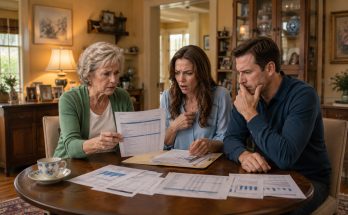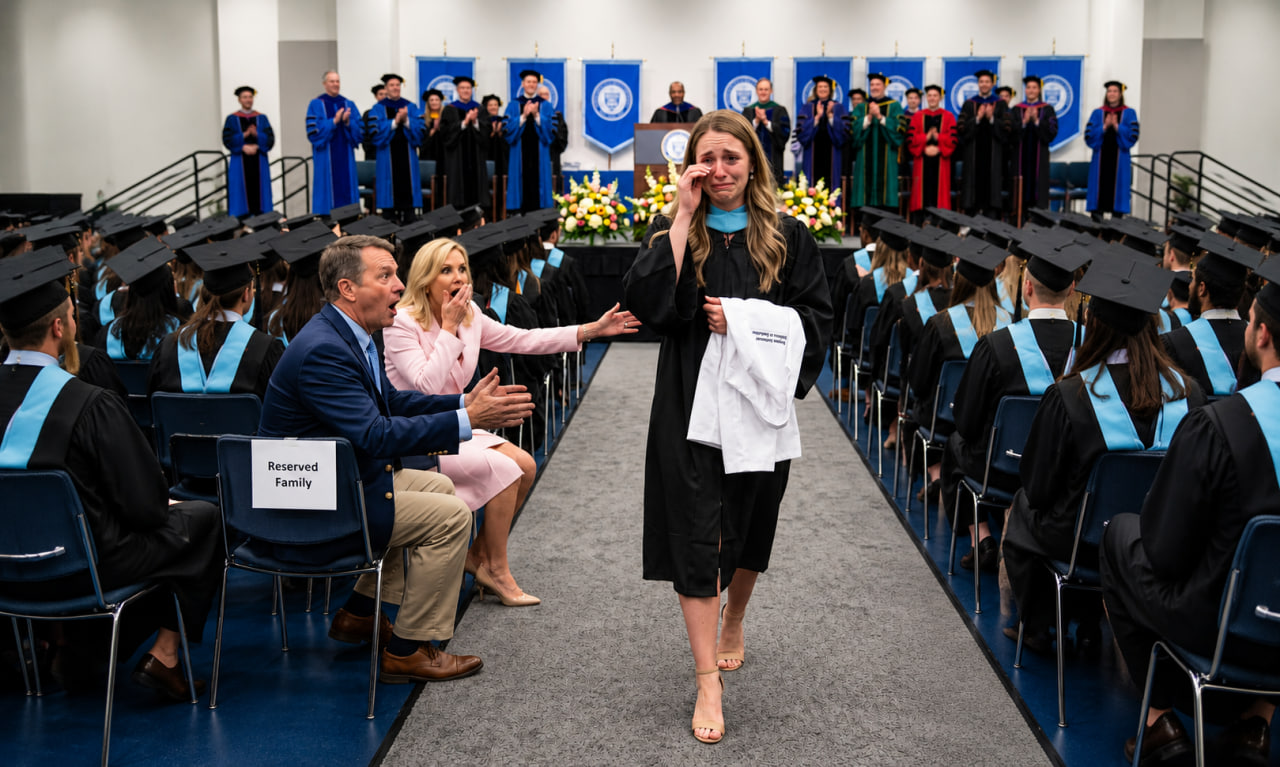
I was thirteen when a doctor told my parents I had acute lymphoblastic leukemia and a strong chance of surviving with treatment. My father’s first question was how much it would cost. When he heard the number could reach $100,000, he pointed to my sister’s $180,000 college fund and said, “We are not sacrificing a promising future for an average one.” They surrendered custody, and a night nurse became the person who stayed through chemotherapy, remission, school, and every difficult year afterward. Fifteen years later, I sat at my medical school graduation with my first white coat folded across my lap. Then I heard my biological mother whisper from the reserved family section, “She owes us this moment.” A few minutes later, the dean reached for the valedictorian card.
“Ready, Emily?”
I nodded, and Laura helped me into the coat. When the fabric settled across my shoulders, I stepped toward the microphone with the graduation speech I had carefully prepared, but after seeing Karen, Thomas, and Megan sitting in the audience, I knew I couldn’t deliver it exactly as written.
“When I was thirteen, a doctor told me I had leukemia.”
The auditorium became silent.
“I was also told, that same day, that my life was not worth the cost of saving it.”
I saw Karen’s expression collapse while Thomas stared straight ahead. I didn’t raise my voice or name them because I didn’t need to; the truth was powerful enough without decoration.
“I survived because medicine mattered. But I became whole because someone stayed.”
I turned toward Laura.
“This coat has my name on it because Laura Davidson gave me hers before I had anything to give back.”
As the applause rose around us, I noticed Dr. Lawson and Susan Myers sitting near the aisle. I had invited them both, and when my biological parents finally noticed them too, Thomas’s expression changed because the people who knew exactly what had happened in Room 314 were now gathered in the same auditorium.
But the confrontation I had avoided for fifteen years didn’t happen on the stage. It began after the ceremony, when Karen found me near the lobby doors and approached with Thomas and Megan behind her.
Laura stood beside me.
Then Karen looked into my eyes and tried to call herself my mother.
Part 3: The Family Who Came Back for the Applause
After the ceremony, the lobby filled with graduates taking photographs, families carrying flowers, and professors offering congratulations. I was standing beside Laura, Dr. Lawson, and Susan when Karen approached with Thomas and Megan behind her, wearing the same strained smile she used whenever she wanted an uncomfortable situation to appear perfectly normal.
“Emily, sweetheart. Your mother would like a hug.”
For several seconds, I simply looked at her. Fifteen years earlier, I would have given almost anything to hear her call herself my mother again, but now Laura was standing beside me, and I finally understood that motherhood wasn’t a title someone could abandon during the difficult years and reclaim when the photographs looked impressive.
“My mother is standing right beside me.”
Karen’s smile disappeared. Thomas immediately stepped forward, clearly expecting the authority he once held over me to return simply because he had decided to use it.
“That’s enough, Emily. Whatever happened in the past, we are still your family.”
I kept my voice calm. I had spent years imagining this confrontation, but now that it was happening, I didn’t feel the anger I expected. Mostly, I felt amazed that they still believed fifteen years of absence could be dismissed as something that had merely “happened.”
“You stopped being my family when you decided Megan’s college fund mattered more than whether I lived.”
Megan’s expression tightened at the mention of her name. She immediately insisted that she had been a teenager and couldn’t be held responsible for the decisions our parents had made.
“I was sixteen, Emily. What was I supposed to do?”
I looked at her and remembered the girl sitting in Room 314 staring at her phone while our father calculated whether saving my life was financially worthwhile. I didn’t blame sixteen-year-old Megan for controlling our parents, but adulthood had given her fifteen years to contact me, and she had never used a single one of them.
“You could have called me once.”
Megan looked away.
Karen quickly changed tactics and began talking about forgiveness. She said people made mistakes under pressure, that my diagnosis had frightened everyone, and that parents sometimes made decisions their children couldn’t understand until they became older themselves.
“We were terrified. Your father was thinking about the whole family. We made mistakes, but you cannot punish us forever.”
Dr. Lawson shifted beside me, and Karen finally noticed him properly. Recognition crossed her face almost immediately because he was the physician who had sat across from them in Room 314 and listened while they discussed surrendering custody of their sick daughter.
Thomas recognized him too.
“This is a private family matter.”
Dr. Lawson’s expression remained calm.
“It became my professional concern the day you asked whether surrendering your thirteen-year-old daughter would save you the cost of treating her cancer.”
Karen’s face went pale. Several people nearby turned toward us, and Thomas lowered his voice as though the volume of the conversation was suddenly more offensive than its history.
“We were exploring options.”
Susan spoke before I could.
“You surrendered custody.”
Thomas looked toward her.
Susan didn’t move.
“You didn’t lose Emily because of paperwork or misunderstanding. You signed the documents.”
For once, nobody could rewrite what had happened. The doctor remembered, the social worker remembered, Laura remembered, and most importantly, I remembered.
Karen’s eyes filled with tears.
“We thought you would come back to us eventually.”
That sentence hurt in a different way because it exposed how completely they had misunderstood the situation. They believed I had been waiting somewhere for fifteen years, still thirteen years old emotionally, hoping they would eventually decide I deserved to return.
“You never came looking for me.”
Karen tried to answer, but I continued before she could invent another explanation. I told her about chemotherapy, the nights Laura slept in hospital chairs, the remission appointments, college move-in day, medical-school acceptance, and every birthday that passed without a call from the people now standing in front of me.
“You missed every difficult day. You don’t get to arrive for the successful one and call it parenting.”
Thomas’s expression hardened.
“We paid for thirteen years of your life before you got sick.”
I stared at him, stunned that after everything, he still thought fatherhood could be reduced to a financial ledger.
“And when the bill became too high, you returned me.”
Thomas fell silent.
Laura gently touched my shoulder, but she didn’t speak for me. She had never needed to. She had raised me to become someone capable of speaking for herself.
Karen glanced at the white coat and then at the name embroidered over my heart.
“You changed your name just to hurt us?”
I looked down at Davidson before meeting her eyes again.
“No. I changed it because somebody else earned the right to share hers with me.”
Laura’s eyes immediately filled with tears.
For the first time since approaching me, Karen seemed to understand that this wasn’t a temporary rebellion waiting to be corrected. I wasn’t Emily Higgins anymore, and Laura wasn’t a substitute mother filling an empty position until my biological family decided to return.
Megan quietly asked the question neither of our parents seemed capable of asking.
“Is there any chance we can start over?”
I considered it carefully. I didn’t hate Megan, but forgiveness and reconciliation were different things, and surviving my childhood had taught me not to confuse compassion with surrendering boundaries.
“I don’t know. But if anything ever changes between us, it won’t begin with pretending nothing happened.”
Megan nodded slowly.
Thomas clearly disliked my answer.
“So that’s it? You become a doctor and suddenly you’re better than everyone?”
I shook my head.
“No. Becoming a doctor didn’t make me better than you. Surviving what you did taught me I don’t need your approval anymore.”
Nobody spoke after that.
I turned toward Laura, and together we walked toward the exit. Dr. Lawson and Susan followed us while my biological family remained behind in the crowded lobby, surrounded by the celebration they had arrived expecting to claim as their own.
Outside, Laura finally allowed herself to cry. She wrapped both arms around me carefully, laughing through her tears while trying not to wrinkle the white coat she had just helped place on my shoulders.
“I am so ridiculously proud of you.”
I hugged her tighter.
“You saved me.”
Laura immediately pulled back.
“No. The doctors saved you. You did the hard part.”
I smiled because after fifteen years, she still refused to take credit for anything she believed belonged to me. That was Laura: the woman who had given without keeping score, stayed without demanding repayment, and loved me without first calculating what my future might be worth.
Years earlier, Thomas Higgins had looked at his sick thirteen-year-old daughter and called her average. He had protected Megan’s future because he believed mine wasn’t worth the investment, never imagining that the daughter he discarded would one day stand on a graduation stage wearing a doctor’s coat.
But the greatest victory wasn’t becoming valedictorian, changing my surname, or watching my biological parents discover what I had accomplished without them. It was realizing that I no longer needed any of those things to prove they had been wrong.
Before we walked toward the parking lot, Laura glanced once more at the embroidery over my heart.
“Dr. Davidson. That sounds pretty good.”
I smiled at her.
“It sounds like home.”
And for the first time, the name Higgins felt exactly where it belonged.
In my past.