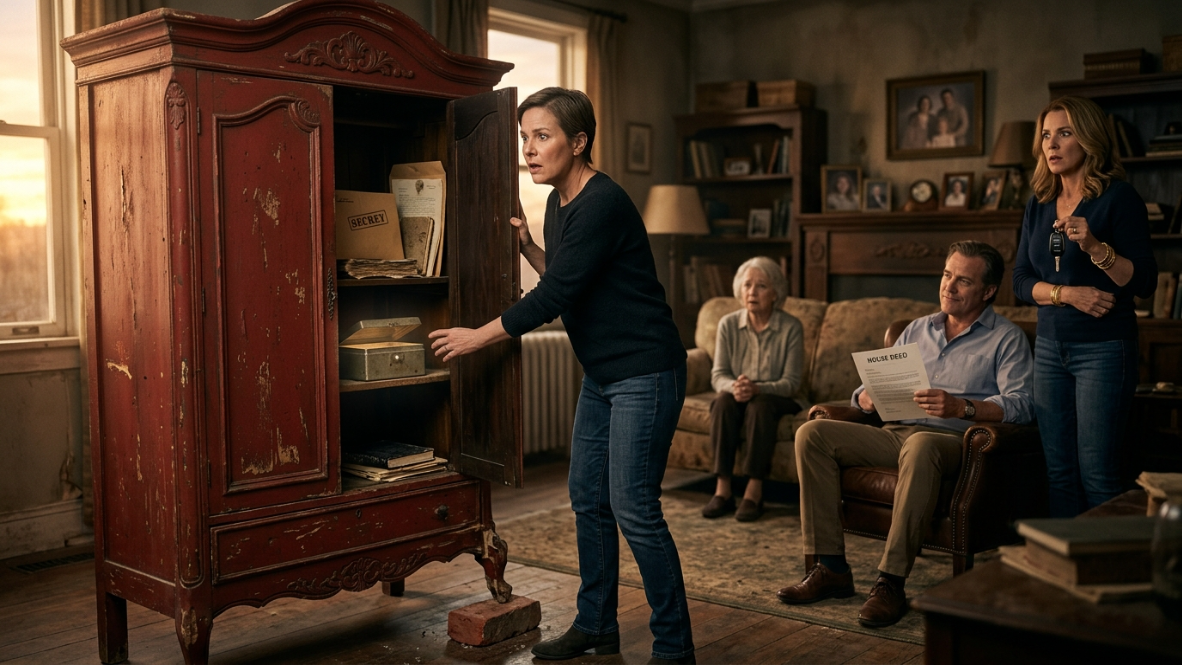
PART 3
My uncle helped me load it into the back of my old pickup truck.
When I turned around, my mother was still standing there.
Her face had gone pale.
“Mom?”
She looked at me.
For a second, neither of us spoke.
Then she said quietly,
“Don’t open the bottom drawer.”
I stared at her.
My brother finally looked up.
“Mom, what are you talking about?”
She immediately shook her head.
“Nothing.”
But I knew my mother.
She had spent my entire childhood telling me not to ask questions.
That was how I knew when something mattered.
I looked at the wardrobe.
Then back at her.
“Why?”
“Because it’s old.”
She forced a smile.
“Probably full of mice.”
My sister laughed from inside.
“Then you finally got something that matches your budget.”
Everyone laughed.
I didn’t.
I climbed into my truck.
Before I started the engine, I looked at my mother one last time.
She was still watching the wardrobe.
And this time, I knew for certain.
She was afraid of what was inside it.
I didn’t take the wardrobe home immediately.
I drove it to my small rented garage across town.
I had nowhere in my apartment big enough for it.
For several minutes, I simply sat in the truck staring at it.
The red paint was almost completely gone.
There were scratches everywhere.
One hinge was rusty.
The bottom drawer was locked.
I remembered that drawer.
As a child, I had once tried to open it.
My father had caught me.
“That’s private,” he’d said.
I had laughed.
“What’s inside?”
He smiled.
“Things you’ll understand when you’re older.”
I had forgotten about that conversation.
Until now.
I climbed out of the truck.
I carried a flashlight into the garage.
Then I opened the wardrobe.
The upper shelves were exactly what I expected.
Old shirts.
A winter coat.
A pair of work boots.
Some newspapers.
A broken radio.
An empty wooden box.
Nothing valuable.
Nothing unusual.
Then I reached the bottom.
The drawer was still locked.
I checked underneath the wardrobe.
Nothing.
I checked the sides.
Nothing.
Then I remembered my father’s old habit.
Whenever he hid a spare key, he always put it somewhere he believed nobody would look.
I ran my hand along the underside of the drawer.
My fingers touched something.
A small piece of tape.
I pulled it loose.
A tiny brass key fell into my palm.
I stared at it.
My heart began beating faster.
I inserted the key.
Click.
The drawer opened.
Inside was a brown envelope.
And underneath it…
a black notebook.
I knew the notebook immediately.
It had belonged to my father.
He had carried it everywhere during the last few years of his life.
I had asked him once what was inside.
“Work,” he’d told me.
I picked it up.
There were dozens of handwritten pages.
Dates.
Names.
Numbers.
Bank account information.
Property addresses.
And near the middle, one sentence written in large letters:
DO NOT TRUST THE FAMILY AGREEMENT.
I stopped breathing.
I turned the page.
There was another sentence.
If they divide the estate without telling her, they are breaking the agreement.
“Her.”
I knew who he meant.
Me.
I kept reading.
The notebook explained something I had never known.
Years ago, my father had created a separate family trust.
He had placed part of his savings, several investments, and a piece of land into it.
The trust had been created specifically for me.
Not because I was the youngest.
Not because he loved me more.
But because he knew exactly what my family had been doing.
My father had seen how my mother favored my brother.
He had seen how my sister was constantly given things.
And he had watched me work myself to exhaustion just to prove that I deserved a place at the table.
The next page made my hands tremble.
Margaret must receive the red wardrobe.
I stared at the sentence.
The wardrobe.
Not the house.
Not the SUV.
Not the savings.
The wardrobe.
I kept reading.
The wardrobe contains the key to everything.
I sat down on the concrete floor.
For several minutes, I couldn’t move.
Then I noticed something else.
There was a folded legal document at the bottom of the drawer.
My father’s signature was at the bottom.
And beneath it was a lawyer’s stamp.
I read the first paragraph.
Then the second.
Then I whispered,
“No.”
Because according to the document, the house my brother had just received…
wasn’t entirely my mother’s to give away.
Neither was the SUV.
Neither were the savings accounts.
My father’s estate had never been legally divided.
My mother had simply decided who would receive what.
And she had apparently expected nobody to challenge her.
But my father had planned for that.
At the bottom of the document was the name of the attorney who had prepared the trust.
Samuel Whitmore.
I knew that name.
My father’s oldest friend.
I hadn’t seen him since the funeral.
I grabbed my phone.
Before I could call him, it rang.
Unknown number.
I answered.
“Hello?”
A man’s voice said,
“Are you Margaret Collins?”
“Yes.”
“My name is Samuel Whitmore.”
I stood up so quickly I nearly dropped the phone.
“How did you get my number?”
“Your father gave it to me.”
I looked at the wardrobe.
“When?”
“Three days before he died.”
My throat tightened.
“What did he tell you?”
There was silence.
Then Samuel said,
“He told me that your family would try to leave you with nothing.”
I closed my eyes.
“He knew?”
“He knew exactly what they would do.”
I sat down again.
“Why didn’t you tell me?”
“Because he made me promise not to until you received the wardrobe.”
I looked at the red paint.
“Why?”
“Because he knew you would never fight your family for money.”
I laughed bitterly.
“That sounds like me.”
“No,” Samuel said.
“That sounds like the daughter he raised.”
I didn’t understand.
“What do you mean?”
“He knew you would accept nothing rather than destroy your family.”
I looked at the papers.
“And now?”
“Now he believed you would have no choice.”
“Why?”
“Because the truth would come with the wardrobe.”
My heart pounded.
“What truth?”
Samuel’s voice became quiet.
“Your father didn’t die without a will.”
I stared at the document.
“I know.”
“No, Margaret.”
He paused.
“You don’t know.”
“There is a will?”
“Yes.”
“Where?”
“Your mother has it.”
My stomach dropped.
“Why would she hide it?”
“Because the will doesn’t give your brother the house.”
I couldn’t speak.
Samuel continued.
“It doesn’t give your sister the SUV.”
I closed my eyes.
“And the savings?”
“Those belong to the trust.”
“The gold?”
“Your grandmother’s bracelets were specifically left to you.”
I stared at the wardrobe.
For years, I had believed I was the child who received whatever was left over.
Now I realized something much more painful.
I had been deliberately pushed aside.
Samuel said,
“Your father knew your mother would try to control the distribution.”
“How?”
“He told me she had already asked him to change the will.”
“Did he?”
“No.”
“Why?”
“Because he had spent his entire life watching her choose favorites.”
My eyes filled with tears.
“What else did he say?”
Samuel was quiet for several seconds.
Then he said,
“He told me something I didn’t understand until now.”
“What?”
“He said, ‘When Margaret receives the wardrobe, tell her to look behind the mirror.’”
I turned toward the wardrobe.
There was an old rectangular mirror attached to the inside of the door.
My hands began shaking.
I opened it.
Behind the mirror was a thin wooden panel.
I pulled it loose.
A small metal box was hidden inside.
I opened it.
Inside was a flash drive.
A key.
And another envelope.
This one had my name written on it.
For my daughter.
I opened it.
My father’s handwriting filled the page.
My dear girl,
If you are reading this, then they have finally given you the one thing in this house they believed was worthless.
I am sorry.
You spent your entire life being asked to understand everyone else.
Your brother needed more.
Your sister deserved more.
Your mother worried about them.
And you were always told you were strong enough to handle less.
I watched it happen.
I should have stopped it sooner.