PART 3
I gave a nervous little laugh.
“I wouldn’t exactly call it feeding. I just brought him food sometimes.”
“Sometimes?”
She smiled through her tears.
“My father kept a list.”
“A list?”
She reached into the bag and pulled out a small black notebook.
The cover was worn.
There were stains along the edges.
I recognized it immediately.
I had seen it once on his kitchen table.
He had been writing in it when I came by with meatloaf.
I remembered teasing him.
“Writing your memoir?”
He had closed it quickly.
“Something like that.”
Now his daughter opened it.
The pages were filled with dates.
Names.
Short sentences.
Some were written neatly.
Others were barely legible.
She turned several pages.
Then she stopped.
“This is you.”
I stared at the page.
My name was written there.
Underneath it was a date.
Then another.
And another.
Almost every day.
Beside each date, my name appeared.
Sometimes followed by a description.
Soup.
Chicken.
Casserole.
Bread.
Apple pie.
And then, on one particular evening:
She stayed today.
I looked at his daughter.
“What does that mean?”
She closed the notebook.
“My father didn’t just keep track of the food.”
I felt something tighten inside my chest.
“What did he keep track of?”
“The days you came.”
I didn’t know what to say.
She took a slow breath.
“My father had been depressed for years.”
I looked down.
“I knew he was lonely.”
“You knew some of it.”
Her voice softened.
“You didn’t know all of it.”
She stepped inside.
I moved aside.
We sat at my tiny kitchen table, the same table where I had chopped vegetables, kneaded dough, and packed meals for a man who had become part of my life without either of us ever officially deciding that he would.
Her name was Linda.
She told me she was Arthur’s oldest child.
There was also a younger son named Michael.
They lived outside New York.
They had families.
Jobs.
Mortgages.
Children.
Busy lives.
The kind of lives Arthur had always described with a joke.
“Living,” he used to say.
“That’s what my kids are doing.”
I had assumed he was bitter.
Linda shook her head.
“He wasn’t.”
She looked at the notebook.
“He was ashamed.”
“Of what?”
“Of needing us.”
That answer broke something in me.
Linda continued.
“My father was proud. Extremely proud. When Mom died, he told everyone he was fine. When he started having trouble walking, he said it was nothing. When he started forgetting things, he said everyone forgets things.”
She rubbed her hands together.
“And when he stopped eating properly, he lied.”
I remembered all the times I had found untouched groceries in his refrigerator.
All the times he had claimed he had already eaten.
All the times he had told me his doctor was exaggerating.
“He told us he was eating,” Linda said.
“He wasn’t.”
I stared at the floor.
“Why didn’t you know?”
Linda looked away.
“Because he made sure we didn’t.”
The words hung between us.
Outside, a car horn sounded.
Someone laughed on the sidewalk.
A child ran down the hallway.
The world continued as if nothing had happened.
But inside my apartment, I felt as though time had stopped.
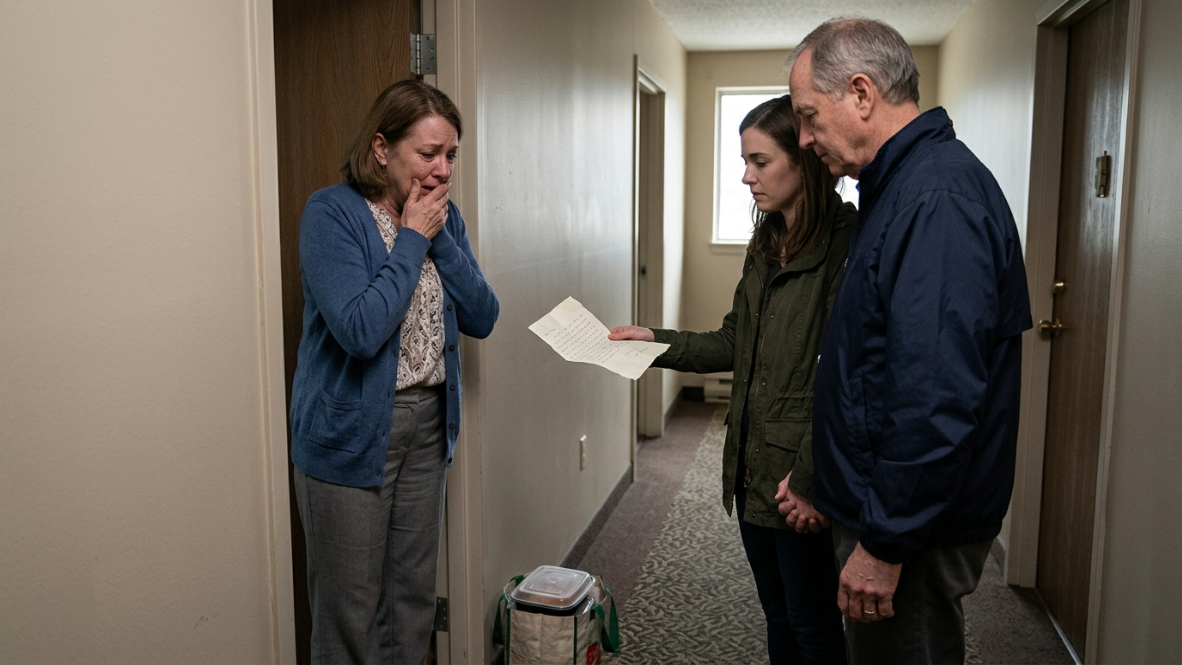
Linda placed the envelope on the table.
“He asked us to give you this only after everything was settled.”
“Settled?”
“His funeral. His apartment. His belongings.”
She hesitated.
“There was one other instruction.”
“What?”
“He didn’t want us to open it.”
I looked at the envelope.
“You haven’t?”
“No.”
“You don’t know what’s inside?”
She shook her head.
“He told Michael and me that it belonged to you.”
My fingers trembled.
“Why would it belong to me?”
Linda gave a sad smile.
“That is what you’re about to find out.”
I stared at the envelope for a long time.
Finally, I opened it.
Inside was a single sheet of paper.
Folded twice.
Arthur’s handwriting covered the page.
The moment I saw it, my eyes blurred.
I recognized the uneven letters.
The little loops in his capital letters.
The way he always pressed too hard on the paper.
At the top, he had written:
To the woman next door.
Not my name.
Just that.
I unfolded the page.
And began to read.
My dear neighbor,
If you’re reading this, then I’ve probably managed to make you angry one last time by leaving you with something you didn’t ask for.
I’m sorry.
But there are things a man should say while he’s alive, and there are things he’s too frightened to say until he knows he won’t have to watch the other person’s face while they hear them.
You gave me food.
But that’s not what you gave me.
You gave me mornings.
You gave me reasons to wash my dishes.
You gave me reasons to turn off the television because someone was coming.
You gave me something to look forward to.
I had forgotten what that felt like.
I stopped reading.
My vision had become too blurry.
Linda quietly reached across the table.
“You can stop.”
“No.”
I wiped my eyes.
“I want to finish.”
I continued.
When Mary died, I thought the hardest part would be missing her.
I was wrong.
The hardest part was discovering that the world continued without her.
People went to work.
Stores opened.
Children went to school.
Christmas came.
Spring came.
Another birthday came.
And nobody stopped the world to tell me that it was okay to be broken.
So I became very good at pretending I wasn’t.
My hands shook.
My children tried.
I want you to know that.
If they tell you they failed me, don’t believe them.
They called.
They visited.
They worried.
I pushed them away because I was embarrassed that I needed them.
A father is supposed to protect his children.
He isn’t supposed to become the thing they worry about.
So I told them I was fine.
I wasn’t.
Linda covered her mouth.
She had heard some of this before.
But never in these words.
I kept reading.
Then you moved into the apartment next door.
You probably thought the burnt soup was an accident.
It wasn’t entirely.
I knew I had left the pot on the stove.
I knew I should have turned it off.
Part of me didn’t care.
I was tired.
Not physically.
I was tired of waking up to another day that felt exactly like the day before.
I looked up.
Linda was crying now.
I continued.
Then you knocked.
You asked if I was okay.
Nobody had asked me that in a long time.
People asked if I needed anything.
They asked if I had taken my medicine.
They asked if I had eaten.
But you asked if I was okay.
There is a difference.
I lied.
I said yes.
You didn’t believe me.
I let out a broken laugh.
That sounded exactly like him.
Then you brought soup.
You said it was leftovers.
It wasn’t.
I knew that.
You knew I knew.
Neither of us said anything.
I had to stop again.
I could almost hear his voice.
It needs salt.
I smiled through my tears.
Linda smiled too.
“He really loved that soup,” she whispered.
I nodded.
Then I read the next line.
Every time you left food at my door, I felt ashamed at first.
I thought, “Look at you. An old man being fed by a stranger.”
Then I realized something.
You weren’t feeding me because I was helpless.
You were feeding me because I was your neighbor.
That distinction saved me.
My chest tightened.
You never asked for my history.
You never asked how much money I had.
You never asked why my children didn’t visit more.
You didn’t treat me like a broken old man.
You treated me like Arthur.
That was the greatest gift anyone had given me since Mary died.
I lowered the letter.
“I can’t.”
Linda reached for my hand.
“Yes, you can.”
I looked at her.
“How did you not know?”
She began crying harder.
“We knew he was lonely.”
“But not this?”
“No.”
She shook her head.
“He was very good at hiding it.”
I looked back at the letter.
There was more.
There is something else you need to know.
The day before I died, I knew something was wrong.
I felt weak.
I knew I should call my children.
I didn’t.
Not because I didn’t love them.
Because I did.
I didn’t want my last conversation with them to be fear.
I wanted them to remember me laughing.
I wanted to leave them one good memory instead of another hospital room.
I stopped breathing for a second.
Then I read the next sentence.
If you are blaming yourself, stop.
You did not fail me.
You were the reason I had better months than I expected.
You were the reason I ate.
You were the reason I opened my curtains.
You were the reason I started shaving again.
You were the reason I began talking to people in the hallway.
You were the reason I started living instead of merely waiting.
I pressed the letter against my chest.
Linda was crying openly now.
I couldn’t stop either.
But then I noticed something.
The letter wasn’t finished.
At the bottom of the page, Arthur had written:
There is one final thing I need you to do.
Please don’t let my story end with me.
There is another person in this building who is lonelier than I ever was.
You haven’t met her yet.
But you will.
Her name is Evelyn.
Apartment 5C.
She has not left that apartment in almost two years.
She will tell you she doesn’t need anyone.
Believe her words.
But don’t believe her loneliness.
And when you meet her, give her the blue box.
I looked up.
“What blue box?”
Linda frowned.
“I don’t know.”
“Your father mentioned Evelyn?”
She nodded slowly.
“He did.”
“What did he say?”
Linda looked uncomfortable.
“He said she was important.”
“To him?”
“To you.”
My stomach dropped.
“What does that mean?”
Linda shook her head.
“I don’t know.”
Then she looked at the letter again.
“Wait.”
“What?”
She pointed to the bottom.
There was another line.
One I hadn’t noticed because my tears had blurred the ink.
And if my children ever come to you asking why I never told them the truth, tell them I was afraid.
Not of dying.
Of being forgiven.
I stared at that sentence.
“What truth?”
Linda’s face changed.
She looked toward the window.
Then back at me.
“There is something my father never told us.”
“What?”
She hesitated.
“He had another child.”
The room went completely silent.
I thought I had misunderstood.
“What?”
“My father had another child.”
“Before you?”
“Yes.”
“Where?”
“We don’t know.”
“You don’t know?”
She shook her head.
“He never talked about her.”
I felt cold.
“Her?”
“A daughter.”
I looked at Arthur’s letter.
“Evelyn?”
Linda shook her head.
“No.”
She swallowed.
“Evelyn is someone else.”
I stared at her.
“Then who is your father’s daughter?”
Linda’s eyes filled with tears again.
“We don’t know.”
I stood slowly.
My chair scraped against the floor.
“Then why would he leave me a letter telling me to find someone in apartment 5C?”
“I don’t know.”
“And what does the blue box have to do with his daughter?”
“I don’t know.”
She sounded almost desperate.
Then, from somewhere outside my apartment, came the sound of footsteps.
Slow.
Dragging.
One step.
Then another.
Linda turned toward the door.
I froze.
The footsteps stopped directly outside.
Neither of us spoke.
Then there were three soft knocks.
Knock.
Knock.
Knock.
I walked toward the door.
My hand was still trembling when I reached for the handle.
I opened it.
An elderly woman stood in the hallway.
She was thin.
Very thin.
Her gray hair was pulled tightly behind her head.
She wore a long blue cardigan.
And in her hand was a small metal key.
She stared at me.
Then at Linda.
Then back at me.
“Arthur is dead,” she said.
It wasn’t a question.
I nodded.
“Yes.”
Her lips trembled.
“I knew.”
“How?”
She looked past me toward the kitchen table.
Toward the letter.
Then her eyes landed on the black notebook.
Her face went pale.
“He gave you that?”
I didn’t answer.
She stepped backward.
“No.”
Linda stood.
“Who are you?”
The woman looked at her.
“My name is Evelyn.”
My heart stopped.
Apartment 5C.
Arthur’s final instruction.
Evelyn’s eyes moved to me.
Then she whispered the words that would change everything I thought I knew about my dead neighbor.
“Arthur promised me he would never tell his children.”
Linda went completely still.
“Tell us what?”
Evelyn’s hand tightened around the key.
“That your father didn’t die alone.”
Linda’s face drained of color.
“What do you mean?”
Evelyn looked directly at me.
“He came to my apartment the night before he died.”
I couldn’t breathe.
“He told me he was going to leave you a letter.”
Linda whispered:
“Why?”
Evelyn’s eyes filled with tears.
“Because he knew you were the only person who might finish what he was too afraid to finish.”
She reached into the pocket of her cardigan.
Then she pulled out a small photograph.
She handed it to me.
I looked down.
It was a picture of Arthur.
Much younger.
Standing beside Mary.
And between them was a little girl.
Maybe six years old.
The little girl was smiling.
But there was something written on the back of the photograph.
Three words.
My first daughter.
I looked at Evelyn.
“Who is she?”
Evelyn’s voice broke.
“I was hoping you would ask.”
Then she pointed toward the hallway.
“Because if you’re really going to help Arthur…”
She looked at Linda.
“…you need to know what happened to that little girl.”
And before I could ask another question, Evelyn whispered:
“Her name was Rose.”
Then she walked away.
Leaving us standing in the doorway.
And for the first time since Arthur died, I understood something terrifying.
The food had never been the whole story.
It had only been the beginning.
PART 4
For several seconds after Evelyn disappeared down the hallway, none of us moved.
Linda was still staring at the empty space where the old woman had been standing.
I was staring at the photograph.
Arthur.
Mary.
And the little girl between them.
Rose.
She couldn’t have been more than six.
She had dark hair pulled into two little braids, a gap between her front teeth, and the kind of smile children have before life teaches them to be careful with happiness.
Arthur’s arm was wrapped around her shoulders.
Mary’s hand rested gently against the girl’s back.
They looked like a family.
A complete family.
A happy family.
Yet Linda had just told me she had never known about Rose.
I looked at her.
“Did your father ever mention this name?”
She shook her head.
“Never.”
“Not once?”
“Not once.”
“Did you know your mother had another daughter?”
Linda’s face crumpled.
“I don’t know what I knew anymore.”
She took the photograph from my hands.
Her fingers immediately began shaking.
She turned it over.
Read the words.
Then she sat down hard in the chair.
“My first daughter.”
She whispered it as if the words themselves were dangerous.
I sat beside her.
“What happened to her?”
“I don’t know.”
“But Evelyn does.”
Linda looked toward the hallway.
“Then we need to ask her.”
We found Evelyn’s apartment door still slightly open.
I knocked.
There was no answer.
I knocked again.
“Evelyn?”
Nothing.
I pushed the door gently.
It opened.
Her apartment was almost completely dark.
The curtains were closed.
The furniture was covered with old blankets.
There were stacks of newspapers against one wall.
A clock on the mantel had stopped at 3:17.
The air smelled faintly of lavender and dust.
“Evelyn?”
A voice came from the bedroom.
“Come in.”
We found her sitting on the edge of her bed.
She looked exhausted.
Like someone who had spent years carrying a secret that had become heavier every morning.
She gestured toward two chairs.
“Sit.”
Linda sat.
I remained standing.
“What happened to Rose?”
Evelyn looked at me.
“You really want to know?”
“Yes.”
“Even if it changes the way you remember Arthur?”
I hesitated.
Then nodded.
“Yes.”
She looked down at her hands.
“Good.”
She took a breath.
“Because your neighbor was not always the quiet old man you knew.”