PART 3
“I said everything I needed to say.”
She rubbed her forehead.
“My father is angry.”
“He should be.”
“He thinks you’re trying to punish Carter.”
“I haven’t punished anyone.”
“You canceled the payments.”
“I stopped paying bills that weren’t mine.”
Her eyes filled with tears again.
“You know what I mean.”
“Yes.”
She looked toward the window.
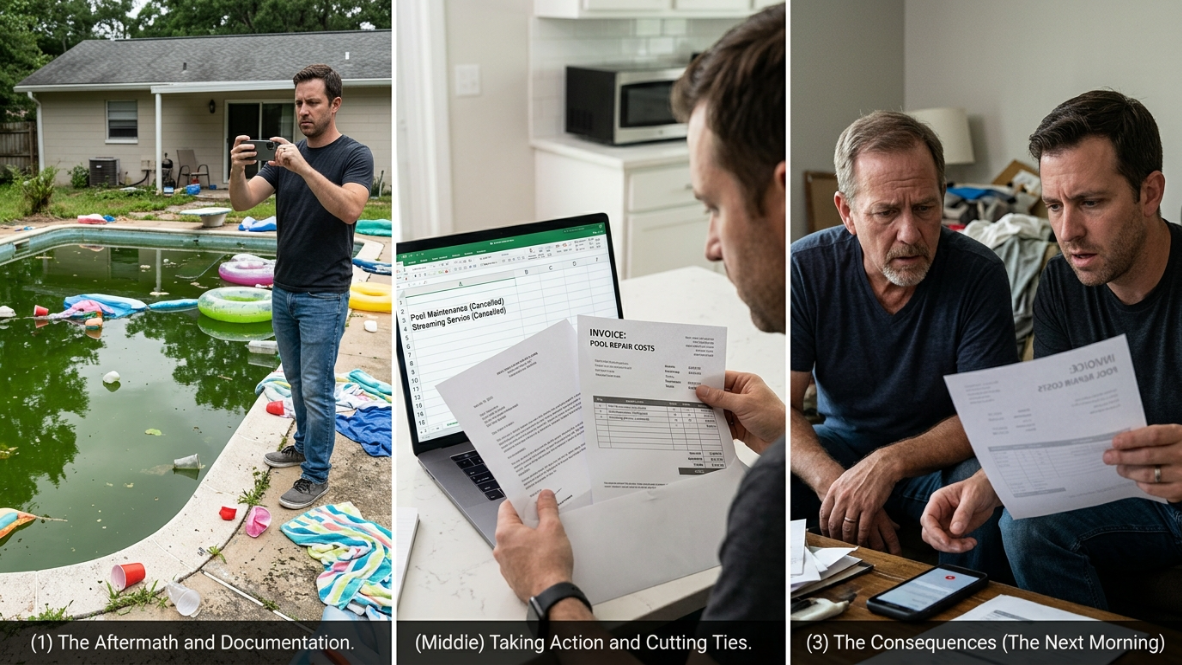
Outside, the empty pool was surrounded by temporary barriers Elijah had placed around the damaged area.
For the first time in years, there was no laughter coming from our backyard.
No children running across the patio.
No cooler sitting beside the grill.
No strangers opening our refrigerator.
No Carter shouting instructions at everyone as though he owned the place.
Just silence.
And strangely, the silence felt peaceful.
Sarah noticed me looking outside.
“You really changed the gate code?”
“Yes.”
“Without telling me?”
“I told you yesterday that Carter’s access was ending.”
“You didn’t tell me you were actually doing it.”
“I thought I had made myself clear.”
She looked wounded.
“You’re treating me like I’m one of them.”
I turned toward her.
“No, Sarah. I’m finally treating our home like it’s ours.”
She didn’t answer.
My phone buzzed again.
This time it was Carter.
I opened the message.
You’re seriously sending me a bill?
Another message followed immediately.
That note was a joke.
Then:
You can’t prove I did anything.
I stared at the screen.
I took a screenshot.
Then another.
I saved both.
“Carter says it was a joke,” I said.
Sarah closed her eyes.
“Maybe you should call him.”
“No.”
“Matthew, please.”
“No.”
“Why?”
“Because every time we talk, he turns a conversation into an argument. This time, I want facts.”
She looked at me for several seconds.
Then she whispered,
“What if he didn’t do it?”
I looked at her.
“He told me not to call him.”
“That doesn’t prove anything.”
“He knew about the damage before I told him.”
Sarah frowned.
“What?”
I turned my phone toward her.
Carter’s first message had arrived before I had sent him the contractor’s estimate.
You’re seriously sending me a bill?
I hadn’t mentioned the bill yet.
I hadn’t even told him Elijah had inspected the pool.
Sarah stared at the screen.
Her expression changed.
“Maybe Dad told him.”
“Maybe.”
She swallowed.
“But how did Dad know?”
I didn’t answer.
Because I was thinking about the note.
Pool parties are over.
Maybe now you’ll understand how it feels when someone takes something you care about.
The sentence hadn’t sounded like Carter.
It sounded like someone trying to teach me a lesson.
And suddenly, another detail bothered me.
The handwriting.
I had recognized it as Carter’s.
But I hadn’t compared it carefully.
I printed a photograph of the note and placed it beside an old birthday card Carter had given Sarah.
Then I took out a magnifying glass from the drawer.
Sarah watched me.
“What are you doing?”
“Looking.”
“At what?”
“The handwriting.”
I compared the letters.
The capital P.
The shape of the lowercase g.
The way the writer crossed the t.
I stared for almost a minute.
Then I looked at Sarah.
“This isn’t Carter’s handwriting.”
She froze.
“What?”
“The letters are close, but they’re not the same.”
“You said you recognized it.”
“I recognized the style.”
“But you just said—”
“I was wrong.”
Sarah stood.
She walked to the counter and picked up the photograph.
Her fingers trembled.
“Then who wrote it?”
“I don’t know.”
A strange silence settled over the kitchen.
Then Sarah said something that changed everything.
“Dad.”
I looked at her.
“Why?”
“Because he writes like that.”
I remembered Joseph’s messages.
Short.
Sharp.
Condescending.
Always sounding like he was delivering a verdict instead of having a conversation.
I picked up my phone.
“Did your father know we were going to Yellowstone?”
“Yes.”
“Did Carter?”
“Yes.”
“Who knew the house would be empty?”
“Family.”
“Who knew the gate code?”
Sarah looked away.
I didn’t need to ask the next question.
She knew.
“Sarah.”
She whispered,
“I gave it to Dad.”
My jaw tightened.
“When?”
“Last summer.”
“Why?”
“He wanted to check something in the backyard.”
“What something?”
She hesitated.
“The outdoor storage cabinet.”
“Why?”
“I don’t remember.”
“You don’t remember giving your father access to our property?”
“I remember now.”
She looked at me.
“He said he wanted to see if Carter had left some tools here.”
“And you gave him the code.”
“Yes.”
“Did you tell me?”
“No.”
I nodded slowly.
That was the moment something inside me changed.
Not because Joseph had entered the property.
Not because Carter had used the pool.
Not even because the pool had been destroyed.
It was because I finally understood the real problem.
The problem wasn’t the gate code.
The problem was that Sarah had spent years deciding that protecting her family’s feelings was more important than protecting our marriage.
She had convinced herself that every compromise was harmless.
Every unpaid bill was temporary.
Every unannounced visit was family.
Every insult was something I should ignore.
And every boundary I tried to establish was somehow an attack.
My phone rang.
Carter.
I declined it.
It rang again.
I declined it again.
Then a voicemail arrived.
I played it on speaker.
Carter’s voice filled the kitchen.
“Matthew, listen. You are taking this way too far. Whatever happened to the pool, we can talk about it like adults. You don’t need to send me some ridiculous bill. Dad says you’re trying to make this a legal issue, and honestly, if you want to destroy the family over this, that’s on you.”
The message ended.
Sarah stared at the phone.
“Did he just say Dad knows?”
“Yes.”
She stood slowly.
“I’ll call my father.”
“No.”
She looked at me.
“Why?”
“Because I don’t want another family meeting.”
“What do you want?”
“The truth.”
I picked up my laptop.
“I’ve already requested the security footage from the neighborhood entrance.”
Sarah’s eyes widened.
“We don’t have cameras.”
“The neighborhood does.”
She said nothing.
I opened the homeowner association portal.
Our street had license-plate cameras at both entrances.
They were installed after several break-ins the previous year.
I submitted a request for footage covering the four days we were gone.
Then I called the insurance adjuster.
I explained the situation.
She asked me to provide the photographs, contractor’s report, written note, and any communication with the suspected person.
I sent everything.
Two hours later, Elijah called.
“I found something.”
I grabbed my keys.
Sarah followed me outside.
Elijah was kneeling beside the pump housing.
He pointed toward a valve.
“This was manually opened.”
“Meaning?”
“Someone deliberately released the water.”
He looked at me.
“This wasn’t an accident.”
Sarah covered her mouth.
“How much damage?”
“More than I originally thought.”
He opened his clipboard.
“The water level dropped low enough that the liner shifted. When the pump continued running, it sucked air into the system. That damaged the motor.”
“How much?”
“Pool structure and liner: around sixteen thousand.”
He pointed to another line.
“Pump and filtration system: roughly seven thousand.”
Then another.
“Underground plumbing is still uncertain.”
He looked toward the planters.
“Landscaping, concrete repair, cleanup…”
He exhaled.
“You’re probably looking at thirty thousand or more.”
Sarah whispered,
“Thirty thousand?”
Elijah nodded.
“And that’s before we know whether the plumbing needs excavation.”
I looked at the empty pool.
For four years, I had paid for chemicals, electricity, repairs, water, maintenance, and insurance.
I had never asked Carter for a dollar.
Not once.
Because I believed family helped family.
Apparently, I had misunderstood the definition.
My phone buzzed.
A message from the neighborhood association.
Vehicle footage available for homeowner review.
I opened the attached file.
The first clip showed our street at 11:42 p.m.
A black pickup entered the neighborhood.
I recognized the truck immediately.
Carter’s.
Sarah leaned closer.
“No.”
I continued watching.
The truck stopped outside our house.
Two people got out.
One was Carter.
The other was Joseph.
Neither of them looked around nervously.
They walked directly toward our side gate.
Carter entered the code.
The gate opened.
They disappeared into the backyard.
The timestamp read 11:48 p.m.
I looked at Sarah.
She was pale.
“They came together.”
I played the next clip.
At 2:13 a.m., they came back out.
Carter was carrying something.
Joseph was carrying a long black hose.
They loaded everything into the truck.
Then, before getting into the vehicle, Joseph turned toward the camera.
For one second, his face was completely visible.
He looked directly into the lens.
Then he smiled.
The truck drove away.
Sarah sat down on the patio step.
“Oh my God.”
I didn’t say anything.
She covered her face.
“Matthew…”
I handed her a bottle of water.
She didn’t drink it.
“I didn’t know.”
“I know.”
“I swear I didn’t know.”
“I believe you.”
She looked up.
“Do you?”
“Yes.”
Her face crumpled.
“But I gave them the code.”
“Yes.”
“And I defended them.”
“Yes.”
“And I told you to let things go.”
“Yes.”
She began crying.
“I was wrong.”
I sat beside her.
For a while, neither of us spoke.
Then she asked,
“What are you going to do?”
I looked at the empty pool.
“I’m going to do what I should have done four years ago.”
“What?”
“Protect what belongs to us.”
That evening, I sent Carter and Joseph one final message.
I attached the security footage.
I attached Elijah’s preliminary report.
I attached photographs of the damage.
And I attached the handwritten note.
My message contained only three sentences.
You entered my property without permission.
You deliberately caused extensive damage.
All further communication will go through my attorney and insurance company.
Then I blocked both numbers.
Sarah stared at me.
“You blocked your father?”
“No.”
“You blocked mine.”
“I blocked Carter and Joseph.”
She nodded slowly.
“Fair.”
It was the first time she had agreed with me without adding a defense for them.
The next morning, the desperate calls began.
Not from Carter.
From everyone else.
Sarah’s mother called first.
Then her aunt.
Then her cousin.
Then one of Joseph’s friends.
By nine o’clock, my phone was filled with messages from people who had never once called me when Carter was using the pool.
Now they wanted me to “be reasonable.”
One message said:
Family mistakes should stay inside the family.
Another:
Thirty thousand dollars is ridiculous. Surely you don’t want to ruin Carter’s life over a misunderstanding.
I didn’t respond.
Then Sarah received a message from her father.
She showed it to me.
Your husband is trying to destroy us. If he files anything, don’t expect me to forgive you for choosing him.
Sarah read it three times.
Then she deleted it.
“No,” she said quietly.
“What?”
“I am not doing this anymore.”
She stood up.
She walked into the bedroom.
Ten minutes later, she returned carrying an old cardboard box.
She placed it on the kitchen table.
“What is that?”
She opened it.
Inside were receipts.
Bank statements.
Copies of checks.
Credit-card records.
And handwritten notes.
I looked at her.
“What am I looking at?”
She swallowed.
“I started keeping these because I knew someday you would ask.”
My stomach tightened.
“Ask what?”
She looked directly into my eyes.
“How much we’ve actually given them.”