PART 3
Ross laughed.
Not because anything was funny.
It was the nervous laugh of a man who suddenly realizes the ground beneath his feet isn’t as solid as he thought.
“That’s what the envelope is for, isn’t it?”
Whit nodded.
“The envelope is part of it.”
Diane stared down at the letter in her hand.
“What does he mean?” she whispered.
I could see the first line still visible.
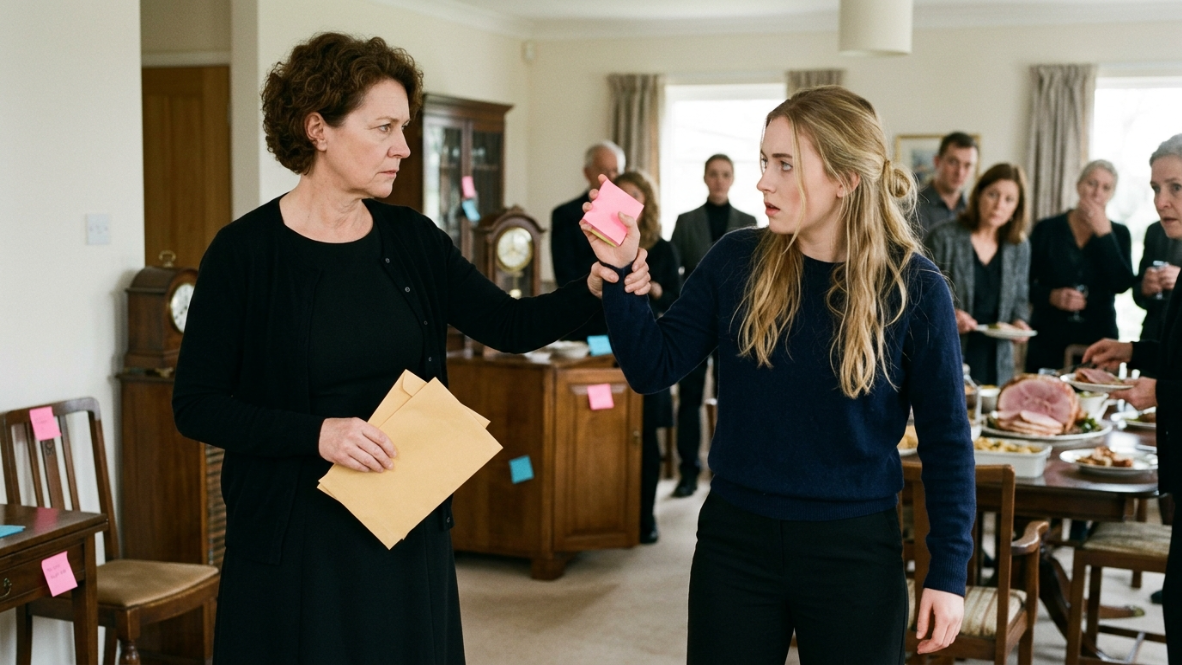
By the time you read this, Diane, you have already put your stickers on the furniture.
She folded the paper quickly.
“That’s not funny.”
“No,” Whit said.
“It isn’t.”
The room became completely silent.
Even the children who had been running through the hallway stopped.
Mrs. Hendricks leaned toward my sister and whispered, “Who is that man?”
My sister whispered back, “I have no idea.”
I did.
Or at least I knew what Frank had told me.
He had told me there would be something I wouldn’t understand until the funeral.
He had told me not to interfere.
And he’d told me something else.
“If they get angry, let them.”
At the time, I had thought he was talking about Diane and Ross getting angry about the inheritance.
Now I wasn’t so sure.
Michael walked into the living room.
He was probably in his early fifties, tall, neat, with silver beginning at his temples. He wasn’t dressed like a funeral guest. His gray suit was too formal, his shoes too polished, and his expression was too calm.
He placed the briefcase on the coffee table.
Click.
One lock.
Click.
The second.
Diane stepped backward.
“What is in there?”
Michael looked at her.
“Documents.”
“What kind of documents?”
“Documents your father instructed me to deliver today.”
Ross stepped forward.
“You work for my father?”
“I did.”
“How long?”
Michael paused.
“Long enough.”
Ross’s jaw tightened.
“That’s not an answer.”
“It’s the answer I’m authorized to give.”
Whit cleared his throat.
“Ross, sit down.”
“I don’t want to sit down.”
“I understand.”
“No, you don’t.”
Ross pointed at the room.
“This is my father’s house.”
I felt something inside me tighten.
Not because his words surprised me.
But because he said them with such certainty.
As if Frank’s death had transferred ownership directly into Ross’s hands.
As if nineteen years of marriage meant nothing.
As if the mortgage payments I’d made beside Frank meant nothing.
As if every night I’d slept beside a man who couldn’t breathe properly meant nothing.
As if the last thing Frank had whispered to me before closing his eyes had never happened.
I looked at Ross.
“This is my house.”
His eyes snapped toward me.
“You said what?”
“I said this is my house.”
Diane gave a small laugh.
“Don’t start this now, Eileen.”
“I didn’t start anything.”
She gestured toward the pink and blue sticky notes scattered around the room.
“We were only trying to figure out what Dad wanted us to have.”
“No.”
I looked directly at her.
“You were trying to figure out what you could take.”
Her mouth fell open.
It was the first time in nineteen years I had ever spoken to her that way.
She looked genuinely offended.
“How dare you?”
“How dare I?”
My voice was shaking, but I didn’t lower it.
“Your father was buried an hour ago.”
Nobody moved.
“You came into my home, while the food was still on the table, and started putting labels on my furniture.”
Diane’s face hardened.
“You’re making this emotional.”
“Of course I’m emotional.”
I pointed toward the hallway.
“My husband is still in the ground.”
The room went silent again.
Ross looked away.
For just a second, I thought I’d finally gotten through to him.
Then he muttered,
“Well, Dad wouldn’t want us fighting.”
I almost laughed.
Because that was exactly the kind of thing Frank had spent his entire life trying to prevent.
Whit looked at me.
“Eileen, may I?”
I nodded.
He walked to the center of the room and pulled a folder from his briefcase.
“Before we address the contents of the envelopes, there are several matters that must be made clear.”
Diane folded her arms.
“Estate matters?”
“Yes.”
“Then maybe we should do this privately.”
“No,” Whit said.
She blinked.
“What?”
“Your father specifically instructed me to conduct this portion of the meeting here, today, with the people who were present at the funeral.”
Ross stared at him.
“Why?”
Whit looked toward Michael.
Then back at the children.
“Because your father believed there were certain things you needed to hear from him, even after he was gone.”
Diane slowly sat down.
Ross remained standing.
Whit opened the folder.
“Frank’s will was updated on February seventeenth.”
Diane’s eyes narrowed.
“February?”
“Yes.”
“After he got sick?”
“Yes.”
“Who was present?”
“I was.”
She looked at me.
“You?”
“No.”
Whit answered before I could.
“Eileen was not present.”
Diane seemed disappointed by that answer.
“Then who was?”
Whit closed the folder.
“That’s not relevant yet.”
Ross stepped forward.
“It is relevant if you’re changing the will.”
“The will was changed legally.”
“How much?”
Whit frowned.
“How much what?”
“How much did Dad leave me?”
Diane turned toward him.
“Ross.”
“What?”
“We need to know.”
Whit sighed.
“I expected you to ask that.”
He looked at both of them.
“Frank left specific instructions regarding your inheritance.”
Diane leaned forward.
“How much?”
Whit didn’t answer.
Instead, he picked up the letter Diane had dropped.
“Perhaps you should finish reading your father’s letter first.”
She stared at it.
Her hands were trembling.
“I don’t want to.”
Whit’s voice softened.
“Your father wanted you to.”
Diane looked at me.
For the first time that afternoon, there was fear in her eyes.
Not grief.
Fear.
She slowly unfolded the paper.
“‘By the time you read this, Diane, you have already put your stickers on the furniture.’”
She swallowed.
“‘You probably believe this house belongs to you because you believe I am gone and there is no one left to tell you otherwise.’”
A few people shifted uncomfortably.
Diane’s cheeks turned red.
She continued.
“‘You are wrong.’”
Ross looked at his sister.
Neither spoke.
Diane kept reading.
“‘For nineteen years, Eileen has been my wife. Not my nurse. Not my housekeeper. Not my replacement for your mother. My wife.’”
Her voice cracked.
I looked down.
I couldn’t bear hearing it.
Not because it hurt.
Because it healed something.
Something I had been carrying for nineteen years.
Diane continued.
“‘I know you have never accepted that.’”
She stopped.
Her lips pressed together.
Then she read the next sentence.
“‘I know you have treated her as though she were temporary.’”
Ross suddenly looked toward the floor.
“‘You were wrong about that too.’”
Diane’s eyes filled with tears.
But she didn’t cry.
Not yet.
“‘Eileen was beside me when you were not.’”
The room became painfully quiet.
“‘She held my hand during the nights I was afraid. She learned every medication. She argued with doctors when they tried to send me home too soon. She slept in a chair because she didn’t want me to wake up alone.’”
Diane lowered the page.
“I don’t need to hear this.”
Whit said gently,
“Your father wanted you to.”
She stared at him.
Then at the paper.
And kept reading.
“‘Diane, I am not writing this to punish you. I am writing it because I need you to understand the difference between losing a father and losing an inheritance.’”
Ross whispered,
“Jesus.”
Diane’s hands shook.
“‘If your first thought after my funeral is about what I left behind, then you have already lost something far more important than money.’”
Diane couldn’t continue.
She handed the letter to Ross.
He took it reluctantly.
For a moment, nobody spoke.
Then Ross read the next paragraph.
“‘Now we come to the man standing in the doorway.’”
Everyone looked at Michael.
“‘His name is Michael Grant.’”
Ross stopped.
Michael gave a small nod.
“‘Michael is the son of a man I once considered my closest friend.’”
I felt my stomach tighten.
Frank had never mentioned him.
“‘His father, Thomas Grant, helped me build my first business when I was twenty-eight. When that business failed, Thomas was the only person who didn’t tell me I was finished.’”
Ross continued.
“‘Years later, I made a mistake that I never told my children about.’”
Diane looked up.
“What mistake?”
Ross kept reading.
“‘I thought money could repair something that money had broken.’”
Michael’s expression didn’t change.
“‘I was wrong.’”
Ross swallowed.
“‘Twenty-seven years ago, Thomas Grant died.’”
Michael looked down.
“‘He left behind a wife and a six-year-old son.’”
I looked at Michael.
He was staring at the floor.
“‘I promised Thomas I would help them.’”
Ross’s voice became quieter.
“‘I didn’t.’”
Nobody moved.
“‘I was young. I was selfish. I was building my company. I told myself I would make it right later.’”
Frank’s words suddenly felt painfully familiar.
“‘Later became years.’”
Michael closed his eyes.
“‘By the time I finally found Michael again, he was grown.’”
Ross lowered the paper.
“Why didn’t Dad tell us?”
Michael answered.
“Because he was ashamed.”
The words hung in the air.
Diane stared at him.
“You’re his son?”
Michael shook his head.
“No.”
She looked confused.
“My father was Thomas Grant.”
“Then who are you?”
Michael took a slow breath.
“I’m the executor of a trust your father created.”
Ross frowned.
“What trust?”
Michael looked at Whit.
Whit nodded.
Michael opened his briefcase.
He removed a thick stack of documents.
“The Frank Coleman Family Trust.”
Ross laughed again.
“You’ve got to be kidding.”
“No.”
“How much money?”
Michael didn’t answer.
Ross took another step.
“How much?”
Michael finally looked directly at him.
“Enough to make today’s conversation very different.”
Diane stood.
“Different how?”
Michael placed the documents on the table.
“Your father did not leave the house directly to either of you.”
Diane’s eyes widened.
“Then who gets it?”
Michael looked at me.
I didn’t breathe.
He said,
“Eileen.”
The room exploded.
“What?”
Ross shouted it.
Diane spoke at the same time.
“That’s impossible!”
My sister grabbed my arm.
I heard Mrs. Hendricks whisper,
“I knew it.”
Whit raised his voice.
“Everyone, please.”
Nobody listened.
Ross slammed his palm onto the table.
“That house is worth over a million dollars!”
Whit nodded.
“Yes.”
“Dad promised me—”
“No,” Whit interrupted.
“Your father promised you nothing.”
Ross stared at him.
“You’re lying.”
“I’m an attorney, Ross. I have no reason to lie.”
Diane looked at me with something close to hatred.
“You knew.”
“No.”
“You knew!”
“I didn’t.”
“Then why are you so calm?”
“I’m not calm.”
My voice broke.
“I’m terrified.”
That silenced her.
Because it was true.
I had spent the entire day terrified.
Terrified of being alone.
Terrified of sleeping in the bedroom without Frank.
Terrified of waking up tomorrow and remembering that he was gone.
Terrified of what came next.
The inheritance had never been what frightened me.
Losing him was.
Whit opened another folder.
“Frank’s estate includes the house, two investment accounts, his retirement funds, a life insurance policy, several business interests, and personal property.”
Ross crossed his arms.
“So Eileen gets everything?”
“No.”
He smiled.
“I knew it.”
“Eileen receives the marital estate and the house.”
His smile disappeared.
“But Frank also established trusts for each of you.”
Diane blinked.
“What?”
“Both of you will receive an inheritance.”
Ross stepped forward.
“How much?”
Whit looked at him.
“That depends.”
“On what?”
“On whether you follow the conditions.”
Diane slowly sat down again.
“What conditions?”
Whit reached for another document.
“Your father knew exactly how this afternoon would go.”
He looked at the pink and blue sticky notes scattered around the room.
“He even mentioned those.”
Diane stared.
“He knew?”
Whit nodded.
“He predicted that you would begin dividing the property before the funeral food was cleared.”
A few guests looked down to hide their reactions.
Ross muttered,
“That’s ridiculous.”
Whit lifted a page.
“It is written here.”
He read:
“‘If Diane has already placed pink stickers on my furniture, and Ross has already measured my television, then I was right about them.’”
Mrs. Hendricks couldn’t help herself.
She laughed.
It was only one short sound.
But it broke the tension.
Ross glared at her.
She immediately covered her mouth.
Whit continued.
“‘Their inheritance should not be given to them outright.’”
Diane whispered,
“Why?”
Whit looked at her.
“Because Frank believed you weren’t ready.”
She looked wounded.
“Not ready for what?”
“Responsibility.”
Ross scoffed.
“You don’t know anything about me.”
“I know your father did.”
That shut him up.
Whit placed two envelopes on the table.
“These are the second documents.”
Diane frowned.
“Second?”
“Yes.”
“The first envelopes contained your father’s personal letters.”
“And these?”
“The conditions.”
Ross reached for his.
Whit put his hand over it.
“Not yet.”
Ross glared.
“Why?”
“Because Michael needs to show you something first.”
Michael turned his briefcase toward them.
He removed a small black notebook.
My heart stopped.
I recognized it.
It had belonged to Frank.
I had seen it beside his chair many times.
He had always kept it locked in the bottom drawer of his desk.
“What is that?” I whispered.
Michael looked at me.
“Your husband called it his accountability book.”
I frowned.
“What does that mean?”
Michael opened it.
“Every time someone asked Frank for money, he wrote it down.”
Ross’s face changed.
Michael continued.
“Every loan.”
“Every promise.”
“Every unpaid debt.”
“Every time someone asked him for something and claimed they would pay him back.”
Diane looked at Ross.
Ross looked at Diane.
Michael turned several pages.
“Your father kept records for twenty-three years.”
Whit said nothing.
Michael stopped at one page.
“Ross.”
Ross’s face went pale.
“What’s that?”
“March 14.”
Michael read.
“‘Ross requested forty-five thousand dollars for business expansion. Promised repayment within six months.’”
Ross shook his head.
“That wasn’t a loan.”
Michael looked at him.
“Your father wrote that you said it was.”
“I paid him back.”
Michael turned the page.
“‘Payment received: zero.’”
Ross stepped forward.
“That’s not true.”
Michael calmly turned another page.
“‘Ross requested twenty thousand dollars for truck purchase.’”
Ross’s mouth opened.
“That was a gift.”
“Your father wrote loan.”
“He changed his mind.”
“Perhaps.”
Michael turned another page.
“‘Ross requested twelve thousand dollars for credit card debt.’”
Ross’s face was now bright red.
“I was going through a difficult time.”
Michael nodded.
“Your father wrote that too.”
Then he closed the notebook.
“And there were other entries.”
Ross said nothing.
Diane slowly looked at him.
“How much did you take?”
Ross snapped,
“Don’t start.”
She stared.
“You told me Dad never helped you.”
“I never said that.”
“You said he treated us equally.”
“He did.”
Michael shook his head.
“No.”
Everyone looked at him.
“He didn’t.”