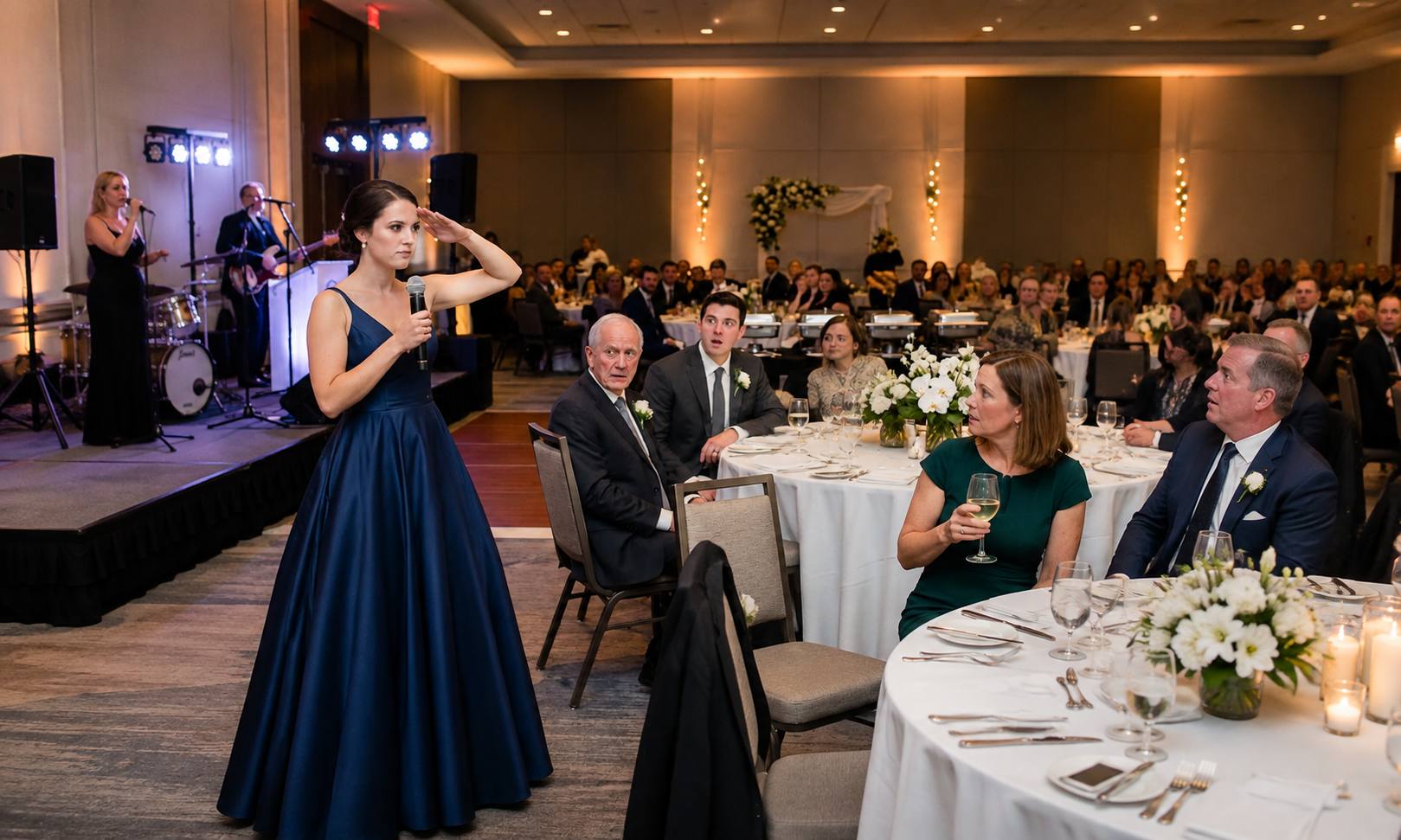
Mara said, “Lieutenant Colonel Elise Voss, retired. She was my commander, and twenty-seven people are alive because she refused to let our aircraft take off.”
The ice shifted inside Conrad’s champagne glass.
Nobody moved.
Image
Seven years earlier, Mara explained, our medical transport had been cleared to leave Joint Base Lewis-McChord with patients, nurses, and a full flight crew aboard.
Minutes before departure, a young flight nurse reported smelling burned plastic near the oxygen system.
Maintenance found nothing during the first inspection.
Operations wanted the aircraft in the air because another delay would have disrupted three scheduled transfers, and the officer above me ordered us to launch.
I kept everyone on the ground.
A second inspection found scorched wiring six inches from the oxygen manifold.
The ballroom remained silent while Mara described the section of insulation that crumbled between a technician’s fingers and the report that estimated the wiring could have ignited after takeoff.
Then she looked at me.
“Elise accepted the consequences before anyone knew she was right,” she said. “She protected every junior person who had questioned that launch, including me.”
Conrad’s fingers tightened around the stem of his glass.
Mara’s voice did not rise.
“She wasn’t invited because we felt sorry for her. I asked Julian to bring her because she was the first person who taught me that an order can sound respectable and still be wrong.”
A woman near the bandstand began clapping.
Someone behind her joined in, then another table, until the sound spread through the room and forced Conrad to stand inside it.
I kept my hands in my lap.
My left heel pulsed against the back of my shoe, and the cold air from the ceiling vent raised bumps along my forearms.
Conrad glanced around as though he were counting which guests had betrayed him by applauding.
Damian looked at his phone.
Julian came to my table and held out his hand.
“Please come with us,” he said.
I followed him and Mara through a service door beside the bandstand.
The corridor beyond it smelled faintly of coffee and industrial soap, and a cart of untouched bread rolls had been parked beneath an EXIT sign.
Mara took off one shoe and balanced against the wall while Julian removed a cream envelope from inside his jacket.
The front bore Conrad’s handwriting.
FAMILY TRANSITION AGREEMENT.
I opened it.
The first page announced that Julian would become president of Voss Restoration Group the following Monday.
The second required him and Mara to move into the guesthouse on Conrad’s property for a minimum of five years.
Another paragraph stated that Mara would leave active service at the end of her current assignment and accept a ceremonial position with the Voss charitable foundation.
The company would pay their housing costs, medical expenses, and future school fees.
Conrad would retain final approval over large purchases, public appearances, and any employment either of them accepted outside the family businesses.
The agreement did not mention love, marriage, or children until page six.
After that, it mentioned all three repeatedly.
“He told me Mara wanted to leave the Air Force,” Julian said.
Mara pressed the heel of her hand against her forehead.
“He told me you were afraid to turn down the company because you thought I expected the money.”
Julian looked at her.
“I never said that.”
“Neither did I.”
I read the signature page.
Both lines were blank.
“Did either of you agree to this?” I asked.
“No,” Mara said.
Julian shook his head.
“Then this belongs to Conrad,” I said. “Not to you.”
Julian took the pages back, but he did not put them inside the envelope.
For several seconds, the only sound came from the ballroom band beginning a slow instrumental version of an old love song.
A busboy pushed through the service door, saw us, and backed out without the tray he had come to collect.
Mara lowered her bare foot to the carpet.
“We were going to tell him tonight,” she said. “Julian accepted a preservation job in Dayton, and I have an instructor assignment there starting next month.”
Conrad had offered to pay for the wedding after learning about the transfer.
At first, he had called it a gift.
Then he began asking for small things.
He changed the guest list.
He replaced the photographer Mara had hired with one used by the company.
He insisted Julian wear his grandfather’s cuff links and scheduled a family portrait before dessert.
Three weeks earlier, he had presented the agreement and told each of them the other was already comfortable with it.
“When we pushed back, he said canceling would embarrass everyone,” Julian said. “He told us we could refuse after the wedding if we wanted, but tonight we were supposed to smile.”
Mara gave a dry laugh.
“That was before I found your name in Julian’s address book.”
She had recognized it immediately.
During our years together, I had never told Mara that Conrad Voss was my father.
I had spoken about the doorway, the rain, and the family that stopped answering calls, but I had kept their names out of it.
Mara had learned the truth only when Julian showed her an old photograph of his aunt.
“You looked exactly the same,” she said.
“I had fewer lines.”
“You had the bracelet.”
My sleeve had slipped back while I held the agreement.
The silver band caught the fluorescent light.
Mara touched two fingers to its edge but did not turn it over.
Before she could say more, the service door opened again.