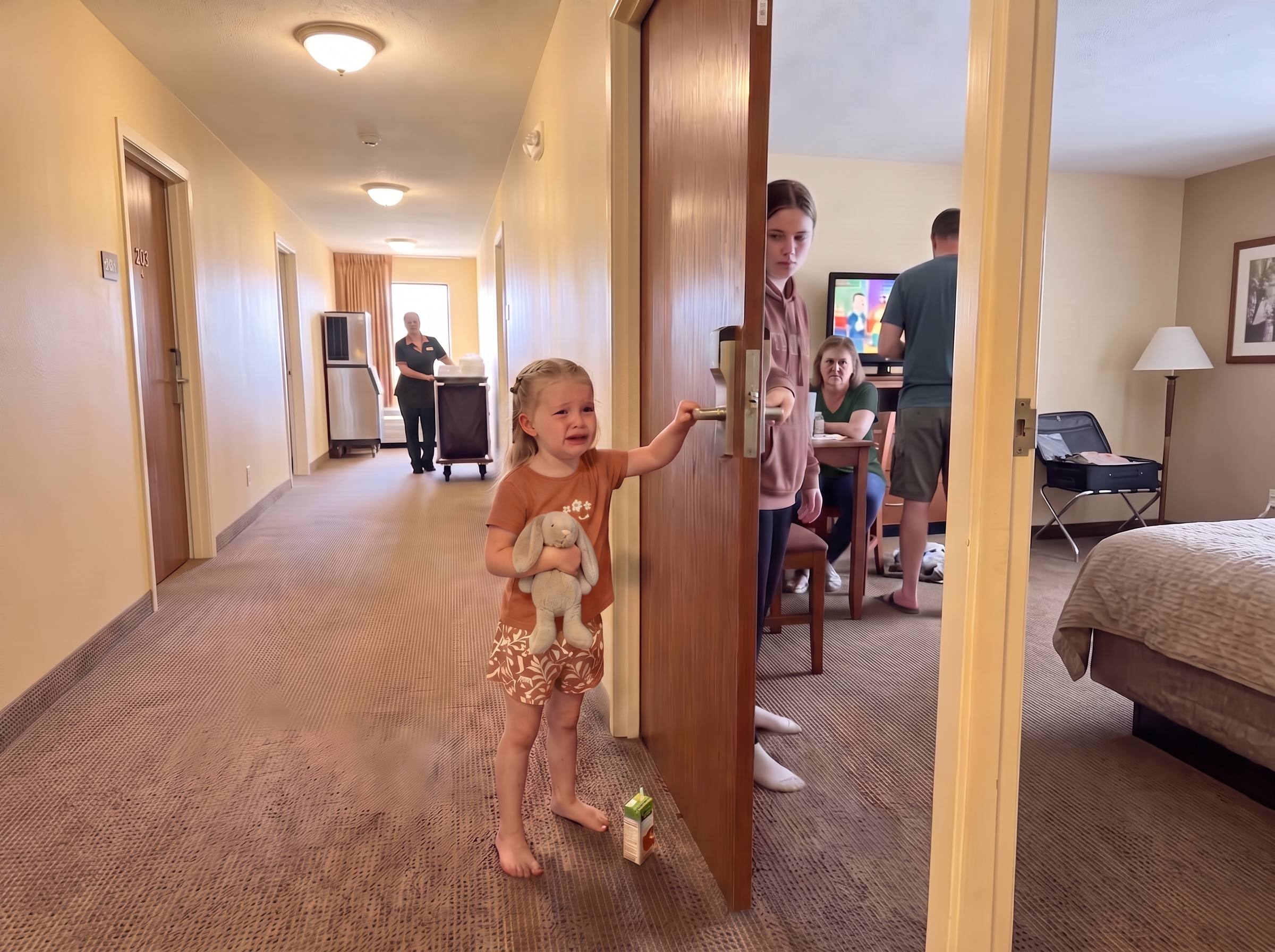
During a family vacation, my sister pushed my six-year-old daughter out of our hotel room and left her barefoot, crying in the hallway for three hours.
When I confronted her about it, she stared at me coldly and said, “That room is for family only.”
My parents sided with her.
I did not yell or make a scene. I simply picked up my daughter, made a few phone calls, and waited.
Three days later, the consequences started arriving.
My name is Claire Bennett, and until last summer, I believed the worst thing my family could do was make me feel as though I did not matter.
I had spent most of my life adjusting myself around them—speaking more softly when Vanessa wanted attention, asking for less when my parents complained about stress, and pretending not to notice whenever my needs became the easiest ones to dismiss.
I told myself that was simply how our family worked.
Vanessa was older, louder, and far better at turning every disagreement into a test of loyalty, while I had learned early that keeping the peace usually meant swallowing whatever I wanted to say.
For years, that arrangement had mostly hurt me.
I never imagined my daughter would become its next target.
The vacation was supposed to be peaceful: five nights at a beachfront hotel in South Carolina with my parents, my older sister Vanessa, her husband Mark, their two sons, my six-year-old daughter Lily, and me.
My husband, Daniel, had died in a construction accident two years earlier, and losing him had divided my life into a before and an after that never quite fit together.
Before the accident, I could sit through family dinners, laugh at Vanessa’s cutting jokes, and go home telling myself that none of it mattered.
After Daniel’s funeral, pretending became harder than grief itself.
I stopped attending family vacations and most celebrations because I could not keep arranging my face into something comfortable for everyone else while I was trying to raise a little girl who still asked when her father was coming home.
This trip was the first one I had agreed to join.
My mother had called several times before I finally said yes, insisting that Lily needed time with her cousins and that the ocean might be good for both of us.
She spoke about the vacation as though it could repair every strained conversation we had avoided since Daniel’s death.
I wanted to believe her.
More than that, I wanted Lily to have the kind of family memories other children seemed to collect without effort—sunburned noses, sandy towels, cousins arguing over seashells, and grandparents buying too much ice cream after dinner.
I paid for my own hotel room and every expense involving Lily.
I bought her meals, packed her pink swimsuit, found the seashell bucket she had begged for, and covered the rental car my parents repeatedly borrowed whenever they claimed they had forgotten something at the store.
I did not complain about the cost because independence had become important to me after Daniel died.
Every receipt I paid meant one less favor that could be brought up later, one less opportunity for someone to say I owed them obedience because they had helped me.
Vanessa still found ways to make comments.
She asked whether the hotel was stretching my budget, whether Lily really needed a new swimsuit, and whether I was sure I could afford restaurant meals for five nights.
Her questions were dressed as concern, but concern had never sounded quite so satisfied.
I answered politely and kept moving.
The first day passed without a major argument, which felt like a small victory.
Lily ran along the edge of the water with her cousins, holding her bucket in one hand while the waves chased her bare ankles, and for a few hours I allowed myself to believe the trip might actually be what my mother had promised.
The second afternoon was hotter, and Lily stayed outside longer than she should have because she did not want to miss anything her cousins were doing.
By the time I noticed how quiet she had become, her cheeks were flushed and her shoulders had begun to droop beneath the straps of her swimsuit.
I wrapped her in a towel and told the others I was taking her upstairs to rest.
She leaned against me in the elevator, still clutching her seashell bucket, and asked whether she could watch cartoons before taking a nap.
I told her she could have a juice box and lie down for a while.
When we entered our connecting room, Vanessa was sitting on my bed and scrolling through her phone while her sons watched cartoons nearby.
Their shoes and beach things had spread across the floor, and the room no longer looked like the quiet place I had paid for so Lily and I could retreat when the larger family became overwhelming.
Vanessa did not look up when we entered.
“This room is not a daycare,” she said.
“It’s my room,” I answered.
My voice was calm, but Lily moved closer to my side because even at six years old she recognized the warning beneath Vanessa’s tone.
Vanessa finally raised her eyes and gave me a faint, dismissive smile.
“Mom said we could stay here while housekeeping finishes ours.”
She said it as though our mother’s permission mattered more than the name attached to the reservation or the credit card that had paid for it.
I looked at the boys, who were focused on the television, and then at Lily, whose eyelids were already heavy.
I decided not to argue in front of the children.
I told Lily she could rest on the other bed, handed her a juice box, and began clearing a space among the towels and scattered belongings.